Bonaventure Island
Bonaventure Island is a small island located in the Gulf of St. Lawrence off the coast of Percé, at the tip of the Gaspé Peninsula in eastern Quebec, Canada.
What is Bonaventure Island?
Bonaventure Island is a small island located in the Gulf of St. Lawrence off the coast of Percé, at the tip of the Gaspé Peninsula in eastern Quebec, Canada.1
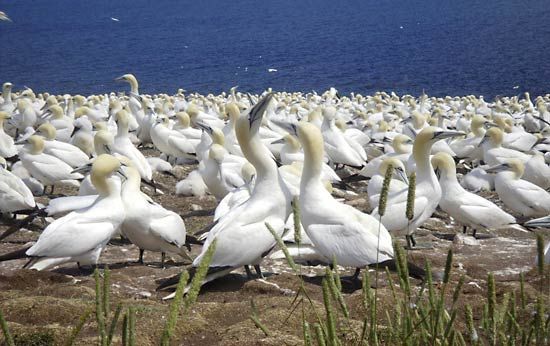
Measuring approximately 2.5 miles (4 km) in length, the island is renowned for its rocky cliffs, which serve as a vital sanctuary for thousands of nesting gannets, as well as auks, gulls, kittiwakes, and guillemots, between April and November.1
The island was named Bonne Aventure by the French explorer Jacques Cartier and was later settled by Captain Peter Duval, a privateer from Jersey. In 1971, the Quebec provincial government acquired the island, and it was officially designated as a conservation park in 1985.1
What are northern gannets and why do they nest there?
The northern gannet (Morus bassanus) is the largest seabird in the North Atlantic, measuring approximately 100 cm (40 inches) in length. These birds are primarily white with black-tipped wings and a distinctive yellowish head. As expert fliers, they spend most of their lives over water, diving with half-closed wings to hunt for fish and squid.23
Northern gannets nest in dense colonies on rocky cliffs, such as those found on Bonaventure Island, which serves as a vital sanctuary for them from April to November. These cliffside locations are ideal for the species because they provide the necessary elevation for these large birds to take flight and offer protection for their colonies. Within these dense nesting grounds, they brood a single bluish, chalky egg in a nest constructed of seaweed or mud.213
Who was Jacques Cartier and what did he explore?
Jacques Cartier (1491–1557) was a French mariner commissioned by King Francis I to explore North America in search of gold, spices, and a passage to Asia.45
His primary explorations included:
- 1534: Cartier explored the Gulf of St. Lawrence, the west coast of Newfoundland, and Prince Edward Island, claiming the shores for France.56
- 1535–1536: He navigated the St. Lawrence River as far as Montreal, visiting the sites of modern-day Quebec city and Hochelaga.56
- 1541–1542: He returned to help establish a colony, though the mission was marred by poor relations with the Iroquois, severe winters, and the discovery of worthless mineral specimens.56
Cartier is credited with naming Canada, derived from the Huron-Iroquois word kanata. While his failure to find riches and his desertion of his superior, Roberval, tarnished his reputation, his voyages laid the foundation for future French claims to North America.56
What other wildlife lives in the Gulf of St. Lawrence?
The Gulf of St. Lawrence supports a diverse range of wildlife, benefiting from the region’s complex water circulation and varied habitats. Animal life in the area includes:
- Fish: The waters are home to species such as sturgeon, smelt, and herring.7
- Mammals: The gulf is a notable habitat for the beluga, also known as the white whale.7
- Mollusks: Various mollusks, including the soft-shell clam (Mya arenaria), are found in the region.7
- Birds: The area is a significant site for the massive migration of ducks, geese, and bustards, which utilize the sandy shores and river reefs as seasonal food sources.7
The biological environment is further supported by a range of vegetation, including sandbank grasses in freshwater sections and salt-tolerant (halophytic) plants found from the middle estuary onward.7
Sources
- Bonaventure Island — Encyclopædia Britannica
- Did you know? — Merriam-Webster
- Gannet — Encyclopædia Britannica
- Jacques Cartier: Top Questions — Encyclopædia Britannica
- Jacques Cartier — Encyclopædia Britannica
- Canada - Jacques Cartier — Encyclopædia Britannica
- St. Lawrence River - Plant and animal life — Encyclopædia Britannica
- Gulf of Saint Lawrence — Encyclopædia Britannica
Published on · 2 min read