Gannet
Gannets are generally long-lived birds, with a mean life expectancy exceeding 16 years for adults. While they are considered to have few natural enemies once…
How long do gannets typically live and what are their main predators?
Gannets are generally long-lived birds, with a mean life expectancy exceeding 16 years for adults. While they are considered to have few natural enemies once they reach adulthood, they are occasionally taken by marine predators.1
Survival rates for gannets are lowest during their early life stages. In the British population, for example, approximately 80 percent of fledglings die before reaching breeding age—which occurs around five years—with the majority of these deaths happening within the first year. Adult mortality is relatively low, averaging less than 6 percent per year.1
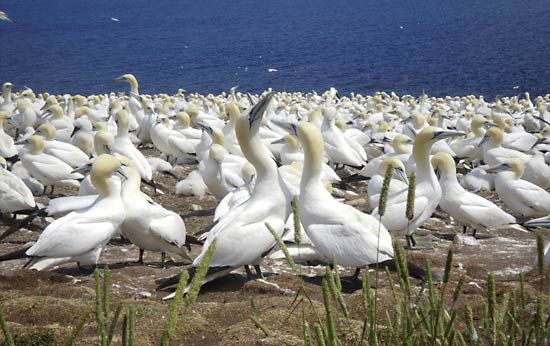
What are the physical characteristics of gannets?
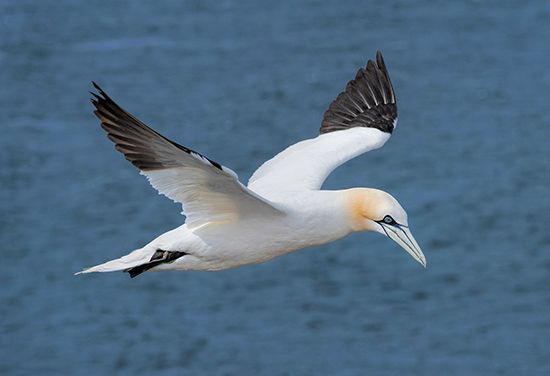
Gannets are large oceanic birds belonging to the family Sulidae. They are characterized by a primarily white plumage accented with black-tipped wing feathers. Their heads are notably large and yellowish or buff-colored, featuring distinctive black markings around the eyes. Additionally, they possess a tapered beak and a pointed tail.12
Regarding their size and physical capabilities:
- Size: The largest species is the northern gannet, which reaches approximately 100 cm (40 inches) in length.12
- Flight and Movement: While they waddle awkwardly on land, they are expert fliers that spend the majority of their lives over water, alternating between rapid wing beats and gliding.12
- Hunting: When hunting for fish and squid, they dive into the sea with their wings held half-closed.12
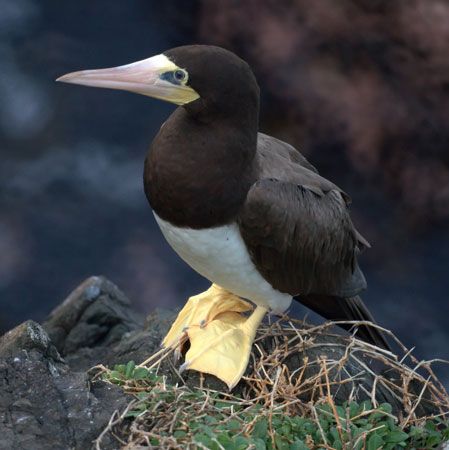
These birds are closely related to boobies and are sometimes classified within the same genus, Sula, or separated into the genus Morus.2
How do gannets compare to other seabirds like albatrosses or pelicans?
Gannets, pelicans, and other seabirds exhibit distinct evolutionary and behavioral adaptations for survival in marine environments. While they were historically grouped together in the order Pelecaniformes, modern genetic analysis suggests that gannets and their relatives (such as boobies, cormorants, and frigate birds) are more accurately classified in the order Suliformes.67
Feeding Strategies
The primary differences between these birds lie in their hunting techniques:
- Gannets: These birds are specialized plunge-divers. They rely on the momentum of a high-speed dive—sometimes from heights exceeding 30 meters—to reach prey underwater, using their wings to steer.27
- Pelicans: Most pelicans catch fish while swimming, using their large, distensible throat pouches as dip-nets. They often cooperate in groups to herd fish into shallow water. Only the brown pelican regularly employs a plunge-diving technique similar to that of the gannet.26
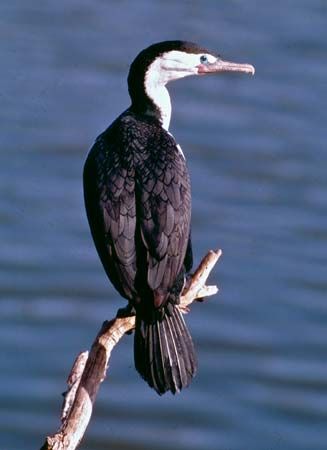
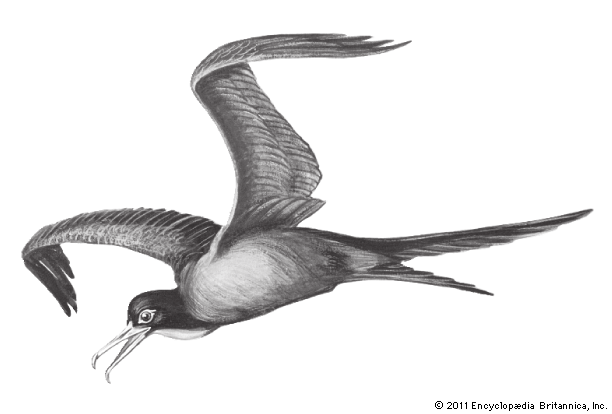
- Other Seabirds: Unlike the plunge-diving gannets, cormorants are adapted for underwater swimming, pursuing prey beneath the surface, while frigate birds are known for aerial piracy, stealing food from other birds.2
How do gannets hunt for fish and what makes their diving technique unique?
Gannets are specialized marine predators that hunt primarily for fish and squid by utilizing a high-speed plunge-diving technique.12
The Mechanics of the Dive
The uniqueness of the gannet’s hunting method lies in its reliance on the momentum generated from a powerful aerial descent. Unlike birds that swim to pursue prey, gannets utilize the following physical adaptations:
- High-Altitude Entry: Gannets are capable of diving from heights exceeding 30 meters (about 100 feet), allowing them to reach significant depths underwater through the sheer force of their impact.6
- Wing Positioning: During the dive, gannets hold their wings half-closed, which streamlines their body for a rapid, controlled entry into the water.12
- Steering: Once submerged, their feet—which are large and webbed—serve primarily as rudders for steering rather than for propulsion, as the bird relies on the initial impetus of the dive to reach its target.6
This specialized approach allows them to access prey that is otherwise unreachable for many other surface-feeding seabirds.
Sources
- Did you know? — Merriam-Webster
- Gannet — Encyclopædia Britannica
- Pelecaniform - Survival and mortality — Encyclopædia Britannica
- Pelecaniform - Nests, eggs, and young — Encyclopædia Britannica
- Reproductive behaviour - Parental care — Encyclopædia Britannica
- Pelecaniform - Feeding ecology — Encyclopædia Britannica
- Pelican — Encyclopædia Britannica
Published on · 3 min read