Bohol
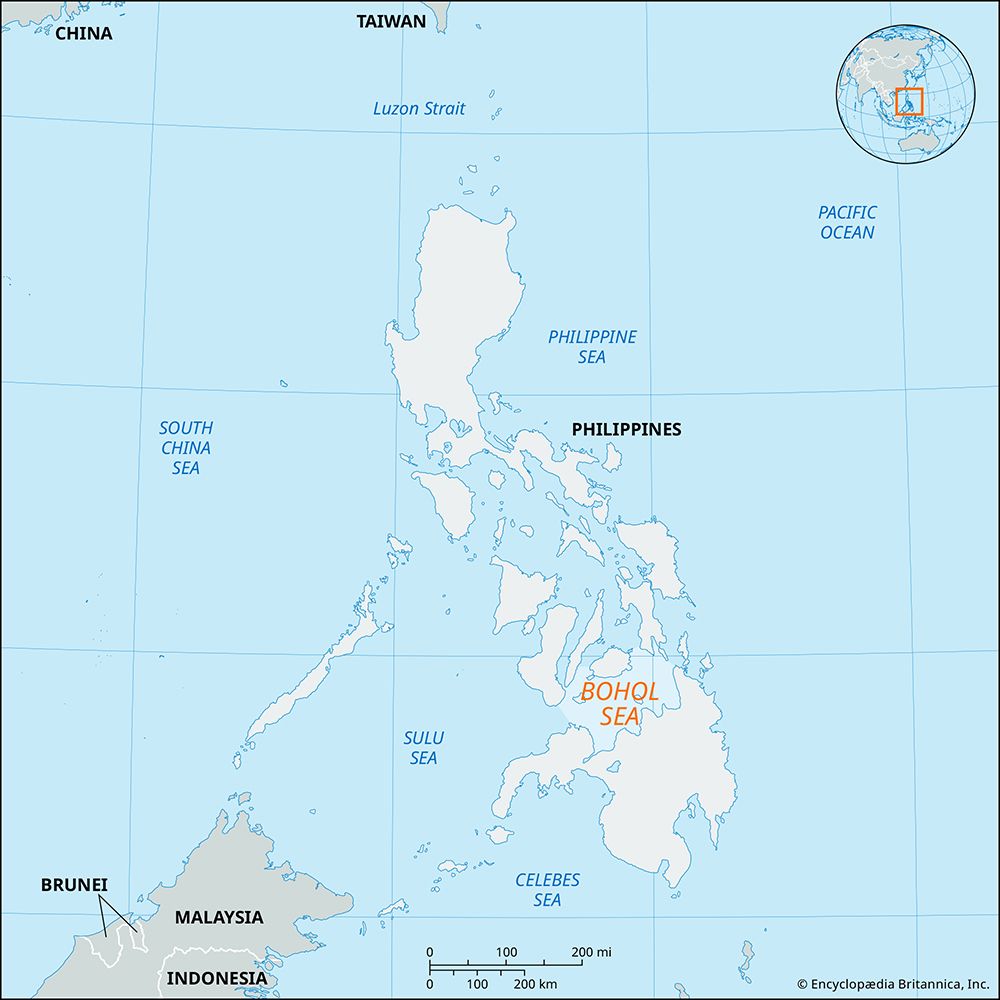
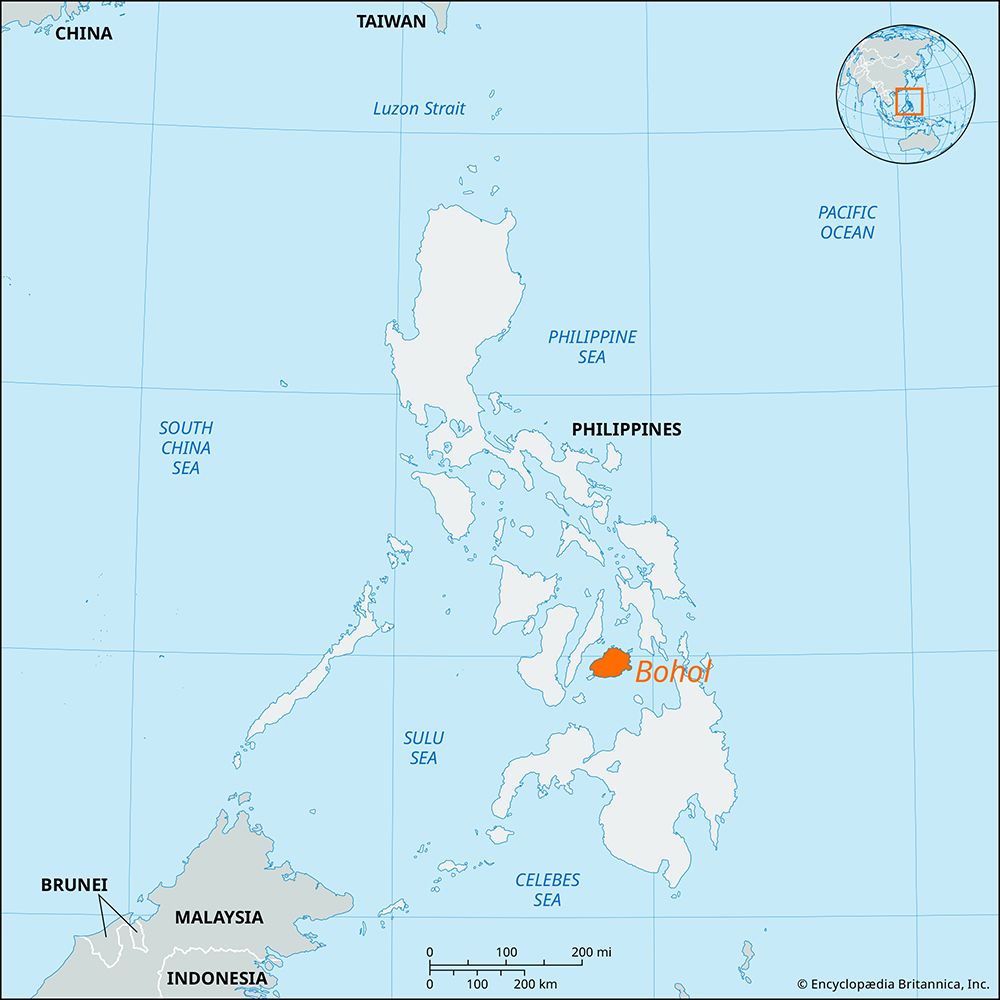
Bohol is an island located in the south-central Philippines as part of the Visayan group. It is situated between the Camotes Sea to the north and the Bohol…
Where is Bohol located within the Philippines, and what are its main geographical features?
Bohol is an island located in the south-central Philippines as part of the Visayan group. It is situated between the Camotes Sea to the north and the Bohol Sea to the south.12
The island is roughly oval in shape and features a volcanic core primarily covered with coralline limestone. While settlement is largely concentrated along the coast, the interior contains a low central plateau surrounding the town of Carmen](https://www.britannica.com/science/plateau-landform) surrounding the town of Carmen.1
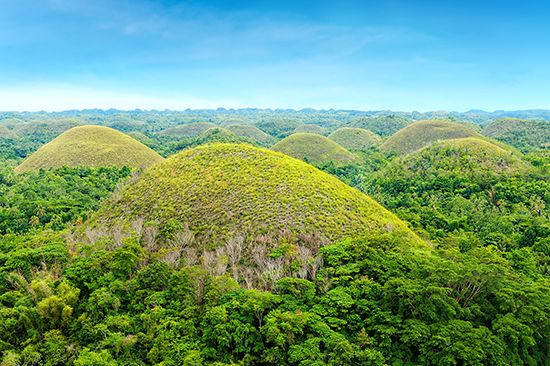
A defining geographical feature of west-central Bohol is the “chocolate hills,” or “haycock hills.” These are symmetrical, conical limestone remnants of an earlier erosion cycle, named for the brown color they take on during the dry season. This specific geological phenomenon is found in only a few places worldwide. Unlike many other islands in the Visayan group, Bohol is not traversed longitudinally by a single mountain range. The island’s rivers are generally short, and it offers few natural anchorages.13
What is the historical significance of Bohol in Philippine history?
Sorry, the Britannica knowledge base does not contain information regarding the specific historical significance of Bohol in Philippine history.
Can you describe the Philippine tarsier and its importance to Bohol?
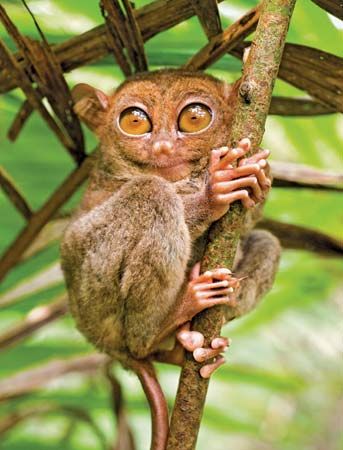
The Philippine tarsier (Carlito syrichta) is a small, nocturnal primate measuring approximately 9–16 cm in length. It is characterized by its enormous, goggling eyes, which lack a reflective layer, and a round head capable of rotating 180 degrees. These primates possess elongated ankle bones—from which the name “tarsier” is derived—and adhesive pads on their digits that aid in clinging to trees. Unlike other primates, they are entirely carnivorous, preying on insects, lizards, and snakes.4
The Philippine tarsier is physically distinguished by its nearly hairless feet and a completely bald tail. While they are found on various islands in the southern Philippines, their continued existence is threatened by human settlement within their natural habitats. Although the provided information does not explicitly detail the specific cultural or economic importance of the tarsier to the island of Bohol, it is widely recognized as a significant part of the region’s natural heritage.4
How are the Chocolate Hills formed by erosion?
The Chocolate Hills of Bohol are not formed by typical surface stream erosion, but are instead a unique manifestation of karst topography.15
These symmetrical, conical formations are limestone remnants left behind from an earlier cycle of erosion. In karst landscapes, the terrain is shaped primarily by the dissolution of soluble bedrock—in this case, the coralline limestone that covers the island’s volcanic core.15
Rather than being carved by rivers, these hills represent the residual mounds that remained as the surrounding landscape was lowered through the chemical weathering and dissolution of the limestone bedrock. This process, often associated with cone and tower karst, results in the distinctive, uniform shapes that turn brown during the dry season, earning them their famous name. This specific geological phenomenon is extremely rare, occurring in only a few other locations worldwide.15
Sources
- Bohol — Encyclopædia Britannica
- Philippines - Relief — Encyclopædia Britannica
- Bohol — Merriam-Webster
- tarsier — Encyclopædia Britannica
- cave - Doline karst — Encyclopædia Britannica
- cave - Karst topography — Encyclopædia Britannica
Published on · 3 min read