Brandywine Creek
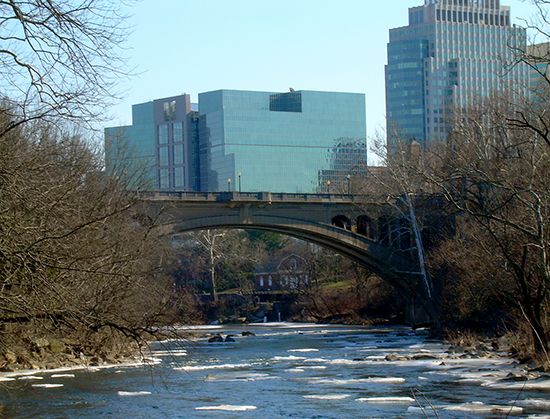
Brandywine Creek is a stream located in southeastern Pennsylvania and western Delaware. It rises in two branches within Chester county, Pennsylvania, which…
What is Brandywine Creek?
Brandywine Creek is a stream located in southeastern Pennsylvania and western Delaware. It rises in two branches within Chester county, Pennsylvania, which converge near Coatesville. The creek flows approximately 20 miles (32 km) southeast, passing through Chadds Ford and Delaware before joining the Christina River near its confluence with the Delaware River at Wilmington.1
Historically, the stream is best known as the site of the Battle of Brandywine, a major engagement during the American Revolution fought on September 11, 1777. During this conflict, British forces under General William Howe defeated the Continental Army led by General George Washington near Chadds Ford1. The creek’s name is believed to honor an early settler named Andrew Braindwine, though it was historically referred to as Wauwaset by local Indigenous peoples and Fiskiekylen by Swedish immigrants.231
Who was the Marquis de Lafayette and why was he important to the American Revolution?
The Marquis de Lafayette (1757–1834) was a French aristocrat and military officer who became a pivotal figure in the American Revolution. Driven by a desire for military glory, he traveled to the American colonies at his own expense in 1777 and was appointed a major general in the Continental Army at age 19.45
Lafayette’s importance to the American cause included:
- Strategic Leadership: He fought with distinction at the Battle of the Brandywine and later commanded his own division, conducting successful operations against British forces.45
- Diplomatic Influence: He returned to France in 1779 to lobby the government of Louis XVI for increased military support, successfully securing troops and naval aid for the colonists.4
- Victory at Yorktown: In 1781, he harried the forces of Lord Charles Cornwallis across Virginia, eventually trapping him at Yorktown. This siege led to the British surrender, effectively ending the war.45
- Close Alliance: He developed a profound, surrogate father-son relationship with George Washington, which helped solidify the bond between the American and French military efforts.4
What were the major consequences of the British capturing Philadelphia?
The British occupation of Philadelphia, which began on September 26, 1777, had several significant consequences for the American Revolution:
- Disruption of Government: As the British approached, the Continental Congress was forced to evacuate the capital, eventually fleeing to York. This forced the revolutionary government to relocate and operate from a new base while the British held the city.26
- Impact on Morale: The loss of the American capital was a major blow to public morale. This setback, combined with earlier defeats at the Battle of Brandywine and the Battle of Germantown, foreshadowed the difficult winter that followed for George Washington and his troops at Valley Forge.26
- Strategic Diversion: General William Howe’s campaign to capture Philadelphia drew his forces away from northern New York. This left the army of General John Burgoyne unsupported, directly contributing to the British disaster at the Battles of Saratoga. These American victories proved to be a major turning point in the war, as they convinced France to formally join the American cause.2
How did the geography of Brandywine Creek influence the tactics used in the battle?
The geography of Brandywine Creek served as the central tactical feature of the Battle of Brandywine. General George Washington aimed to use the creek as a natural barrier to block the British advance toward Philadelphia. He positioned his forces to defend the various fords along the stream, specifically concentrating his strength at Chadds Ford, where he held the high ground with artillery.2
Washington’s defensive strategy relied on the assumption that he could control these crossing points, forcing the British to engage him in a head-on assault at the center. However, the geography proved to be a vulnerability rather than a shield. British General William Howe, aided by local Loyalist scouts, discovered that the creek was not impassable further north. By identifying unguarded fords beyond Washington’s defensive line, the British were able to cross the creek undetected. This allowed them to execute a flanking maneuver, marching south to surprise the American right flank. Because Washington had focused his resources on the fords he deemed critical, his army was caught off guard and unable to mount a coordinated defense when the British emerged from the north.2
Sources
- Brandywine Creek — Encyclopædia Britannica
- Battle of Brandywine — Encyclopædia Britannica
- Delaware — Encyclopædia Britannica
- Marquis de Lafayette — Encyclopædia Britannica
- Marquis de Lafayette: Top Questions — Encyclopædia Britannica
- Philadelphia - Cultural dominion — Encyclopædia Britannica
- Pennsylvania - Colonial growth — Encyclopædia Britannica
- Continental Congress — Encyclopædia Britannica
- American colonies - The Intolerable Acts — Encyclopædia Britannica
Published on · 3 min read