Delaware River
The Delaware River has served as a vital artery for American commerce, settlement, and military strategy throughout history.

How has the Delaware River played a significant role in American history?
The Delaware River has served as a vital artery for American commerce, settlement, and military strategy throughout history.
Colonial Significance
In the 17th and 18th centuries, the river was essential to the development of the middle colonies. William Penn received his land grant along the river in 1681, establishing Pennsylvania as a diverse and prosperous colony. The river also facilitated the growth of Delaware, which was acquired by Quakers to secure a water route to Pennsylvania.1
Military History
The river played a pivotal role during the American Revolution. On Christmas night in 1776, George Washington led a daring, hazardous amphibious operation across the ice-choked river to launch a surprise attack on Hessian troops at the Battle of Trenton. This victory provided a crucial morale boost for the Continental Army.23
Economic Development
During the 19th century, the river fueled rapid industrialization. Its water power supported mills in Wilmington, while steamboats and canals—such as the Chesapeake and Delaware Canal—connected the region to broader markets, transforming cities like Philadelphia and Wilmington into major commercial hubs.245
How does the Delaware River contribute to the water supply of major cities?
The Delaware River is a critical source of water for major urban centers, managed through collaborative regional efforts and large-scale engineering projects.
Regional Management
The Delaware River Basin Commission (DRBC) oversees the river’s resources, including planning the conservation of water supply for cities throughout the watershed. Established in 1961, this body represents an equal partnership between federal and state governments—specifically New York, New Jersey, Pennsylvania, and Delaware—to manage water quality and development along the entire course of the river.1
Infrastructure and Supply
Beyond direct municipal withdrawals, the river serves as a primary water source for New York City via the Delaware Aqueduct. This massive infrastructure project, which is the longest tunnel in the world, draws water from the river near its source in the Catskill Mountains. The aqueduct carries approximately half of New York City’s daily drinking water, demonstrating the river’s vital role in sustaining major metropolitan populations.6
What are the major cities and states that the Delaware River flows through?
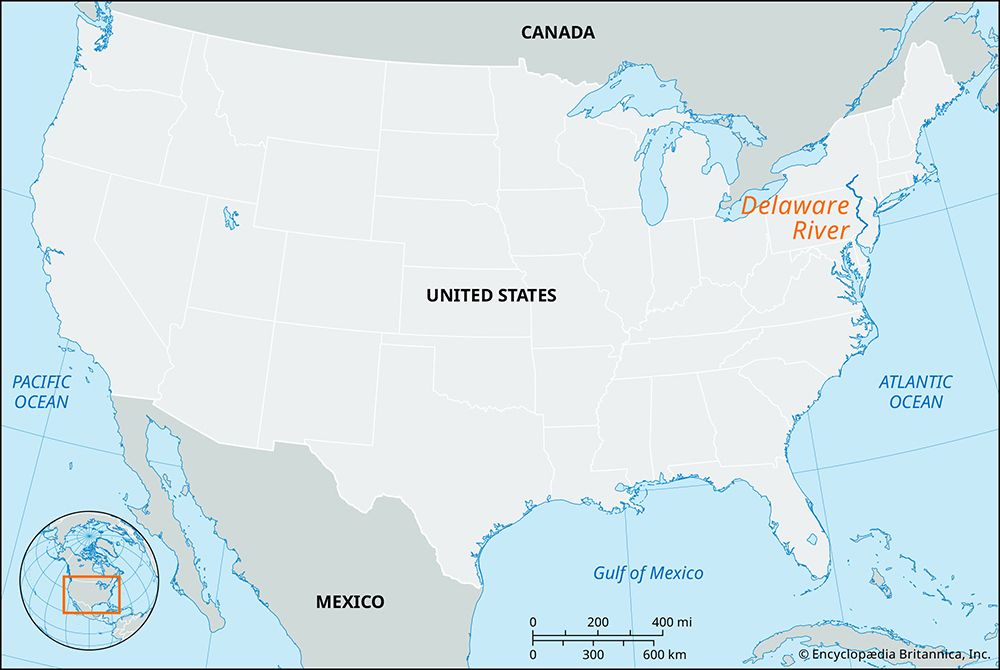
The Delaware River flows through four states, serving as a natural boundary for much of its course. It originates in New York and flows southward, forming the border between New York and Pennsylvania, then between Pennsylvania and New Jersey, and finally between New Jersey and Delaware before reaching Delaware Bay.1
Several major cities are situated along its banks:
- New York: Port Jervis1
- Pennsylvania: Easton, Philadelphia, and Chester1
- New Jersey: Trenton and Camden1
- Delaware: Wilmington1
The river’s path is defined by its journey from the Catskill Mountains through various Appalachian valleys and eventually into a broad, tidal estuary.1
What significant bridges span the Delaware River, and what is their importance?
The Delaware River is spanned by numerous bridges that serve as vital infrastructure for regional transportation, commerce, and connectivity between Pennsylvania, New Jersey, and Delaware. These crossings range from historic suspension bridges to modern highway structures.
Key Bridges and Their Importance
The Delaware River Port Authority manages several major crossings that are essential for linking the Philadelphia and Camden metropolitan areas. These include:
- Benjamin Franklin Bridge: A historic wire-cable steel suspension bridge that, upon its completion in 1926, held the record as the world’s longest span at 525 meters (1,750 feet). It remains a critical link for both vehicular traffic and the PATCO high-speed transit line.18
- Walt Whitman Bridge: A major crossing that facilitates heavy regional traffic flow between Pennsylvania and New Jersey.1
- Betsy Ross Bridge: An important connector that supports the regional transportation network in the Philadelphia area.1
- Commodore Barry Bridge: Another significant structure administered by the Port Authority, serving as a key artery for regional commerce and transit.1
In addition to these, a joint Delaware–New Jersey agency operates twin bridges near New Castle, which are essential for highway traffic moving through the region. Furthermore, a joint New Jersey–Pennsylvania commission oversees a vast network of 20 additional bridges north of Philadelphia, including 7 toll bridges and 13 tax-supported structures, two of which are dedicated exclusively to pedestrian use.91
Sources
- Delaware River — Encyclopædia Britannica
- Battles of Trenton and Princeton - The Battle of Trenton — Encyclopædia Britannica
- Delaware - Economic development in the 19th century — Encyclopædia Britannica
- Delaware - Relief — Encyclopædia Britannica
- United States - The middle colonies — Encyclopædia Britannica
- Delaware Aqueduct — Encyclopædia Britannica
- river - Environmental problems attendant on river use — Encyclopædia Britannica
- Delaware - Transportation — Encyclopædia Britannica
- Philadelphia - Transportation — Encyclopædia Britannica
- bridge - Suspension bridges — Encyclopædia Britannica
Published on · 3 min read