Broadbill
Broadbills (family Eurylaimidae) are a group of approximately 15 species of Old World tropical passerine birds that exhibit distinct anatomical and…
How do broadbills differ from other bird families in terms of behavior or anatomy?
Broadbills (family Eurylaimidae) are a group of approximately 15 species of Old World tropical passerine birds that exhibit distinct anatomical and behavioral characteristics compared to other perching birds.
Anatomical Differences
The most significant anatomical distinction is the unique arrangement of the leg muscles that bend the toes, which differs from all other passerines. Physically, broadbills are characterized as chunky birds, typically ranging from 12.5 to 28 cm (5 to 11 inches) in length, and possess a short, wide bill that often features bristles or wattles at the base.1
Behavioral Differences
Broadbills are known for several specific behaviors:
- Nesting: They construct distinctive pear-shaped, hanging nests, usually positioned over water, featuring a porched side entrance near the top.1
- Vocalization: They are notably loud, producing a variety of sounds including whistles and croaks. Some species also generate noise through wing whirring or by snapping their bills.1
- Sociality: While many are sociable and noisy insect eaters, there is a minor group of quiet, solitary fruit eaters, such as the lesser green broadbill.1
How do broadbills build their nests, and what materials do they use?
Broadbills (family Eurylaimidae) construct distinctive, pear-shaped, hanging nests. These structures are typically positioned over water and feature a porched side entrance located near the top.1
While the provided information confirms the shape and placement of these nests, the specific materials used by broadbills are not detailed in the available search results. Generally, bird nests are known to be constructed from a variety of materials, including twigs, leaves, mud, feathers, or spiderwebs, but specific confirmation for the broadbill family is not provided.4
How many species of broadbills exist, and what are some notable examples?
There are approximately 14 to 15 species of broadbills belonging to the family Eurylaimidae. These birds are primarily found in the forests and cloud forests of Indo-Malaysia, the Philippines, and Africa.
Notable examples include:
- Long-tailed broadbill (Psarisomus dalhousiae): A 25-cm (10-inch) bird that represents the main group of broadbills. It is known for being sociable and noisy, feeding primarily on insects. It features a green body, a black-and-yellow head, and a graduated blue tail, with a range extending from the Himalayas to Borneo.
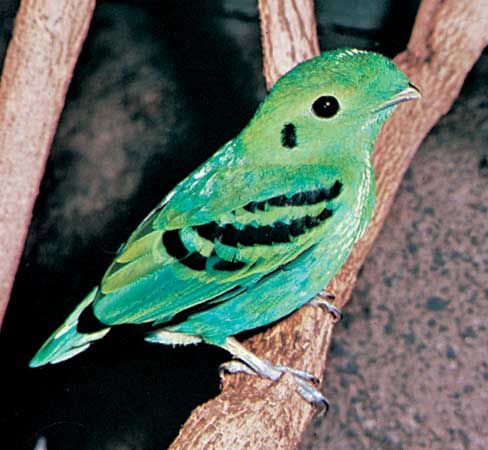
- Lesser green broadbill (Calyptomena viridis): A 15-cm (6-inch) species found in Malaysia. It represents a minor group of broadbills that are quiet and solitary fruit eaters. It is characterized by its green plumage, a stubby tail, and a distinctive puff of feathers over its bill.
Are there any interesting myths or cultural significance associated with broadbills in different parts of the world?
Sorry, the Britannica knowledge base does not contain information regarding specific myths or cultural significance associated with broadbills. While these birds are recognized as typical inhabitants of the forests in the Oriental region, their role in folklore or cultural traditions is not documented in the provided sources.
Sources
- Broadbill — Encyclopædia Britannica
- broadbill — Merriam-Webster
- Passeriform - Size range and structural diversity — Encyclopædia Britannica
- Coraciiform - Life history — Encyclopædia Britannica
- Passeriform - Critical appraisal — Encyclopædia Britannica
- Nest — Encyclopædia Britannica
- Passeriform - Annotated classification — Encyclopædia Britannica
- Asia - Birds — Encyclopædia Britannica
Published on · 2 min read