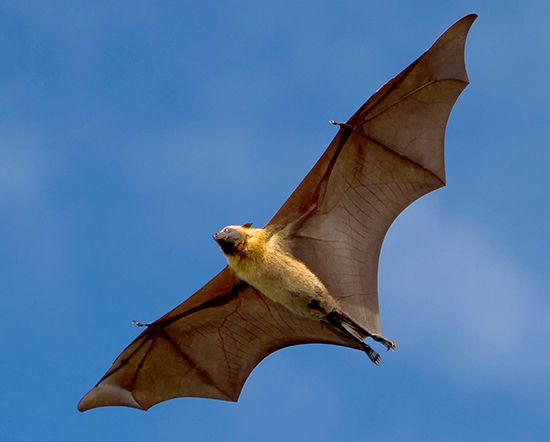
Brown Bat
Brown bats, like other microchiropteran bats, navigate and hunt using echolocation, a biological sonar system. They emit high-frequency sound pulses through…
How do brown bats use echolocation for navigation and hunting?
Brown bats, like other microchiropteran bats, navigate and hunt using echolocation, a biological sonar system. They emit high-frequency sound pulses through their mouths or noses and interpret the returning echoes to determine the distance, direction, velocity, and size of objects in their environment.12
The hunting process occurs in three distinct phases:
- Search: The bat emits approximately 10 pulses per second to scan its surroundings.1
- Approach: Upon detecting prey, the bat increases its pulse rate to 25–50 per second and shortens the pulse duration as it closes the distance.1
- Terminal: During the final interception, the bat emits extremely short pulses at a rapid rate of 200 or more per second to pinpoint the target.1
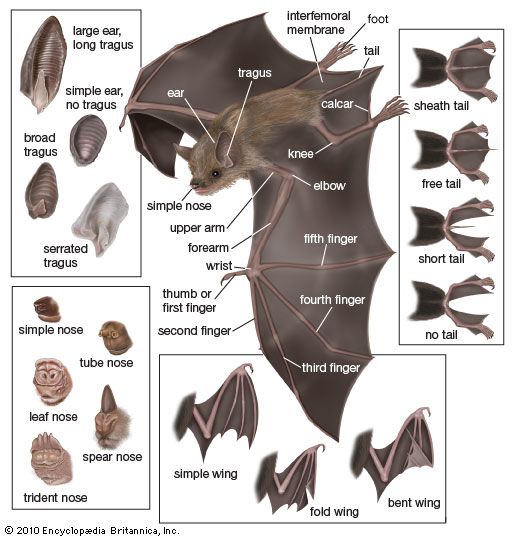
To process this information, bats rely on specialized auditory systems, including large, movable ears that act as resonators and a highly developed central nervous system capable of analyzing echoes in milliseconds. By using high-frequency sounds, they can detect objects as small as fruit flies or as fine as thin wires.13
How do brown bats differ from other bat species in terms of appearance and behavior?
The term “brown bat” refers to two distinct genera of vesper bats: Myotis (little brown bats) and Eptesicus (big brown bats). While they share a general insectivorous diet, they differ from other bat species in specific physical and behavioral traits.4
Physical Appearance
- Size and Build: Myotis species are generally smaller, ranging from 3.5–8 cm in length, while Eptesicus species are slightly more robust, measuring 3.5–7.5 cm. In contrast, other specialized bats, such as the smoky bat, are characterized by unique features like reduced, non-functional thumbs.45
- Coloration: Like many bats, brown bats typically exhibit shades of brown, tan, gray, or black. However, unlike species that use bright colors or patterns for camouflage (such as those mimicking sunlight or leaves), brown bats generally lack these specialized visual adaptations.6
Behavioral Differences
- Flight and Roosting: Big brown bats (Eptesicus) are noted for being relatively slow, heavy fliers and frequently inhabit buildings and hollow trees. This contrasts with more agile or specialized species that may roost in different environments.4
- Reproduction: While most bats bear a single offspring, the big brown bat is known to occasionally bear twins, a trait that distinguishes it from many other species that strictly produce one young.7
- Longevity: Brown bats are among the longest-lived small mammals, with documented lifespans exceeding 20 to 30 years. This longevity is attributed to their colonial lifestyle, use of isolated roosts, and the ability to reduce their body temperature at rest to conserve metabolic energy.7
What is the geographical distribution of brown bats?
The term “brown bat” encompasses two genera of vesper bats, Myotis and Eptesicus, both of which are among the most widely distributed land mammals in the world.4
- Genus Myotis: These bats have a global range that is nearly equal to that of the entire order of bats, excluding only polar regions and some isolated islands. Specific examples include the little brown bat (M. lucifugus), which is widely distributed across North America, and the large mouse-eared bat (M. myotis), which is found in Europe.495
- Genus Eptesicus: These bats, often called big brown bats or serotines, are also broadly distributed. The big brown bat (E. fuscus) is common in North America, with a range extending from southern Canada to northern South America. The serotine (E. serotinus) is a common form found throughout Eurasia.410
Generally, members of the family Vespertilionidae, to which these brown bats belong, are found worldwide except in polar regions.9
How do bats distinguish between their own echoes and the sounds made by other bats?
Bats possess a highly sophisticated sensory system that allows them to navigate and hunt by interpreting the echoes of their own vocalizations. Distinguishing their own pulses from the background noise of other bats and environmental sounds is a complex task managed by specialized anatomical and neurological adaptations.1
Mechanisms for Signal Discrimination
- Neural Integration: The bat’s central nervous system is uniquely developed to analyze the reflected, altered form of its own pulse within milliseconds. This system must simultaneously filter out echoes from other individuals and its own previous pulses to maintain a clear “acoustic image” of its surroundings.1
- Auditory Specialization: The bat’s middle and inner ears are highly specialized for high-frequency sensitivity. The bony auditory complex is often isolated from the skull, which enhances the bat’s ability to compare signals received by both ears, aiding in the discrimination of target direction and distance.1
- Resistance to Masking: Bats exhibit a remarkable resistance to “masking” by extraneous noises. Their hearing is tuned specifically to the frequency range of their own echolocation cries. Because they have limited sensitivity to lower-frequency sounds—which often contain environmental noise—they are less likely to be distracted or overwhelmed by sounds that do not contribute to their sonar function.3
- Pulse Design: By systematically altering the duration, repetition rate, and frequency pattern of their pulses during different phases of flight (search, approach, and terminal), bats can maintain focus on a specific target while ignoring irrelevant acoustic information.1
Sources
- bat - Orientation — Encyclopædia Britannica
- Echolocation — Encyclopædia Britannica
- sound reception - Echolocation in bats — Encyclopædia Britannica
- brown bat — Encyclopædia Britannica
- bat - Migration — Encyclopædia Britannica
- bat - Life cycle — Encyclopædia Britannica
- bat - Anatomical specializations — Encyclopædia Britannica
- smoky bat — Encyclopædia Britannica
- big brown bat — Merriam-Webster
- Migration - Flying mammals ( bats ) — Encyclopædia Britannica
- little brown bat — Merriam-Webster
- bat - Distribution — Encyclopædia Britannica
Published on · 4 min read