Old World Fruit Bat
Old World and New World fruit bats belong to entirely different families and exhibit distinct biological characteristics.
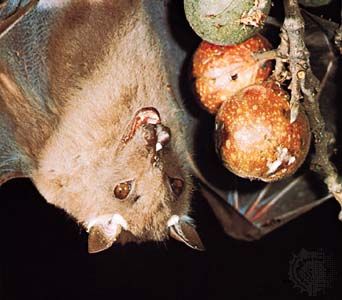
How do Old World fruit bats differ from New World fruit bats?
Old World and New World fruit bats belong to entirely different families and exhibit distinct biological characteristics.
Old World Fruit Bats (Family Pteropodidae)
- Distribution: Found across Africa, Southeast Asia, and Australia.1
- Sensory Perception: Most rely on vision rather than echolocation to navigate, with the exception of rousette bats.1
- Physical Features: They include the flying fox, the largest of all bats. They lack the specialized nose structures found in New World species.1
New World Fruit Bats (Family Phyllostomidae)
- Distribution: Native to the Americas, ranging from the United States to Argentina.2
- Sensory Perception: These bats utilize echolocation to orient themselves in the dark.3
- Physical Features: They are characterized by a spear-shaped structure on the muzzle known as a nose leaf. While many are frugivorous, the family also includes insect-eating, carnivorous, and nectar-feeding species, as well as vampire bats.23
While both groups play vital roles in their respective ecosystems, they are distinguished by their evolutionary lineage and specific anatomical adaptations.4
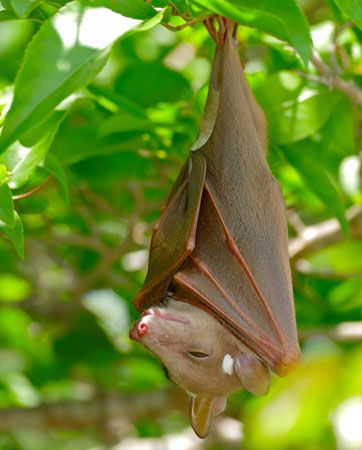
Where are Old World fruit bats typically found, and what are their preferred habitats?
Old World fruit bats (family Pteropodidae) are widely distributed throughout the tropical and subtropical regions of the Old World, spanning from Africa across Southeast Asia to Australia and various tropical islands, such as Madagascar and Indonesia.167
Regarding their preferred habitats, these bats exhibit diverse roosting behaviors:
- Open-air roosting: Many species, including the flying fox, typically roost in the open, hanging from the branches of trees. These colonies can be massive, sometimes numbering hundreds of thousands of individuals, and may cause noticeable defoliation of the trees they occupy.14
- Sheltered environments: Other members of the family prefer more protected locations, including caves, rock crevices, and occasionally buildings.14
While their specific requirements for light, temperature, and humidity can influence their local distribution, they are generally well-adapted to the tropical environments where they are most abundant.74
How do Old World fruit bats communicate and interact with each other?
Old World fruit bats (family Pteropodidae) exhibit a variety of social structures, ranging from solitary individuals to highly gregarious colonies. While detailed observations of social interactions between adults are limited, their behaviors are shaped by several key factors:9
- Roosting Dynamics: Many species are colonial, often forming large groups that roost in trees, caves, or buildings. In species like the flying fox, these colonies can number in the hundreds of thousands. Within these groups, individuals often maintain physical contact, using touch to find comfort and stability while resting.1093
- Sensory Communication: Unlike many other bats, most Old World fruit bats rely on vision rather than echolocation for navigation. However, they utilize other senses for social interaction. They possess large dermal glands that secrete odorous substances, or pheromones, which are believed to function as signals for species or sex recognition. Smell is also likely used to locate members of the same species and differentiate individuals by sex.9113
- Social Organization: Bats often segregate by sex, with pregnant females frequently occupying specific nursery roosts. In some colonial species, individuals may arrange themselves in specific patterns within a group, such as males occupying the periphery while females remain in the center.8
How are Old World fruit bats adapted for their fruit-eating lifestyle?
Old World fruit bats (family Pteropodidae) have evolved specialized traits that allow them to thrive on a diet of fruit, nectar, and pollen:
- Enhanced Vision: Unlike most other bats that rely on echolocation, Old World fruit bats possess large eyes adapted for excellent vision in low-light conditions, such as under the jungle canopy, which helps them locate food sources at night.112
- Olfactory Senses: They utilize a keen sense of smell to detect the specific scents of fruits and flowers. Many plants that rely on these bats for pollination or seed dispersal produce fruits or flowers with strong, musky, or sour odors that are easily identified by the bats.1312
- Specialized Feeding Structures: Some species, such as the long-tongued fruit bats, have evolved specialized tongues to efficiently extract nectar and pollen from flowers. Others, like the hammer-headed fruit bat, possess distinct facial features, including large muzzles and lips, that assist in their feeding habits.113
These adaptations enable them to occupy vital ecological niches as primary consumers and essential pollinators in tropical ecosystems.1311
Sources
- Old World fruit bat — Encyclopædia Britannica
- Phyllostomidae — Encyclopædia Britannica
- Jamaican fruit bat — Encyclopædia Britannica
- fruit bat — Encyclopædia Britannica
- pteropod — Encyclopædia Britannica
- flying fox — Encyclopædia Britannica
- bat - Distribution — Encyclopædia Britannica
- bat - Roosting — Encyclopædia Britannica
- bat - Anatomical specializations — Encyclopædia Britannica
- bat - Social interactions — Encyclopædia Britannica
- bat - Senses — Encyclopædia Britannica
- bat - Food habits — Encyclopædia Britannica
- mammal - Food habits — Encyclopædia Britannica
Published on · 4 min read