Burmese Python
The Burmese python (Python bivittatus) is a large, nonvenomous constrictor snake native to diverse environments across Southeast Asia, including forests…
What is a Burmese python?
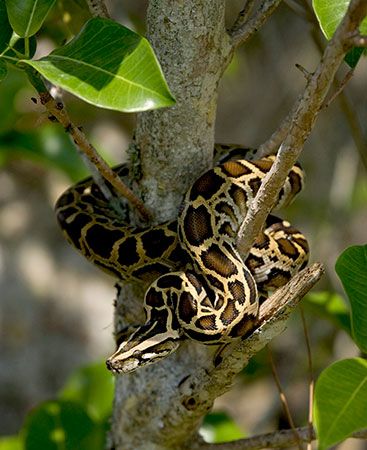
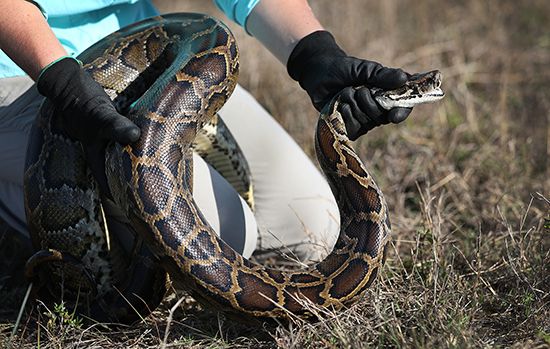
The Burmese python (Python bivittatus) is a large, nonvenomous constrictor snake native to diverse environments across Southeast Asia, including forests, swamps, and grasslands.1
Known for its exceptional size, the species typically reaches lengths of 3 to 5 meters (10 to 16 feet), though some individuals may grow even larger. These apex predators hunt by waiting motionless for prey—ranging from small rodents to large mammals and reptiles—before striking, coiling around their target, and suffocating it.1
While native to Asia, the Burmese python has become an invasive species in southern Florida. Likely introduced through the exotic pet trade, these snakes have established breeding populations that significantly disrupt local ecosystems by preying on native wildlife. Despite their invasive success in Florida, the species is listed as vulnerable by the IUCN due to habitat loss and harvesting for food, leather, and the pet trade in its native range.21
Where do Burmese pythons live in the wild?
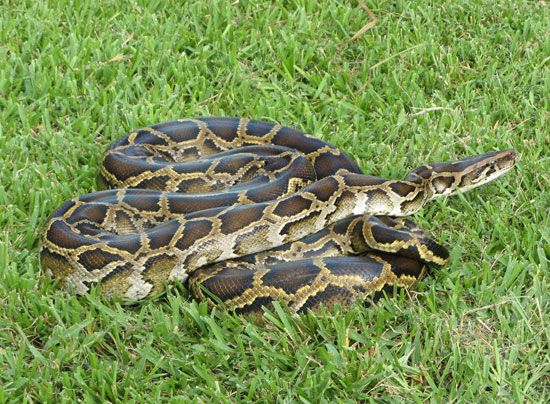
Burmese pythons are native to a wide range of environments across southern and Southeast Asia. Their natural geographic range extends from Nepal, Bangladesh, northeastern India, and Myanmar eastward to southern China. They are also found southward through Vietnam, Laos, Cambodia, and Thailand (north of the Isthmus of Kra), as well as on the Indonesian islands of Java, Bali, Sumbawa, and Sulawesi.2
Within these regions, they inhabit diverse habitats including mangrove forests, rainforests, swamps, grasslands, rivers, and rocky areas.2
Additionally, the species has established an invasive population in southern Florida, particularly within the Everglades, where they thrive in the warm, frost-free wetlands.2
What do Burmese pythons eat?
Burmese pythons are apex predators that consume a wide variety of prey by waiting motionless until their target is close enough to strike. Once they secure the quarry with their powerful jaws, they coil their bodies around the victim to suffocate it before consuming it whole.2
Their diet includes:
- Small mammals: Such as rodents, rabbits, and raccoons.2
- Large mammals: Including deer, pigs, and goats.2
- Other animals: They also consume alligators and domesticated birds like poultry.2
In their invasive range within the Everglades, these snakes have significantly reduced populations of native species, including bobcats and opossums, and have effectively wiped out local foxes and rabbits. While there are reports of the snakes attacking people, such encounters are rare and typically limited to provoked, captive animals.2
How do Burmese pythons catch and kill their prey?
Burmese pythons are apex predators that utilize a patient, ambush-style hunting strategy to secure their prey. They typically wait motionless until an animal passes within striking distance.1
Once the prey is close enough, the python strikes rapidly, using its powerful jaws to seize and hold the animal. Because they are constrictors, they immediately coil their muscular bodies around the victim. This constriction suffocates the prey, causing death.12
After the prey has been subdued, the python consumes it whole. This is made possible by the unique anatomy of the snake’s skull, which features flexible joints and independently moving jaw arches. This “walk-feeding” method allows the python to manipulate and swallow prey that is significantly larger than the diameter of its own head.12
Sources
- Burmese python — Merriam-Webster
- Burmese python — Encyclopædia Britannica
- python — Encyclopædia Britannica
- snake - Skull and sense organs — Encyclopædia Britannica
Published on · 3 min read