Triceratops
Triceratops is frequently depicted using its three prominent horns and large, bony frill to defend itself against large carnivorous dinosaurs like…
How did Triceratops defend itself against predators like Tyrannosaurus rex?
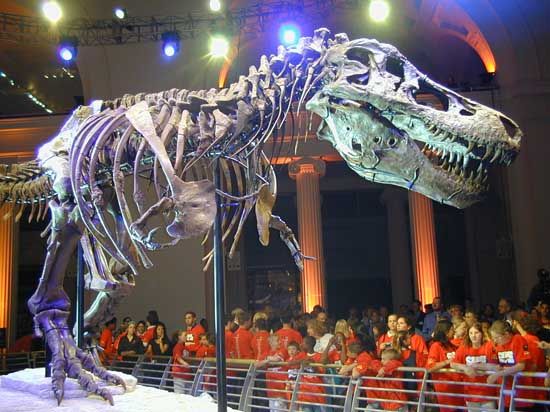
Triceratops is frequently depicted using its three prominent horns and large, bony frill to defend itself against large carnivorous dinosaurs like Tyrannosaurus rex. While these features are often interpreted as defensive weaponry, paleontologists also consider other possibilities.
The presence of pathologies—injuries or signs of disease—on the frills of some specimens suggests that Triceratops may have engaged in intraspecific combat, using their horns to fight members of their own species. Alternatively, the horns and frills may have functioned primarily as display structures, serving to signal maturity or status to other members of the group. This theory is supported by the fact that the shape of these features changed dramatically as the animal matured, allowing for clear differentiation between juveniles and adults.
While the exact role of these features in predator-prey interactions remains a subject of study, the physical evidence of healed wounds on some plant-eating dinosaurs confirms that Tyrannosaurus rex was an active predator that engaged with its prey.12
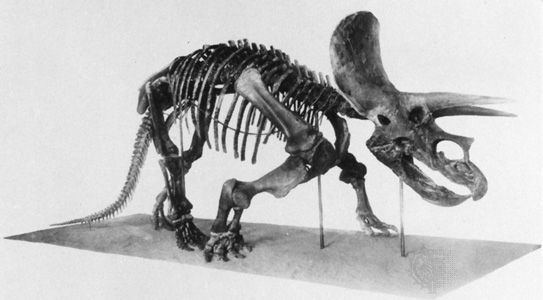
How did the Triceratops get its name, and what does it mean?
The name Triceratops is derived from New Latin and originates from Ancient Greek roots: tri- (three), kerat- or keras (horn), and ōps (face). When translated, the name literally means “three-horned face”.41
This name refers to the dinosaur’s distinct facial features: two prominent horns located above its eyes and a third, smaller horn situated on its snout. The genus was officially named and described by the American paleontologist O.C. Marsh in 1889. Interestingly, when the first specimen was discovered in 1887, it was initially mistaken for a gigantic species of extinct bison before further findings confirmed it was a horned dinosaur.415
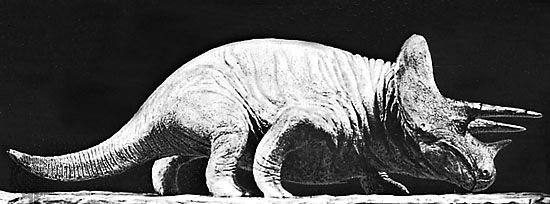
How did Triceratops use its distinctive frill and horns?
The distinctive frill and horns of Triceratops have long been subjects of scientific debate, with several hypotheses proposed to explain their function:
Defensive and Offensive Roles
- Predator Defense: Triceratops is frequently depicted using its three prominent horns to defend itself against large carnivorous dinosaurs like Tyrannosaurus rex. The animal’s stout, semisprawling stance may have provided a stable base for directing these horns toward an opponent and resisting attacks.15
- Intraspecific Combat: Evidence of pathologies—such as puncture wounds—in consistent locations on the frills suggests that Triceratops may have engaged in rutting combat with members of its own species, similar to some modern horned animals.15
Display and Biological Signaling
- Species Recognition and Maturity: The horns and frill may have functioned as display structures to signal maturity or status. This is supported by the fact that these features changed shape dramatically as the animal developed from a juvenile to an adult.1
- Visual Signaling: Because the skull was likely covered in colorful keratin, these structures may have created a formidable or recognizable visual profile.15
Other Hypotheses
- Muscle Attachment: The frill may have served as an attachment site for powerful neck muscles used to wield the head or for enlarged jaw muscles.5
- Thermoregulation: Some researchers have suggested the frill acted as a heat-control apparatus, utilizing a network of blood vessels to absorb or dissipate heat, though this remains difficult to test.5
What were the key physical characteristics of the Triceratops?
Triceratops was a large, quadrupedal ceratopsian dinosaur characterized by several distinct physical features:
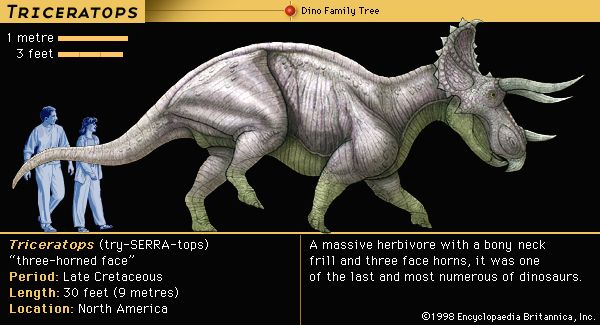
- Skull and Horns: It possessed a massive skull, sometimes reaching 3 metres (10 feet) in length. It featured three prominent horns—one on the snout and two above the eyes—along with smaller hornlike projections on the cheekbones. A large, solid bony frill extended from the back of the skull, bordered by 19–26 small spikes known as epoccipitals.1
- Feeding Apparatus: The front of the mouth formed a beak used for cropping vegetation. The jaws contained stacked columns of teeth that functioned as serrated shearing blades, specialized for processing tough, fibrous plants.16
- Body Structure: Adults were substantial, weighing between 5,450 and 7,260 kg (12,000–16,000 pounds) and reaching lengths of up to 9 metres (30 feet). They had stout limbs, with the hind limbs being larger than the forelimbs. The feet were hoofed, and the tail was relatively short.16
- Integument: Evidence suggests the head was covered in keratin, which may have been brightly colored, while the rest of the body likely had a similar covering.1
Sources
- Triceratops — Encyclopædia Britannica
- Tyrannosaurus rex: Top Questions — Encyclopædia Britannica
- dinosaur - Tetanurae — Encyclopædia Britannica
- triceratops — Merriam-Webster
- dinosaur - Ceratopsia — Encyclopædia Britannica
- dinosaur - The plant eaters — Encyclopædia Britannica
Published on · 3 min read