Burrowing Owl
The burrowing owl (Athene cunicularia) is a small, slender owl belonging to the family Strigidae. Measuring about 20 cm (8 inches) in length, these birds are…
What is Burrowing owl?
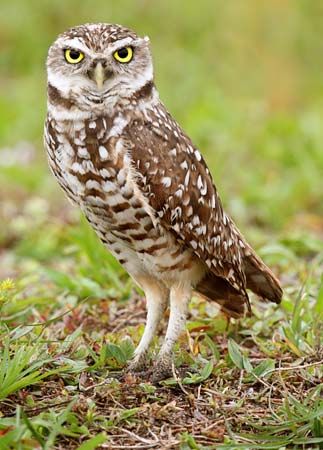
The burrowing owl (Athene cunicularia) is a small, slender owl belonging to the family Strigidae. Measuring about 20 cm (8 inches) in length, these birds are characterized by their long legs, brown plumage with white spots, white brows, and yellow eyes.1
Unlike many other owls, they are diurnal and ground-dwelling, inhabiting prairie lands and desert regions across the Western Hemisphere, ranging from southwestern Canada to Tierra del Fuego. They typically nest in burrows abandoned by other animals, though they are also capable of digging their own nest chambers. Their diet consists primarily of insects and small rodents, which they hunt near sunrise and sunset by running along the ground or swooping from perches. When approached by humans, they are known to bob their heads to gauge distance before flying away.123
What other animals share burrows with these owls?
Burrowing owls typically inhabit burrows that have been abandoned by other animals, particularly rodents. While the provided search results note that these owls utilize holes created by such animals, they do not specify the exact species of rodents or other creatures whose abandoned burrows are occupied.12
How do burrowing owls protect themselves from predators?
Burrowing owls employ specific behavioral strategies to protect themselves and their young from predators. When threatened, young burrowing owls emit a vocalization that mimics the warning buzz of a rattlesnake, a sound likely to deter potential intruders that associate the noise with the dangerous reptiles often found in rodent burrows.4
When approached by humans, adult burrowing owls typically bob their heads up and down, a behavior believed to help them accurately gauge the distance of the approaching threat before they fly a short distance away to safety. Additionally, like many other owl species, they rely on their natural camouflage to avoid detection by predators while at their daytime roosts.14
What are some differences between burrowing owls and other owl species?
Burrowing owls (Athene cunicularia) possess several distinct characteristics that set them apart from most other owl species:
- Nesting Habits: While most owls nest in trees, cliffs, or buildings, burrowing owls are ground-nesters that dig or occupy chambers within abandoned rodent burrows.13
- Locomotion: Unlike typical owls that use their feet primarily for perching and grasping prey, burrowing owls are highly terrestrial. They are capable of running rapidly across the ground and rarely perch in vegetation.5
- Activity Patterns: While many owls are strictly nocturnal, burrowing owls are known to hunt near sunrise and sunset and are frequently seen standing outside their burrows or on posts during the day.1
- Defensive Vocalizations: When threatened, young burrowing owls emit a call that mimics the warning buzz of a rattlesnake, a unique adaptation to deter predators that might otherwise enter their underground homes.4
- Physical Appearance: They are slender, long-legged birds with yellow eyes, white brows, and a white face, contrasting with the varied plumage and often larger, more robust builds of many other owl species.1
Sources
- burrowing owl — Encyclopædia Britannica
- burrowing owl — Merriam-Webster
- owl - Reproduction and development — Encyclopædia Britannica
- owl - Behaviour — Encyclopædia Britannica
- owl - Locomotion — Encyclopædia Britannica
Published on · 2 min read