Caracara
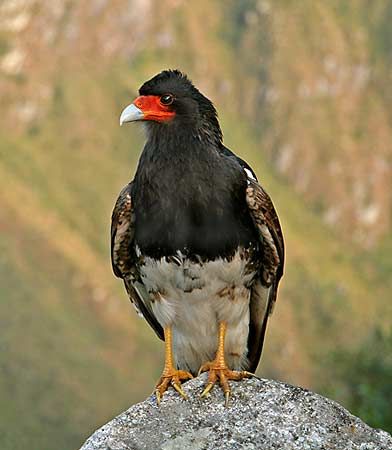
Caracaras are a group of approximately 10 species of birds of prey belonging to the subfamily Polyborinae within the family Falconidae. While they share…
What different species of caracaras exist, and how do they vary?
Caracaras are a group of approximately 10 species of birds of prey belonging to the subfamily Polyborinae within the family Falconidae. While they share common traits such as long legs, aggressive behavior, and reddish naked skin on their cheeks and throat, they exhibit variations in size and diet.1
Key Species and Variations
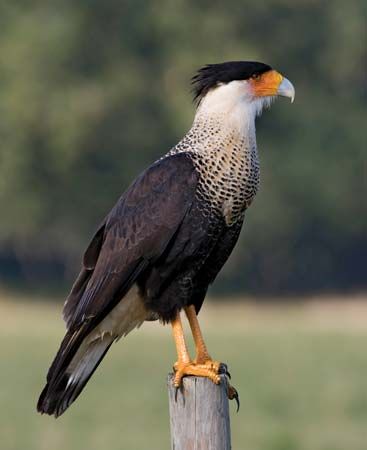
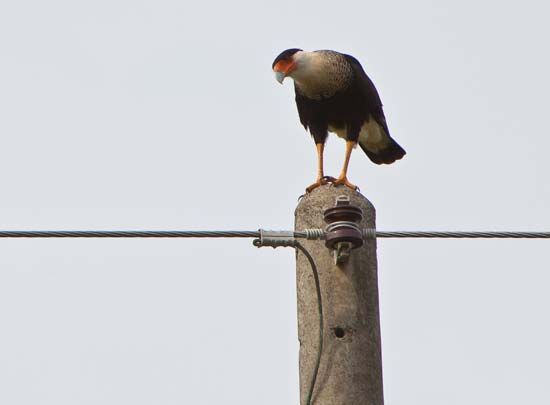
- Crested Caracara (Caracara plancus or Polyborus plancus): These birds range from 40 to 60 cm (16 to 24 inches) in length. Their classification is subject to debate; some experts categorize the entire population across the Americas as a single species with multiple subspecies, while others distinguish between the northern crested caracara (C. cheriway) and the southern caracara (C. plancus).1
- Chimango (Milvago chimango): Also known as the beetle eater, this is a smaller South American species that primarily feeds on insects.1
- Black Caracara (Daptrius ater): Another South American species, this bird is also noted for its smaller size and insect-based diet.1
Generally, while larger caracaras are known to dominate vultures when feeding on carrion, smaller species focus their foraging on insects.1
What is the conservation status of caracaras, and are there any threats to their population?
Sorry, the Britannica knowledge base does not contain information regarding the specific conservation status or population threats for the various species of caracaras. While the provided search results discuss the caracal—a distinct feline species—they do not provide data on the environmental pressures or protection levels for the bird subfamily Polyborinae.
How do caracaras raise their young and what is their breeding behavior like?
Caracaras follow a reproductive cycle typical of many falconiforms, characterized by a sequence of courtship, nest construction, incubation, and chick rearing.
Breeding Behavior and Nesting
Caracaras are known to construct their own nests, typically using sticks. These structures are often built in trees or on cliff ledges. While some large species may return to and repair old nests annually, smaller species often build new ones each season. The presence of fresh green material in a nest often signals imminent occupation, though it does not guarantee that eggs will be laid.4
Nuptial displays are a key part of their breeding behavior. These can include:
- Calling: Vocalizations performed from perches or during soaring flight.
- Aerial Displays: Undulating flight patterns involving dives and swoops accompanied by loud calls.
- Mutual Displays: Interactions where the male dives toward the female, who may respond by turning over and raising her claws.4
Incubation and Rearing
Caracaras typically lay a small clutch of eggs, which are often rounded and heavily spotted with brown or reddish-brown pigment. Incubation is primarily performed by the female, though the male may assist. Once hatched, the chicks are covered in down. Parental care is a significant investment; in the early stages, the male is responsible for hunting to provide food for the female and the brood. As the chicks grow and become partly feathered, they begin to tear up their own prey, at which point the female also begins to hunt to increase the food supply.4
Competition among siblings can occur, especially if food resources are scarce, sometimes leading to direct interference or aggression between nestlings. Parental attention gradually decreases as the young approach their first flight, after which they may remain near the nest for several weeks or months to continue receiving food while learning to hunt for themselves.4
What role do caracaras play in their ecosystem?
Caracaras serve as active predators and scavengers within their ecosystems, playing a significant role in the food web of the New World. As members of the Falconidae family, they are known for their gregarious and aggressive nature, which allows them to dominate other scavengers, such as vultures, when competing for food.1
Their ecological impact is defined by a diverse diet that includes:
- Carrion: They function as important scavengers, helping to clean the environment by consuming dead animal matter.1
- Prey Species: They actively hunt birds, reptiles, and amphibians.1
- Insects: Smaller species, such as the chimango or beetle eater, specifically target insects, contributing to the regulation of insect populations.1
By occupying these various niches, caracaras help maintain balance within their habitats, ranging from the southern United States down to the Falkland Islands and Tierra del Fuego.1
Sources
- Caracara — Encyclopædia Britannica
- caracara — Merriam-Webster
- caracal — Encyclopædia Britannica
- Falconiform - Reproduction — Encyclopædia Britannica
- Animal social behavior - Social interactions involving the costs and benefits of parental care — Encyclopædia Britannica
Published on · 3 min read