Caprimulgiform
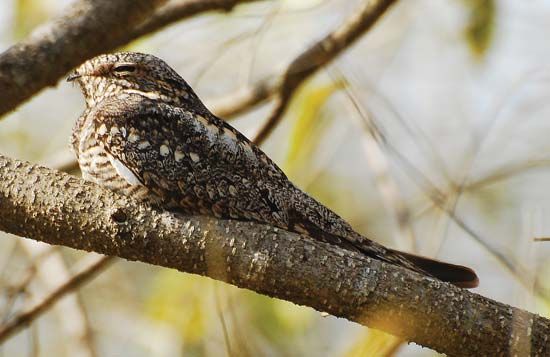
Caprimulgiform birds, which include nightjars, nighthawks, potoos, and frogmouths, are often surrounded by an aura of mystery due to their nocturnal habits…
What folklore or myths are associated with Caprimulgiform birds in various cultures?
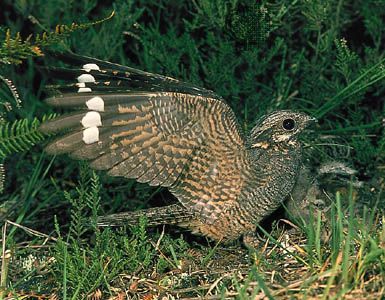
Caprimulgiform birds, which include nightjars, nighthawks, potoos, and frogmouths, are often surrounded by an aura of mystery due to their nocturnal habits and strange, startling vocalizations.1
The most prominent myth associated with these birds is reflected in their historical name, “goatsucker” (derived from the genus Caprimulgus). This ancient belief held that the birds, frequently seen flying near livestock at dusk, were stealing milk from the udders of goats. This misconception was likely fueled by the birds’ uncommonly large mouths, which are actually adapted for catching insects attracted to the animals.1
Beyond this specific myth, the order is generally associated with the occult and the otherworldly in many cultures, a reputation shared with other nocturnal birds like owls. Their secretive behavior, cryptic plumage, and haunting calls have historically elicited both fascination and fear from humans.12
How do scientists study Caprimulgiform birds, given their nocturnal nature?
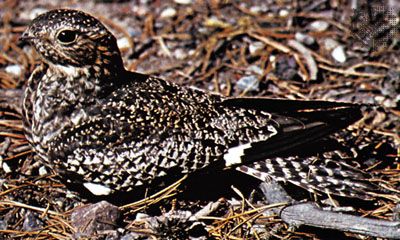
Studying Caprimulgiform birds—such as nightjars, potoos, and frogmouths—presents unique challenges due to their nocturnal or crepuscular activity patterns and their highly cryptic plumage, which provides excellent camouflage during the day.74
Scientists employ several methods to overcome these difficulties:
- Acoustic Research: Because these birds are often heard before they are seen, researchers use high-quality, portable audio equipment to record and analyze their distinct vocalizations. This has become a primary tool for identifying species and understanding their communication, territorial marking, and mating behaviors.68
- Field Observation and Technology: While simple field observation with binoculars remains a staple, modern ornithology utilizes advanced tracking tools. Bird banding (ringing) helps track longevity and movement, while minute radio transmitters (telemeters) allow scientists to record individual movements in real time.6
- Radar: Sensitive radar technology is frequently used to monitor the movements of nocturnal birds, providing data on migration and flight patterns that would be impossible to capture visually.6
- Museum Collections: Because many species are difficult to observe in the wild, researchers rely on museum collections of skins and skeletons to study the internal anatomy and taxonomy of these birds.6
What role do Caprimulgiform birds play in their ecosystems?
Caprimulgiform birds play a vital role in their ecosystems primarily as specialized insectivores, helping to regulate populations of night-flying insects. By hunting on the wing, these birds occupy a unique ecological niche, effectively utilizing food sources that are largely unavailable to diurnal species.10811
The ecological impact of these birds varies by group:
- Insect Control: Most members of the order, including nightjars, nighthawks, frogmouths, and owlet-frogmouths, are insectivorous. They serve as primary predators of nocturnal insects, filling a role that minimizes competition with insectivorous owls.10311
- Seed Dispersal: The oilbird is a notable exception to the insectivorous nature of the order. As a primarily frugivorous bird, it plays a significant role in seed dispersal within its habitat, as it consumes fruit and transports seeds away from parent plants.114
By occupying diverse habitats—ranging from semideserts to humid forests and from sea level to high altitudes—these birds maintain balance within their respective food webs.11
Which families are included in the Caprimulgiform order, and what are some examples of birds from each family?
The order Caprimulgiformes consists of five distinct families of soft-plumaged, cryptically colored birds. While they share certain characteristics, such as enormous gapes and nocturnal or crepuscular habits, each family possesses unique anatomical and behavioral traits.
The following table outlines the families within the order:
Family
Common Name
Examples
Steatornithidae
Oilbirds
Oilbird
Podargidae
Frogmouths
Tawny frogmouth, Papuan frogmouth
Aegothelidae
Owlet-frogmouths
Australian owlet-nightjar
Nyctibiidae
Potoos
Common potoo, Great potoo
Caprimulgidae
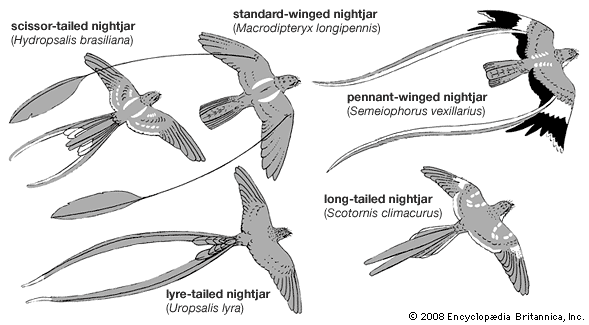
Nightjars
and
Nighthawks
Whippoorwill, Chuck-will’s-widow, Poorwill, Pauraque
The Caprimulgidae family is the most widely distributed, containing over 90 species divided into true nightjars and nighthawks. In contrast, families like the Podargidae and Aegothelidae are primarily restricted to the Australasian and Oriental regions, while the Nyctibiidae are found in the Neotropics and the Steatornithidae are localized to parts of South America and Trinidad.
Sources
- nightjar — Merriam-Webster
- goatsucker — Merriam-Webster
- Caprimulgiform - Form and function — Encyclopædia Britannica
- Caprimulgiform — Encyclopædia Britannica
- owl — Encyclopædia Britannica
- Why do birds chirp at night? — Encyclopædia Britannica
- Ornithology — Encyclopædia Britannica
- Caprimulgiform - Habitat — Encyclopædia Britannica
- Caprimulgiform - Natural history — Encyclopædia Britannica
- Caprimulgidae — Encyclopædia Britannica
- Nightjar — Encyclopædia Britannica
- Tropical rainforest - Relationships between the flora and fauna — Encyclopædia Britannica
- seed - Dispersal by birds — Encyclopædia Britannica
- Caprimulgiform - Critical appraisal — Encyclopædia Britannica
- Caprimulgiform - Annotated classification — Encyclopædia Britannica
Published on · 3 min read