Button Quail
Button quail exhibit several unique behavioral traits that distinguish them from many other bird species, particularly regarding their reproductive roles.…
What are the unique behavioral traits of button quail?
Button quail exhibit several unique behavioral traits that distinguish them from many other bird species, particularly regarding their reproductive roles. Unlike many birds, button quail exhibit a form of sex-role reversal: females are larger and more strongly patterned than males, and they take the lead in courting and nest building.1
In a departure from typical avian parenting, the females are polyandrous, mating with multiple males in a single season before moving on once the eggs are laid. The males, which are less vocal, assume the responsibilities of incubating the eggs and caring for the young. Their reproductive cycle is remarkably rapid; the incubation period of 12 or 13 days is the shortest known for any precocial bird, and the young reach independence within two weeks.1
In their daily movements, these birds typically travel singly or in pairs, often running in a crouching, zigzagging pattern through grass. While they are capable of weak, whirring flight, they rely heavily on their ability to navigate scrubby grasslands on foot.1
What are the distinctive physical characteristics of button quail?
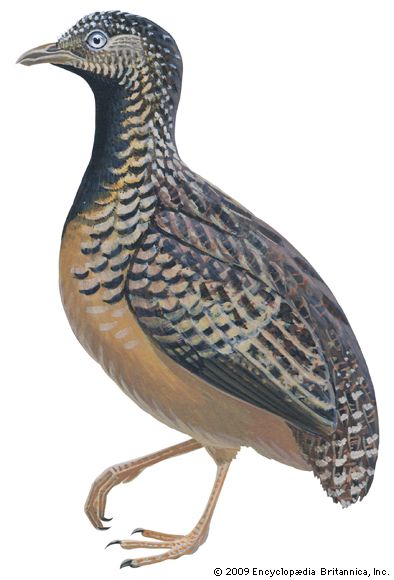
Button quail are small, round-bodied birds belonging to the family Turnicidae, typically measuring between 11 and 19 centimeters (about 4 to 7 inches) in length. Their physical appearance is characterized by short legs and short, rounded wings, which allow for weak, whirring flight, though they primarily navigate their scrubby grassland habitats on foot.13
Key anatomical and physical features include:
- Skull and Beak: They possess a short, slightly downcurved beak and are unique within the order Gruiformes for having only one carotid artery and a well-developed basipterygoid process (a projection at the base of the skull).3
- Feet: Unlike many other birds, they lack a hallux (hind toe).3
- Sexual Dimorphism: In most species, females are larger and more strongly patterned or brightly colored than males.13
- Plumage: Generally described as dull-colored, though specific variations exist; for example, the striped button quail features reddish-gray upperparts with an orange breast patch and black-spotted sides.1
While most species conform to these traits, the lark quail (Ortyxelos meiffrenii) is an exception, appearing more like a lark with longer wings that make it a stronger flier.1
Are button quail commonly kept as pets, and what are the challenges of keeping them?
The provided Britannica entry on button quail focuses on their biological classification, reproductive behaviors, and physical characteristics within their natural habitats in the Old World.
The available information does not contain details regarding the suitability of button quail as pets or the specific challenges associated with keeping them in captivity. Consequently, I cannot provide an answer to this query based on the current knowledge base.
How do button quail reproduce and care for their young?
Button quail exhibit a unique reproductive strategy characterized by polyandry, a system in which females mate with multiple males during a single breeding season.15
Nesting and Courtship
In this family, the traditional gender roles are reversed: females are larger and more brightly patterned than males, and they take the lead in courtship and nest building. They construct their nests in grass-lined hollows on the ground, often creating a domed roof with a side entrance for concealment.15
Incubation and Parental Care
Once the eggs are laid, the female leaves the nest to seek other mates, leaving the male to perform all parental duties. The male is solely responsible for incubating the eggs and caring for the hatchlings. The incubation period for button quail is 12 to 13 days, which is the shortest duration known for any precocial bird. The young are independent within two weeks of hatching, reach full size in six to seven weeks, and are capable of breeding when less than three months old.15
Sources
- Button quail — Encyclopædia Britannica
- Galliform - Courtship and mating — Encyclopædia Britannica
- Gruiform - Annotated classification — Encyclopædia Britannica
- painted quail — Merriam-Webster
- Gruiform - Nesting — Encyclopædia Britannica
Published on · 3 min read