Bullfinch
A bullfinch is a stocky, stout-billed songbird belonging to the families Fringillidae and Emberizidae.
What is Bullfinch?
A bullfinch is a stocky, stout-billed songbird belonging to the families Fringillidae and Emberizidae.1
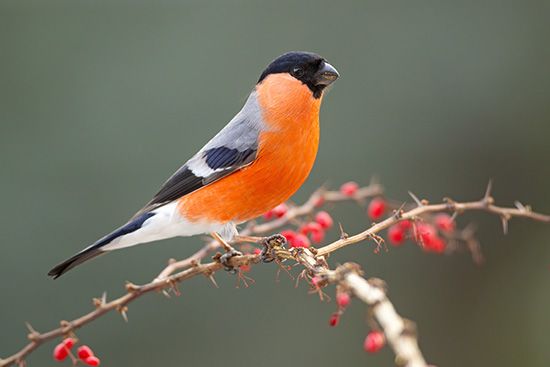
These birds are characterized by their bold markings. The common bullfinch (Pyrrhula pyrrhula), a well-known species found in Eurasia, typically measures about 15 cm (6 inches) in length. Males of this species are particularly striking, featuring a black cap, chin, tail, and wings, paired with a blue-gray back and rosy-red or pinkish-orange underparts. They are often found in hedgerows and evergreen groves and are popular as cage birds due to their soft, warbling calls.12
While most bullfinches are fringillids, the group also includes the trumpeter bullfinch, found in arid regions from the Canary Islands to India, and various Caribbean species classified within the family Emberizidae.1
What are the main differences between the common bullfinch and the trumpeter bullfinch?
The common bullfinch and the trumpeter bullfinch differ significantly in their physical appearance, habitat, and vocalizations:
- Physical Appearance: The common bullfinch (Pyrrhula pyrrhula) is a boldly marked bird measuring about 15 cm (6 inches) in length, featuring a black cap, chin, tail, and wings, with a blue-gray back and a pinkish-orange underside in males. In contrast, the trumpeter bullfinch (Rhodopechys githaginea) is a paler bird characterized by a wash of pink across its plumage.1
- Habitat: The common bullfinch is typically found in evergreen groves and hedgerows throughout Eurasia. The trumpeter bullfinch is adapted to arid environments, ranging from the Canary Islands to India.1
- Vocalization: The common bullfinch is known for a soft, warbling call, whereas the trumpeter bullfinch is distinguished by a blaring, buzzy note.1
What do bullfinches typically eat in their natural habitat?
Bullfinches are categorized as finches, which are defined as small, conical-billed songbirds that primarily consume seeds. Like other members of the Fringillidae and Emberizidae families, bullfinches use their heavy, stout bills to crack open the seeds of grasses and weeds.13
While seeds form the core of their diet, many finch species supplement their intake with insects. This is particularly important during the breeding season, as nestlings are unable to crack seeds and are typically fed a diet of insects by their parents.3
How do male and female bullfinches differ in appearance?
In the common bullfinch (Pyrrhula pyrrhula), there is a distinct sexual dimorphism in plumage. The male is characterized by its striking rosy-red or pinkish-orange underparts, a blue-gray back, and a black cap, chin, tail, and wings. While the provided information does not explicitly detail the female’s appearance, it is common among many finch species for females to exhibit more muted, brownish, or grayish coloration compared to the vibrant hues of the males, which helps them remain camouflaged while nesting.12
Sources
- Bullfinch — Encyclopædia Britannica
- bullfinch — Merriam-Webster
- Finch — Encyclopædia Britannica
Published on · 2 min read