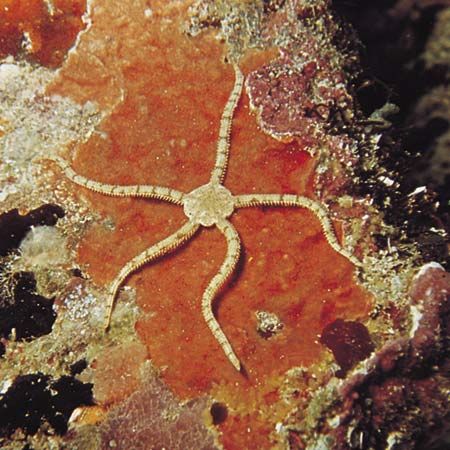
Cake Urchin
Cake urchins, members of the order Clypeastroida, have evolved several specialized adaptations to thrive in shallow marine environments where they typically…
How have cake urchins adapted to their specific marine habitats?
Cake urchins, members of the order Clypeastroida, have evolved several specialized adaptations to thrive in shallow marine environments where they typically burrow into sandy substrates.1
Their most notable adaptation is a flattened, disk-like body, which allows them to remain stable and move efficiently through sand. Their surface is covered in short, fur-like spines that assist in locomotion, while tube feet on the underside of the body are used to capture organic particles from the water and transport them to the mouth.12
To facilitate respiration while buried, cake urchins possess a radial, flower-like arrangement of porous spaces on the upper surface of their test (internal skeleton) called petaloids, which allow for the extension of specialized tube feet. Some species also feature narrow perforations known as lunules, which may help manage water flow or stabilize the animal in shifting currents. Unlike many other sea urchins, these irregular echinoids generally lack the complex dental apparatus known as Aristotle’s lantern, relying instead on their spines and tube feet to gather food.123
What are the unique physical characteristics of cake urchins?
Cake urchins, which belong to the order Clypeastroida, possess several distinct physical characteristics that differentiate them from other echinoids:
- Body Shape: Unlike the globular bodies of regular sea urchins, cake urchins have a flattened, disk-like body. Some species, commonly known as sand dollars, are particularly thin-edged and coinlike.1
- Test Structure: Their internal skeleton, or test, is hollow and slightly elongated. In many species, the edge of the test is symmetrically notched or features narrow perforations called lunules.1
- Surface Features: The body is covered in short, often fur-like spines and small, pincer-like organs known as pedicellariae.1
- Respiration and Feeding: The upper surface of the test displays a radial, flower-like arrangement of five porous spaces called petaloids, which allow for the extension of tube feet modified for respiration. Tube feet on the underside of the body are used for gathering food and assisting in locomotion.1
- Lack of Dental Apparatus: Unlike many other sea urchins, cake urchins generally lack the complex dental apparatus known as Aristotle’s lantern.14
What predators do cake urchins have in their natural environment?
In their natural marine environments, cake urchins are primarily preyed upon by other echinoderms and various mollusks.1
These invertebrates, which belong to the order Clypeastroida, typically inhabit shallow sandy substrates where they burrow to feed on organic particles. While they are well-adapted to these environments through their flattened body shape and specialized tube feet, they remain vulnerable to these specific predators that share their habitat.1
How do cake urchins feed and move in their marine environment?
Cake urchins, which are members of the order Clypeastroida, are specialized marine invertebrates that have adapted to life in shallow, sandy environments. Their methods of feeding and movement are primarily facilitated by their water-vascular system, a hydraulic network that powers their tube feet1.18
Feeding
Cake urchins are typically burrowers that feed on organic particles found in the sand. These particles are wafted toward the animal’s mouth by water currents. The tube feet located on the underside of the body are specifically modified to assist in this feeding process, helping the urchin gather nutrients from the substrate. Unlike many regular sea urchins, cake urchins generally lack the complex, scraping dental apparatus known as Aristotle’s lantern.18
Movement
Locomotion in cake urchins is achieved through the coordinated action of their short, fur-like spines and their tube feet. While the spines provide support and movement across the surface, the tube feet—extended by hydraulic pressure from the ampullae—assist in navigating the sandy environment. As irregular echinoids, they are well-adapted to burrowing just below the surface of soft sediments, a behavior that allows them to remain protected while they feed.189
Sources
- cake urchin — Encyclopædia Britannica
- echinoderm - Food and feeding habits — Encyclopædia Britannica
- sea urchin — Encyclopædia Britannica
- echinoderm - Symmetry and body form — Encyclopædia Britannica
- echinoderm - Reproductive system — Encyclopædia Britannica
- urchin — Encyclopædia Britannica
- echinoderm - Habitats — Encyclopædia Britannica
- muscle - Echinoderms — Encyclopædia Britannica
- echinoderm - Water-vascular system — Encyclopædia Britannica
- tube foot — Merriam-Webster
- echinoderm - Burrowing — Encyclopædia Britannica
Published on · 3 min read