Platycrinites
Platycrinites is a genus of extinct crinoids, commonly known as sea lilies. These marine invertebrates are particularly notable as fossils found in Early…
What is Platycrinites?
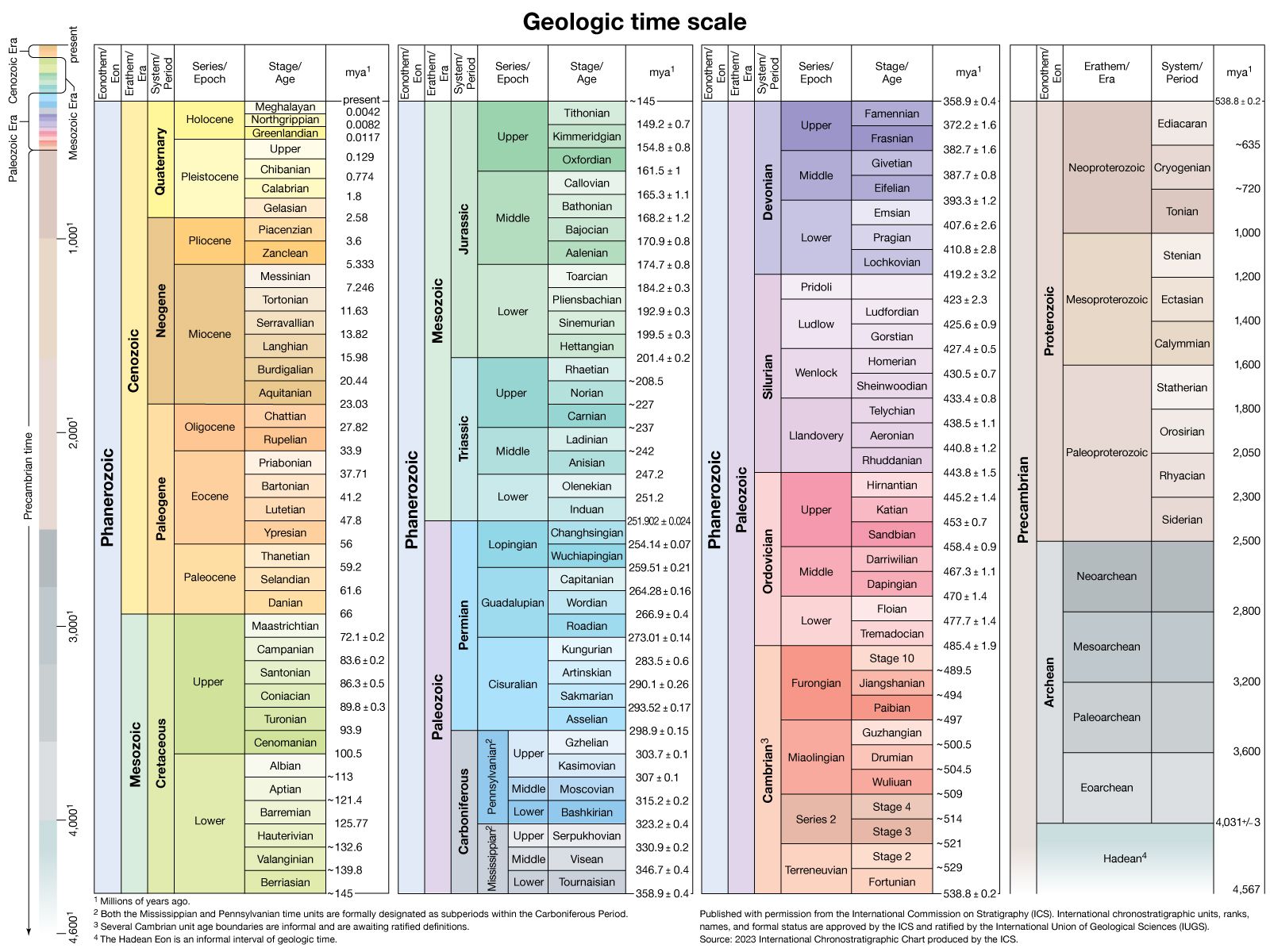
Platycrinites is a genus of extinct crinoids, commonly known as sea lilies. These marine invertebrates are particularly notable as fossils found in Early Carboniferous marine deposits, dating back approximately 359 million to 318 million years ago.1
Physically, Platycrinites were of moderate size and featured a distinct, twisted pattern along their columnar stems, which serves as an unusual identifying characteristic for the genus. Like other crinoids, they belonged to the phylum Echinodermata and possessed a cup-shaped body with flexible, feathery arms used for feeding.12
What are the main differences between sea lilies and feather stars?
While both sea lilies and feather stars belong to the class Crinoidea within the phylum Echinodermata, they are distinguished primarily by their mobility and physical structure.45
The main differences include:
- Attachment: The adult sea lily is permanently fixed to the sea floor by a stalk, which consists of a series of limy disks. In contrast, feather stars lack this stalk entirely.4
- Mobility: Because they are not anchored to the substrate, feather stars are capable of moving from place to place, whereas sea lilies remain stationary.4
- Habitat: Sea lilies are found primarily in deep waters, where they feed on detritus.4
Both groups share a similar body plan, featuring a central body surmounted by frondlike, feathery arms and an internal skeleton composed of close-fitting limy plates.4
How do index fossils help scientists date rock layers?
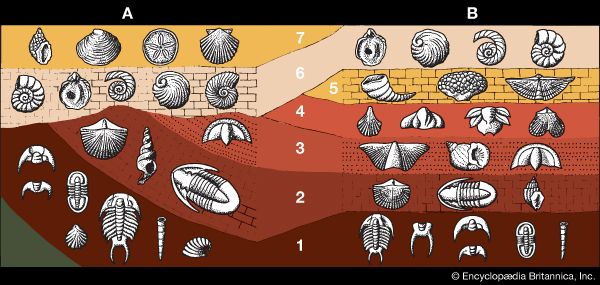
Index fossils are essential tools for geologists to determine the relative age of rock layers and correlate strata across different geographic locations. To be effective, an ideal index fossil must be easily recognizable, abundant, widely distributed, and have a short temporal range—meaning the species existed for only a brief period in geologic time.66
Scientists use these fossils based on the principle of faunal succession, which observes that life-forms have followed a specific, predictable order of evolution throughout Earth’s history. By identifying a unique fossil assemblage within a rock layer, researchers can associate that layer with a specific interval of time. This process, known as biochronology, allows geologists to piece together information from separated outcrops to create a chronological profile of the Earth’s history.67
While physical characteristics of rocks can help with local correlation, index fossils remain a primary method for defining boundaries in the geologic time scale and confirming the relative order of strata, which is frequently validated by radiometric dating.86
What other marine animals belong to the phylum Echinodermata?
In addition to sea lilies and feather stars, the phylum Echinodermata includes several other diverse groups of marine invertebrates. Living representatives are categorized into the following classes:
- Asteroidea: Commonly known as sea stars or starfishes, these animals typically feature broad, hollow arms and tube feet used for movement and feeding.910
- Ophiuroidea: This class includes brittle stars, basket stars, and serpent stars, which are characterized by a distinct central disk and long, slender, flexible arms.910
- Echinoidea: This group encompasses sea urchins, heart urchins, and sand dollars. They are known for their rigid, globular or discoid skeletons (tests) covered in movable spines.911
- Holothuroidea: Known as sea cucumbers, these animals have elongated, cylindrical bodies with a ring of feeding tentacles around the mouth.910
- Concentricycloidea: These are rare, disk-shaped animals commonly referred to as sea daisies, which were only discovered in the 1980s.910
Sources
- Platycrinites — Encyclopædia Britannica
- crinoid — Encyclopædia Britannica
- flatworm - Distinguishing taxonomic features — Encyclopædia Britannica
- sea lily — Encyclopædia Britannica
- echinoderm — Encyclopædia Britannica
- index fossil — Encyclopædia Britannica
- Triassic Period - Correlation of Triassic strata — Encyclopædia Britannica
- dating - Principles and techniques — Encyclopædia Britannica
- echinoderm - Annotated classification — Encyclopædia Britannica
- echinoderm - Critical appraisal — Encyclopædia Britannica
- echinoderm - Size range and diversity of structure — Encyclopædia Britannica
- List of echinoderms — Encyclopædia Britannica
Published on · 3 min read