Brittle Star
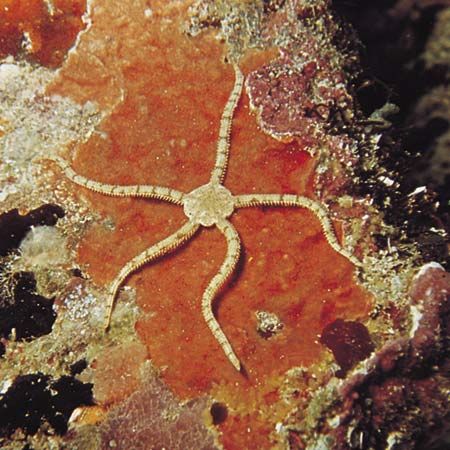
Brittle stars, members of the subclass Ophiuroidea, play a vital role in marine ecosystems by functioning as deposit feeders, scavengers, and plankton…
What role do brittle stars play in marine ecosystems?
Brittle stars, members of the subclass Ophiuroidea, play a vital role in marine ecosystems by functioning as deposit feeders, scavengers, and plankton feeders. By extending their arms into the water column or across the seafloor, they efficiently capture nutrients, which helps cycle organic matter within their habitats.1
These echinoderms are known for forming vast aggregations on the seafloor, particularly in areas with strong currents that transport significant amounts of plankton. These dense groupings are ecologically significant for several reasons:2
- Structural Stability: By using their arms to anchor themselves to one another, they can maintain their position in high-current environments that would otherwise sweep them away.2
- Reproductive Success: Aggregation increases the likelihood of successful propagation for the species.2
- Predator Defense: Living in large groups may provide collective protection against predators.2
Brittle stars occupy a wide range of marine environments, from shallow littoral zones to great depths, often hiding in crevices or under rocks during the day to emerge at night.1
How many species of brittle stars are known to exist?
There are approximately 2,000 to 2,100 known living species of brittle stars, which constitute the subclass Ophiuroidea within the phylum Echinodermata.14
How do brittle stars differ from their close relatives, the sea stars?
While brittle stars and sea stars both belong to the phylum Echinodermata, they are classified into distinct groups—Ophiuroidea and Asteroidea, respectively—and exhibit significant anatomical differences:
- Body Structure: In brittle stars, the central disk is sharply distinct from their long, slender, and solid arms. Conversely, sea stars have an indistinct central disk, and their arms are broad and hollow.146
- Locomotion and Tube Feet: Sea stars possess rows of tube feet in grooves along the underside of their arms, which they use for creeping and clinging. Brittle stars lack these grooves and do not have suctorial (sucker-tipped) tube feet; instead, they move by using their arms to push or pull themselves across the seafloor.614
- Anatomy: Brittle stars lack an anus and specialized pincerlike organs called pedicellariae, both of which are typically present in sea stars.46
- Respiration: Brittle stars respire through interradial gills located on the oral surface of the body, whereas sea stars often respire through skin structures on the aboral (upper) surface.46
How do brittle stars move and feed?
Brittle stars exhibit unique methods for locomotion and feeding, adapted to their life on the seafloor:
Locomotion
Unlike many other echinoderms, brittle stars do not rely on their tube feet for movement. Instead, they move by using their long, flexible arms to push or pull themselves across the seafloor. While they are capable of moving in a jerky fashion, they are more frequently found clinging to the substrate, such as rocks, sponges, or cnidarians like coral, often hiding in crevices during the day and emerging at night.1
Feeding
Brittle stars are primarily scavengers, deposit feeders, and plankton feeders, though they are occasionally capable of trapping larger prey. Their feeding process typically involves:
- Anchoring: They use some of their arms to anchor themselves to the seafloor or other surfaces.1
- Extension: They extend one or more of their remaining arms into the water column or across the mud to capture food particles.1
- Ingestion: Food is processed through the mouth located on the underside of the central disk, which is equipped with five teeth.1
Sources
- brittle star — Encyclopædia Britannica
- brittle star — Merriam-Webster
- echinoderm - Aggregation — Encyclopædia Britannica
- echinoderm - Annotated classification — Encyclopædia Britannica
- skeleton - Skeleton of echinoderms — Encyclopædia Britannica
- sea star — Encyclopædia Britannica
Published on · 3 min read