Blastoid
A blastoid is a member of the extinct class Blastoidea, a group of echinoderms that lived between 472 million and 251 million years ago. Related to modern…
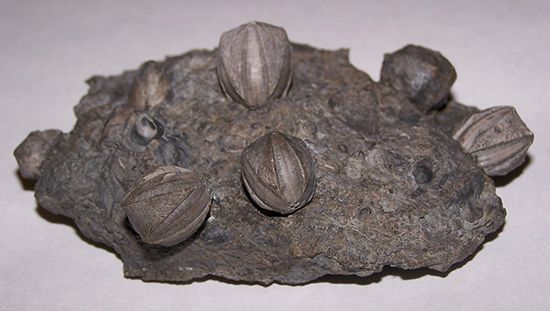
What is blastoid?
A blastoid is a member of the extinct class Blastoidea, a group of echinoderms that lived between 472 million and 251 million years ago. Related to modern starfish and sea lilies, these sedentary animals were anchored to the seafloor by a stemlike column.1
Blastoids are distinguished by their highly regular structure, featuring a body composed of 13 plates of calcium carbonate arranged in three distinct circles. Because of their prevalence and specific time range, certain blastoids, such as the genus Pentremites, serve as important index fossils used by geologists to correlate rock units. The term can also be used as an adjective to describe something relating to or resembling the Blastoidea.12
What are other examples of extinct echinoderms?
Beyond the blastoids, the fossil record contains numerous extinct classes of echinoderms that exhibit diverse body plans, many of which lack the characteristic five-part radial symmetry seen in modern species.3
Notable examples of extinct echinoderm classes include:
- Carpoids (Subphylum Homalozoa): These Middle Cambrian to Middle Devonian organisms are unique for their asymmetrical, flattened bodies and lack of a water-vascular system. Some researchers suggest they may be related to primitive chordates.34
- Edrioasteroids (Class Edrioasteroidea): These were small, disk-shaped or cylindrical organisms that lived from the Lower Cambrian to the Lower Carboniferous. They are characterized by five food grooves radiating from a central mouth.35
- Cystoids (e.g., Class Rhombifera and Class Diploporita): These groups typically featured globular bodies with specialized respiratory structures, such as rhomboid folds or pairs of pores, used for gas exchange.36
- Eocrinoids (Class Eocrinoidea): Often considered early stalked echinoderms, they possessed a theca (chamber) and feeding appendages known as brachioles.3
- Helicoplacoids (Class Helicoplacoidea): Found in the Lower Cambrian, these organisms had a distinct pear-shaped or spindle-shaped body covered in plates arranged in a spiral pattern.3
How do scientists use index fossils to date rock layers?
Scientists use index fossils to date rock layers by relying on the law of faunal succession, which observes that fossilized plants and animals appear in the rock record in a predictable, nonrepetitive order over time.89
To be effective for dating and correlation, an index fossil must meet several criteria:
- Short temporal range: The species must have existed for a relatively brief period, ensuring that its presence in a rock layer pinpoints a specific interval of geologic time.810
- Wide geographic distribution: The organism should be cosmopolitan, allowing geologists to match strata across different regions.810
- Abundance and distinctiveness: The fossil should be easy to identify and common enough that finding it is highly probable.810
By identifying these specific fossils within sedimentary layers, geologists can determine the relative age of the rock. This method serves as a fundamental tool in stratigraphy and has been consistently validated by modern radiometric dating techniques.910
What are the main characteristics of modern echinoderms like starfish?
Modern echinoderms, such as starfishes, are marine invertebrates defined by several distinct biological characteristics:
- Symmetry: While they exhibit bilateral symmetry during their larval stages, adults are characterized by a conspicuous pentamerous (five-rayed) radial symmetry.1112
- Water-Vascular System: This unique system of fluid-filled canals is derived from the coelom. It powers tube feet, which are used for locomotion, feeding, respiration, and sensory perception.1312
- Skeleton: Most echinoderms possess a dermal skeleton composed of calcium carbonate (calcite) plates called ossicles. In starfishes, these ossicles are held together by muscles and ligaments, allowing for flexibility.1214
- Regeneration: These animals have a highly developed ability to regenerate lost body parts. Many starfishes can regrow entire arms, and if a portion of the central disk remains attached to an arm, a new individual can regenerate.15
- Habitat: Because their coelomic fluid maintains the same osmotic pressure as seawater, they are restricted to wholly marine environments.13
Sources
- blastoid — Encyclopædia Britannica
- blastoid — Merriam-Webster
- echinoderm - Annotated classification — Encyclopædia Britannica
- List of echinoderms — Encyclopædia Britannica
- edrioasteroid — Merriam-Webster
- Edrioasteroidea — Merriam-Webster
- carpoid — Encyclopædia Britannica
- index fossil — Encyclopædia Britannica
- law of faunal succession — Encyclopædia Britannica
- dating - Principles and techniques — Encyclopædia Britannica
- echinoderm - Asexual reproduction — Encyclopædia Britannica
- echinoderm - Symmetry and body form — Encyclopædia Britannica
- echinoderm — Encyclopædia Britannica
- Circulatory system - Echinodermata — Encyclopædia Britannica
- echinoderm - General features — Encyclopædia Britannica
- echinoderm - Skeleton — Encyclopædia Britannica
Published on · 3 min read