Carpoid
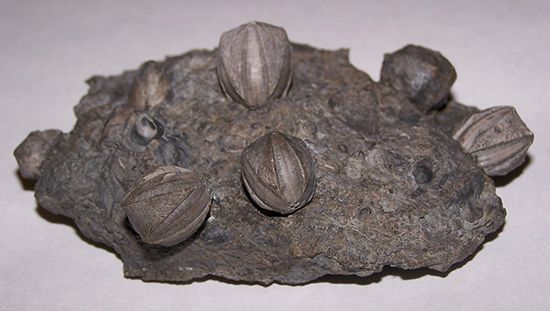
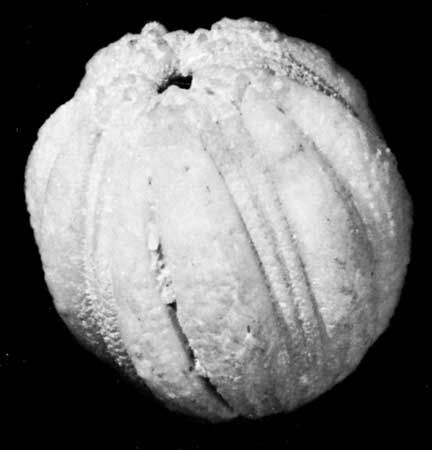
A carpoid is a member of an extinct group of unusual echinoderms that lived from the Middle Cambrian to the Early Devonian period.
What is carpoid?
A carpoid is a member of an extinct group of unusual echinoderms that lived from the Middle Cambrian to the Early Devonian period.1
It is important to clarify that the term “carpoid” refers to these ancient fossils and should not be confused with Carpiodes, which is a genus of freshwater fish known as carpsuckers. Unlike modern echinoderms, such as starfish or sea urchins, carpoids lack radial symmetry and a water-vascular system. They are characterized by flat bodies, a system of calcitic plates, and stemlike or armlike appendages. Because some species appear to possess gill slits—a trait typically associated with primitive chordates—scientists have explored the possibility that carpoids may be related to early vertebrates or represent an ancestral link to more advanced echinoderms.21
How do carpoids differ from modern echinoderms like starfish?
Carpoids differ significantly from modern echinoderms, such as starfish, in their fundamental body structure and organization. While most modern echinoderms are characterized by five-part (pentamerous) radial symmetry, carpoids lack this symmetry entirely, possessing a fundamentally asymmetrical and flattened body.13
Key differences include:
- Symmetry and Body Plan: Modern echinoderms exhibit radial symmetry, whereas carpoids are known for their flat, asymmetrical forms.13
- Water-Vascular System: A defining feature of modern echinoderms is the water-vascular system, a complex hydraulic network used for locomotion, feeding, and respiration. Carpoids do not appear to have possessed this system.41
- Anatomical Features: Carpoids often feature stemlike or armlike appendages and a system of calcitic plates. Some species exhibit gill slits, a trait typically associated with primitive chordates, leading some researchers to theorize that they may be related to early vertebrates or represent an ancestral link to more advanced echinoderms.15
What are the key characteristics of primitive chordates?
Primitive chordates are defined by a specific set of anatomical features that appear at some stage in their life cycle, often serving as the foundation for the more complex body plans seen in vertebrates.7
The key characteristics of chordates include:
- Notochord: A stiff, flexible, rodlike supporting structure derived from mesodermal cells that runs along the dorsal side of the body.78
- Dorsal Nerve Cord: A hollow nerve cord located above (dorsal to) the gut, which serves as the precursor to the central nervous system.79
- Pharyngeal Gill Slits: Openings in the pharynx that lead to the exterior, used for respiration or filter feeding.710
- Post-anal Tail: A muscular tail that extends beyond and above the anus.710
- Endostyle: A mucus-secreting structure located between the gill slits, which is involved in feeding.7
These organisms are classified as deuterostomes, meaning their mouth forms separately from the anus during embryonic development. While some features, such as the notochord, may disappear or be modified as an organism matures into an adult, they remain essential markers of the phylum Chordata.1197
Why is the lack of radial symmetry significant in paleontology?
In paleontology, the lack of radial symmetry is significant because it highlights the immense diversity of early body plans and provides critical clues regarding the evolutionary origins of major animal groups. While modern echinoderms are defined by their pentamerous (five-part) radial symmetry, many early, extinct forms—such as the carpoids—exhibited asymmetrical or bilateral body plans.14151
The significance of this lack of radial symmetry includes:
- Evolutionary Experimentation: The presence of bizarre, non-radial forms in the fossil record suggests that early echinoderms were “experimenting” with various body shapes and feeding mechanisms before radial symmetry became the dominant, successful strategy for the phylum.14
- Ancestral Links: Because some asymmetrical fossils, like carpoids, possess features such as gill slits, they serve as potential evolutionary links between primitive chordates and more advanced echinoderms.1
- Developmental Insights: The transition from bilateral to radial symmetry is a key area of study. Understanding why certain groups abandoned bilateral symmetry in favor of radial patterns helps paleontologists map the development of organ systems, such as the water-vascular system, which became central to echinoderm success.15
Sources
- carpoid — Encyclopædia Britannica
- Carpiodes — Merriam-Webster
- echinoderm - Annotated classification — Encyclopædia Britannica
- echinoderm - Critical appraisal — Encyclopædia Britannica
- List of echinoderms — Encyclopædia Britannica
- echinoderm - Water-vascular system — Encyclopædia Britannica
- Chordate — Encyclopædia Britannica
- Animal development - Differentiation of the germinal layers — Encyclopædia Britannica
- Chordate - External features — Encyclopædia Britannica
- cephalochordate - Evolution and paleontology — Encyclopædia Britannica
- notochord — Encyclopædia Britannica
- Chordate - Evolution and paleontology — Encyclopædia Britannica
- Chordate - General features — Encyclopædia Britannica
- echinoderm - Extinct echinoderms — Encyclopædia Britannica
- echinoderm - Symmetry and body form — Encyclopædia Britannica
- evolution - Evolution and development — Encyclopædia Britannica
- holostean - Distinguishing taxonomic features — Encyclopædia Britannica
Published on · 3 min read