Calotes
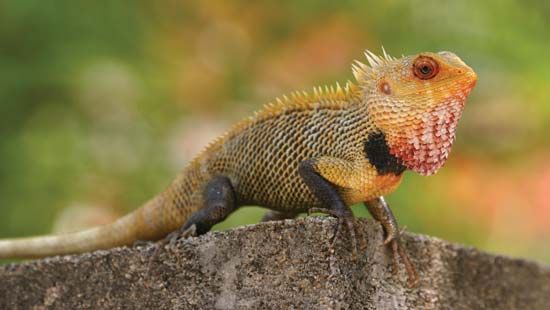
The provided information does not contain details regarding the depiction of Calotes lizards in local cultures or folklore. While the genus is commonly…
How have Calotes lizards been depicted in local cultures and folklore where they are found?
The provided information does not contain details regarding the depiction of Calotes lizards in local cultures or folklore. While the genus is commonly referred to as “garden lizards” and “bloodsuckers”—the latter due to the red coloration males display during courtship or territorial combat—these names are descriptive of their biological behavior rather than cultural or folkloric representations.1
What is the diet and feeding behavior of Calotes lizards?
Calotes lizards, which belong to the family Agamidae, are primarily insectivorous lizards that feed on a variety of insects and other small invertebrates.2
As members of the iguanian group, Calotes typically employ a “sit-and-wait” predatory strategy. They are known to perch motionless at familiar sites within their forest or garden habitats, waiting for prey to come within range. Once prey is detected using visual cues, the lizard dashes from its perch to capture the item using its tongue, a method known as lingual prehension. Because they are insectivorous, these lizards obtain a significant portion of their necessary water intake directly from the prey they consume.123
Are there any Calotes species that are considered endangered or threatened?
The provided information does not contain data regarding the conservation status of specific Calotes species. While the genus includes approximately 21 recognized species found across India, Sri Lanka, and Southeast Asia, the current Britannica knowledge base does not specify which, if any, are considered endangered or threatened.1
Where are Calotes lizards typically found in the wild?
Calotes lizards are primarily arboreal creatures, meaning they are adapted for a life spent in trees. In the wild, they are typically found inhabiting forests and gardens.
Their geographic range spans across India, Sri Lanka, Southeast Asia, and various Pacific islands. Because they possess long limbs, they are well-suited for navigating vertical surfaces, such as tree trunks, within these environments.1
Sources
- Calotes — Encyclopædia Britannica
- lizard - Feeding habits — Encyclopædia Britannica
- lizard - Water loss and other variables — Encyclopædia Britannica
Published on · 1 min read