Agamidae
Agamidae is a diverse family of the order Squamata, comprising approximately 350 species across 50 genera of lizards. These reptiles are characterized by…
What is Agamidae?
Agamidae is a diverse family of the order Squamata, comprising approximately 350 species across 50 genera of lizards1. These reptiles are characterized by their scaly bodies, well-developed legs, and moderately long tails, though their physical dimensions vary significantly across the family.1
Agamids are primarily found in Australia, Africa, and southern Asia, where they occupy a wide range of habitats, including deserts, steppes, and both mountain and tropical rainforests. They exhibit diverse lifestyles, with species that are either ground-dwelling or arboreal. Notable members of this family include the agama, the frilled lizard, the flying lizard, and the moloch.1
How do flying lizards use their skin flaps to glide?
Flying lizards of the genus Draco are expert gliders that utilize specialized skin membranes to navigate between trees in the forests of Southeast Asia and the East Indies.34
These “wings” are not independent limbs but are instead supported by five or six elongated ribs that extend laterally from the body. When the lizard is at rest, these ribs and the attached membranes remain folded against its sides. To initiate a glide, the lizard jumps into the air and spreads its ribs outward like a fan, which unfolds the membranes into broad, semicircular surfaces.345
By increasing its surface area, the lizard creates wind resistance that allows it to drift downward. A low-angle glide can carry the animal up to 50 meters (about 160 feet). Just before reaching a new perch, the lizard turns upward sharply to slow its momentum before landing.453
What makes the frilled lizard’s display unique?
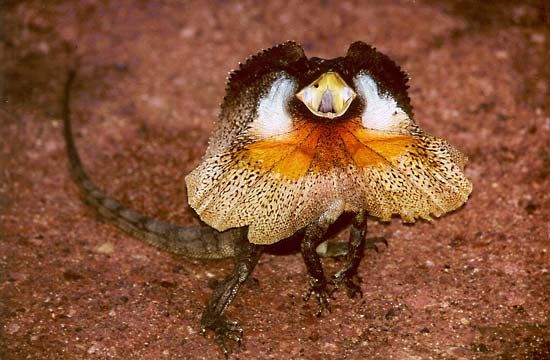
The frilled lizard (Chlamydosaurus kingii) possesses a unique defensive display centered on a large, scaly membrane surrounding its neck. Under normal conditions, this structure rests like a cape over the lizard’s shoulders.6
When the lizard feels threatened or irritated, it rapidly extends this frill perpendicular to its body. Because the frill can be nearly as wide as the lizard is long, this sudden expansion makes the animal appear several times its normal size, effectively surprising and intimidating potential predators or intruders. This dramatic visual display is a specialized strategy used to defend its territory.67
Beyond this display, the frilled lizard is also known for its remarkable ability to run bipedally, standing up on its hind legs with its forelegs and tail held in the air.6
How do agamid lizards adapt to living in desert environments?
Agamid lizards, which include species like the agama and the moloch, have evolved several physiological and behavioral adaptations to thrive in harsh desert environments.910
Thermoregulation
Because they are ectothermic, agamid lizards rely on behavioral thermoregulation to manage their body temperatures. In hot deserts, they often adjust their activity periods to avoid extreme heat, sometimes occupying microhabitats that remain cooler than the surrounding environment. By basking in the sun, they can raise their body temperature to an optimal range for metabolic performance, though they must balance this with the risk of predation while exposed.111
Water Conservation
Agamids are well-equipped for arid conditions due to their efficient waste excretion. Like other reptiles, they excrete uric acid, which requires very little water compared to the waste products of mammals. Furthermore, their low metabolic rates allow them to consume less water overall. Some desert-dwelling lizards can even harvest moisture from dew that collects on their skin during the early morning hours.2
Sources
- Agamidae — Encyclopædia Britannica
- agama — Encyclopædia Britannica
- reptile - Flying — Encyclopædia Britannica
- Draco — Encyclopædia Britannica
- Locomotion - Gliding — Encyclopædia Britannica
- frilled lizard — Encyclopædia Britannica
- frilled lizard — Merriam-Webster
- lizard - Defensive strategies — Encyclopædia Britannica
- lizard - Water loss and other variables — Encyclopædia Britannica
- lizard - Thermoregulation — Encyclopædia Britannica
- reptile - Thermal relationships — Encyclopædia Britannica
- lizard - Locomotion and limb adaptations — Encyclopædia Britannica
Published on · 3 min read