Camellia
The genus Camellia consists of approximately 250 species of evergreen shrubs and trees within the tea family. While many are valued for their aesthetic…
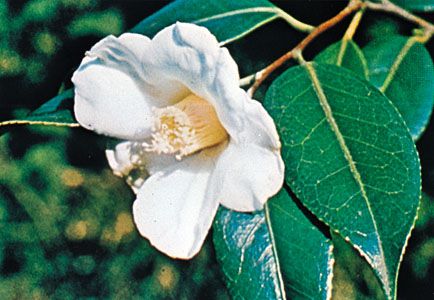
What are some of the most popular species of Camellia and their uses?
The genus Camellia consists of approximately 250 species of evergreen shrubs and trees within the tea family. While many are valued for their aesthetic appeal, others hold significant economic importance.1
Popular Species and Their Uses
- Camellia sinensis: This is the most economically significant species, as it is the primary source of tea. Cultivators typically prune these plants into low, mounded shrubs to encourage the growth of young leaves and buds, which are then harvested and processed to create the beverage.12
- Camellia japonica: Often referred to as the common camellia, this species is widely cultivated as an ornamental plant. It is prized for its glossy, oval leaves and roselike flowers, which appear in a variety of colors ranging from white to pink and red.13
- Camellia sasanqua: This species is a loose, straggling shrub known for its slightly fragrant autumn blooms. It is frequently utilized in landscaping as a wall or hedge plant due to its ability to tolerate alkaline soils and dry conditions.1
- Camellia reticulata: Similar in appearance to C. japonica but generally shorter, this species is noted for its large flowers, which can reach up to 15 cm (6 inches) in width.1
How are Camellias used in the production of tea, and which species are most commonly used?
The production of tea is derived exclusively from the species Camellia sinensis. While the genus Camellia includes approximately 250 species, only this specific plant is cultivated for the beverage.12
Primary Varieties Used
Commercial tea production relies on two principal varieties of C. sinensis, along with their hybrids:42
- China plant (C. sinensis variety sinensis): A hardy, small-leaved, multi-stemmed bush capable of withstanding cold winters. It is frequently used to produce green tea and certain oolong varieties.425
- Assam plant (C. sinensis variety assamica): A large-leaved, single-stem tree that thrives in warmer climates. It is the preferred variety for producing black tea.425
- Cambodia variety (C. sinensis variety cambodiensis): A third, less commonly cultivated variety.2
Production Process
To produce tea, growers maintain the plants as low, mounded shrubs through frequent pruning, which encourages the development of young shoots. The harvest, or “plucking,” typically consists of the terminal bud and the two youngest leaves.12
The manufacturing process determines the final classification of the tea:
- Green tea (unfermented): The leaves are steamed or roasted to inactivate enzymes, preventing oxidation and preserving the green color.65
- Black tea (fermented): The leaves undergo oxidation, which turns them a copper or red color and creates a more astringent flavor profile.5
- Oolong/Pouchong (semifermented): These are processed to achieve a middle ground between green and black teas, often resulting in unique flavor profiles.5
How many species are there in the Camellia genus, and where are they primarily found?
The Camellia genus comprises approximately 120 to 250 species of evergreen shrubs and trees belonging to the tea family.17
These plants are primarily native to and found throughout East Asia, with their distribution extending from Southeast Asia to the Indo-Malesia region. While the genus is most famous for its ornamental flowering species and Camellia sinensis—the source of tea—the plants are widely cultivated globally for their aesthetic value and the production of oils used in cooking, soap, and cosmetics.17
How is tea processed from the leaves of Camellia sinensis?
The processing of tea from Camellia sinensis leaves involves several stages, including withering, rolling, fermentation, and drying, designed to dry the leaf and develop its characteristic quality. The manufacturing process is the primary method of classifying tea into three categories: fermented (black), unfermented (green), and semifermented (oolong).84
Black Tea (Fermented)
Black tea undergoes all manufacturing stages. During rolling, leaf cells are broken, initiating a series of chemical reactions often called fermentation. This process requires oxygen and is controlled by temperature and humidity. The enzyme polyphenol oxidase oxidizes tannins (polyphenols) into theaflavins and thearubigins, which provide the tea’s characteristic copper color, strength, and astringency.86
Green Tea (Unfermented)
To produce green tea, the oxidizing enzymes are inactivated immediately by steaming or roasting the leaves. This prevents the oxidation of polyphenols, allowing the leaves to retain their green color. The leaves are then rolled and heated until they reach a moisture content of 3 to 4 percent.9
Oolong (Semifermented)
Oolong tea is produced through variations in the fermentation stage, resulting in a profile between green and black teas.84
Sources
- Camellia — Encyclopædia Britannica
- tea — Encyclopædia Britannica
- camellia — Merriam-Webster
- tea - Green tea — Encyclopædia Britannica
- Tea plant — Encyclopædia Britannica
- tea - Classification of teas — Encyclopædia Britannica
- Ericales - Theaceae — Encyclopædia Britannica
- tea - Processing the leaf — Encyclopædia Britannica
- tea - Fermentation — Encyclopædia Britannica
Published on · 3 min read