Dutchman’s Breeches
Dutchman’s breeches (Dicentra cucullaria) is a herbaceous plant belonging to the poppy family (Papaveraceae). It is native to open woodlands throughout…
What is Dutchman’s breeches?
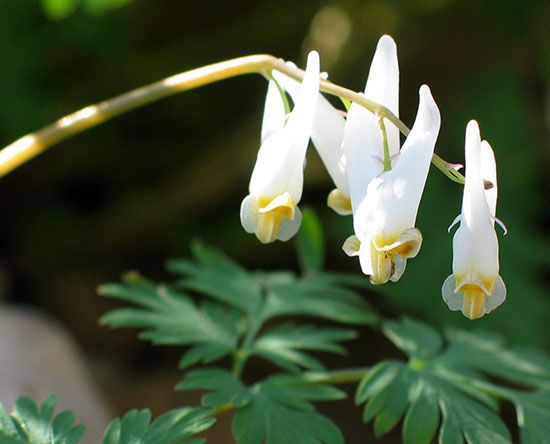
Dutchman’s breeches (Dicentra cucullaria) is a herbaceous plant belonging to the poppy family (Papaveraceae). It is native to open woodlands throughout eastern and midwestern North America.12
The plant is named for its distinctive, tremulous white flowers with yellow tips, which fancifully resemble the wide-legged, traditional pantaloons worn by Dutch men. These flowers are double-spurred and bilaterally symmetrical. The plant features finely divided, trifoliate leaves that grow from white underground tubers.132
As a member of the genus Dicentra, it is a popular garden ornamental that thrives best in shady, wind-free locations. Its foliage typically dies back after the fruits have ripened.12
What is the difference between Dutchman’s breeches and bleeding hearts?
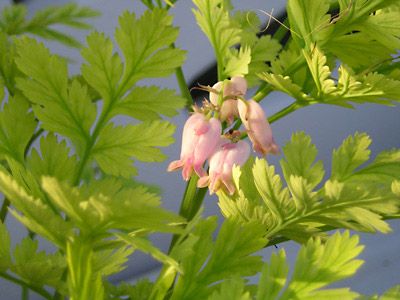
While both Dutchman’s breeches and bleeding hearts belong to the poppy family, they are distinct plants with unique floral characteristics and classifications.
Key Differences
- Classification: Dutchman’s breeches (Dicentra cucullaria) is a member of the genus Dicentra. While some species of bleeding heart are also in the genus Dicentra (such as D. eximia and D. formosa), the most famous “bleeding heart” is the Asian bleeding heart, which has been reclassified as Lamprocapnos spectabilis.45
- Floral Appearance: The flowers of Dutchman’s breeches are named for their resemblance to white, wide-legged pantaloons. In contrast, bleeding hearts are named for their distinct heart-shaped flowers, which often feature a “drip” of petal at the bottom, giving the appearance of a bleeding heart.43
- Growth and Distribution: Dutchman’s breeches are native to woodlands throughout eastern and midwestern North America. Bleeding hearts have a broader range, with various species native to both North America and eastern Asia.4
Both plants are popular shade-garden ornamentals, though it is important to note that all parts of the bleeding heart are considered poisonous if ingested.4
How do ants help disperse the seeds of Dicentra plants?
Ants assist in the dispersal of seeds for many specialized plants, a process known as myrmecochory. While some harvester ants are destructive and consume seeds entirely, other species—such as those in the genera Lasius, Myrmica, and Formica—act as beneficial dispersal agents.67
These ants are attracted to a fleshy, edible appendage on the seed called an elaiosome, which is rich in nutrients like fatty acids. The ants carry the seeds back to their nests to feed on this appendage, effectively transporting the seeds away from the parent plant and depositing them in nutrient-rich environments suitable for germination.67
Although the provided search results do not explicitly detail the mechanism for Dicentra specifically, the genus is closely related to other myrmecochorous spring flora, such as corydalis and bloodroot, which rely on this mutualistic relationship to ensure the survival and spread of their progeny.67
What are some other common spring-flowering woodland plants?
In deciduous forests, the period before the tree canopy fully develops is critical for spring ephemerals and other wildflowers. These plants take advantage of the abundant sunlight reaching the forest floor to grow and bloom before the trees come into full leaf.9
One notable example is bloodroot (Sanguinaria canadensis), a member of the poppy family. It is well-known for its white flowers and its distinct red root and sap, which have historically been utilized for their medicinal properties.10
While the provided search results highlight bloodroot specifically, many other herbaceous plants thrive in this niche. These species are adapted to complete their life cycles rapidly during the brief window of high light availability in early spring.9
Sources
- Dutchman’s breeches — Encyclopædia Britannica
- Dutchman's-breeches — Merriam-Webster
- Dicentra — Encyclopædia Britannica
- bleeding heart — Encyclopædia Britannica
- 7 Especially Fitting Common Names for Plants | Bleeding Heart — Merriam-Webster
- seed dispersal - Ants — Encyclopædia Britannica
- seed - Dispersal by ants — Encyclopædia Britannica
- seed dispersal — Encyclopædia Britannica
- 12 Words for Signs of Spring | Bloodroot — Merriam-Webster
- Deciduous forest — Encyclopædia Britannica
Published on · 3 min read