Canaan Dog
The Canaan dog is a breed developed in the 20th century from semiwild pariah dogs that have inhabited the Middle East since biblical times. While these…
What role did Canaan dogs play in ancient times in the Middle East?
The Canaan dog is a breed developed in the 20th century from semiwild pariah dogs that have inhabited the Middle East since biblical times. While these animals were historically utilized by ancient populations as guardians and hunting dogs, many eventually reverted to a wild state, living in desert regions for centuries before modern redomestication efforts began in the 1930s.1
More broadly, dogs have served as essential partners in human societies for millennia. In ancient civilizations across the Middle East, dogs were frequently depicted in art and archaeological findings as hunting allies and protectors. Following the domestication of livestock roughly 7,000 to 9,000 years ago, dogs also became vital for herding and guarding sheep, goats, and cattle. These early roles established a foundational relationship between humans and canines that persists in various working capacities today.21
How has the Canaan dog breed contributed to or been recognized by major kennel clubs?
The Canaan dog was developed in Israel during the 20th century through a systematic breeding program that began in the 1930s to redomesticate semiwild pariah dogs. While the provided search results do not explicitly detail the specific recognition status of the Canaan dog by major organizations like the American Kennel Club or the Kennel Club of England, they confirm that national registries maintain pedigrees and stud books for purebred dogs worldwide.12
The breed’s development was formalized in 1949 when the Institute for Orientation and Mobility of the Blind assumed responsibility for its breeding, utilizing a stock of approximately 150 kennel-raised dogs. These dogs have since been recognized for their versatility, having been trained for roles such as herding, guarding, tracking, and serving as guide dogs. Because the global population of the breed is relatively small—estimated at 2,000 to 3,000 individuals—experts emphasize the importance of maintaining genetic diversity to prevent the development of degenerative diseases.14
What are the origins and history of the Canaan dog breed?
The Canaan dog is a breed established in Israel during the 20th century. Its origins trace back to semiwild “pariah” dogs that inhabited the Middle East since biblical times. While these dogs were historically used by ancient populations for hunting and guarding, many eventually reverted to a wild state and lived in desert regions for centuries.1
In the 1930s, a dedicated breeding program was initiated to redomesticate these animals, primarily to serve as guards for isolated kibbutzim. During wartime, the breed proved highly capable, serving as messengers, sentries, and land mine detectors. In 1949, the Institute for Orientation and Mobility of the Blind assumed responsibility for the breed, establishing a foundation stock of approximately 150 kennel-raised dogs. Today, the Canaan dog is recognized for its intelligence and versatility, performing roles in herding, tracking, and as guide dogs for the blind.1
What are the physical characteristics and appearance of Canaan dogs?
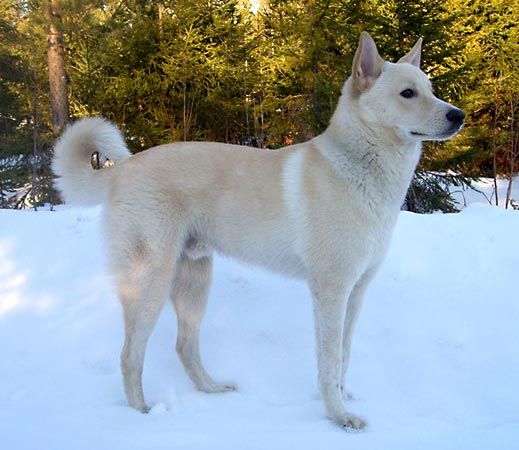
The Canaan dog is a medium-sized, square-bodied breed characterized by a hardy and athletic build. These dogs typically stand between 19 and 24 inches (48 to 61 cm) tall and weigh between 35 and 55 pounds (16 to 25 kg).12
Key physical features include:
- Head and Ears: They possess a distinct wedge-shaped head and upright ears.1
- Coat: The breed features a short, straight, and harsh double coat.12
- Coloration: Coats may be solid black or various shades of brown, often with white markings. Alternatively, they may be white with large patches of brown, black, or red, frequently featuring a mask or hood of a contrasting color.1
- Tail: They have a bushy tail that typically curls over the back.12
These physical traits reflect their origins as descendants of semiwild pariah dogs, resulting in a functional, agile appearance suited for their historical roles as guardians and working dogs.12
Sources
- Canaan dog — Encyclopædia Britannica
- Canaan dog — Merriam-Webster
- dog - Role in human societies — Encyclopædia Britannica
- dog - The breeds — Encyclopædia Britannica
Published on · 3 min read