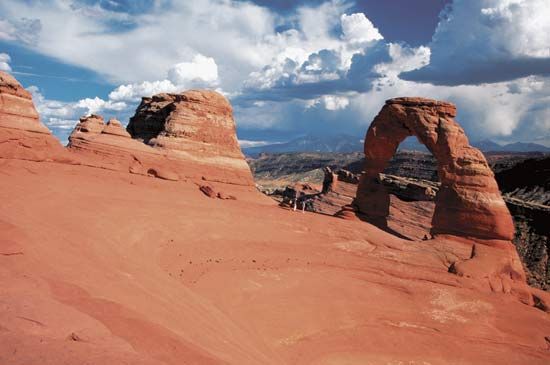
Canyonlands National Park
The landscape of Canyonlands National Park is primarily defined by the erosive power of the Colorado River and its major tributary, the Green…
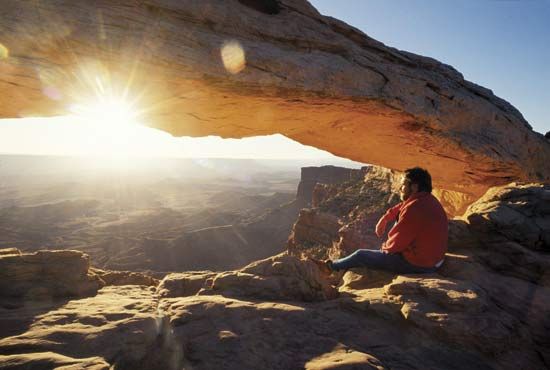
How did the Colorado River and its tributaries shape the landscape of Canyonlands National Park?
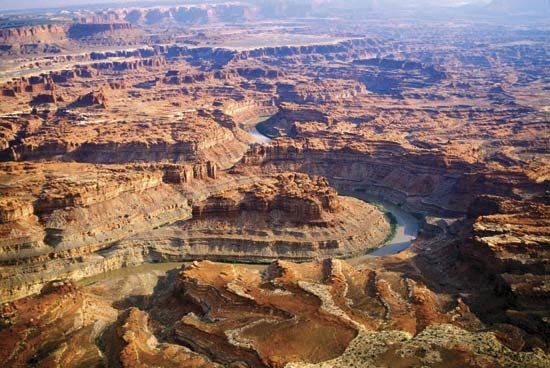
The landscape of Canyonlands National Park is primarily defined by the erosive power of the Colorado River and its major tributary, the Green River](https://www.britannica.com/place/Green-River-Wyoming-Colorado-Utah). These rivers have carved deep, winding canyons into the horizontal layers of sandstone that characterize the region.41
The rivers serve as the primary agents of landscape evolution in the park, creating the deep valleys in which they flow. At the park’s southern tip, the confluence of the Green and Colorado rivers acts as a focal point for this geological activity. Following their junction, the Colorado River continues to carve the 14-mile-long Cataract Canyon, a site known for its intense white-water rapids.21
Beyond the direct incision of the river channels, the park’s dramatic topography—including mesas, buttes, and spires—is the result of ongoing weathering and erosion. The semiarid climate and the river’s ability to transport sediment are essential to maintaining these features, as they prevent the landscape from being leveled by slope wash.3145
What types of plants and animals can be found in Canyonlands National Park?
The wildlife and vegetation within Canyonlands National Park are adapted to its arid environment.
Animal Life
Wildlife in the park is relatively limited due to the harsh desert conditions. Commonly observed animals include:
- Bighorn sheep
- Coyotes
- Foxes
- Deer
- Various species of lizards5
Plant Life
Vegetation is most abundant in areas with access to moisture, particularly along riverbanks. Common plants found in these wetter zones include:
- Cottonwoods
- Willows
- Tamarisks, which are considered an invasive species in many desert riparian areas57
Additionally, the park experiences a bloom of wildflowers during the spring season.5
What are the main geological features that make Canyonlands National Park unique?
Canyonlands National Park is defined by its dramatic, water-eroded sandstone landscape. Its unique geological features are categorized by the park’s distinct sections:
- Island in the Sky: A massive, level mesa situated 6,000 feet above sea level. It features the “White Rim,” a continuous terrace located 1,200 feet below the mesa top, and the Upheaval Dome, a deep, sheer-walled crater likely formed by a salt dome or meteorite impact.5
- The Needles: Named for its massive red- and white-banded rock pinnacles. This area also contains “grabens”—elongated fault blocks that have created deep, narrow canyons—and gigantic balanced rock formations like the Druid and Angel arches.5
- The Maze: A remote, complex jumble of sheer-walled canyons that twist and divide, reaching depths of 600 feet.5
- River Confluence: The park surrounds the meeting point of the Green and Colorado rivers, which have carved deep, winding canyons throughout the region, including the white-water rapids of Cataract Canyon.5
Where is Canyonlands National Park located, and when was it established?
Canyonlands National Park is located in southeastern Utah, United States, situated just southwest of Moab and Arches National Park. The park was established in 1964 and encompasses 527 square miles of desert wilderness surrounding the confluence of the Green and Colorado rivers.5
Sources
- How was the Grand Canyon formed? — Encyclopædia Britannica
- Rocky Mountains - Physiography — Encyclopædia Britannica
- Grand Canyon - Geologic history — Encyclopædia Britannica
- Green River — Encyclopædia Britannica
- Canyonlands National Park — Encyclopædia Britannica
- river - Valleys and canyons — Encyclopædia Britannica
- Grand Canyon - Biological past and present — Encyclopædia Britannica
- Canyonlands National Park — Merriam-Webster
Published on · 2 min read