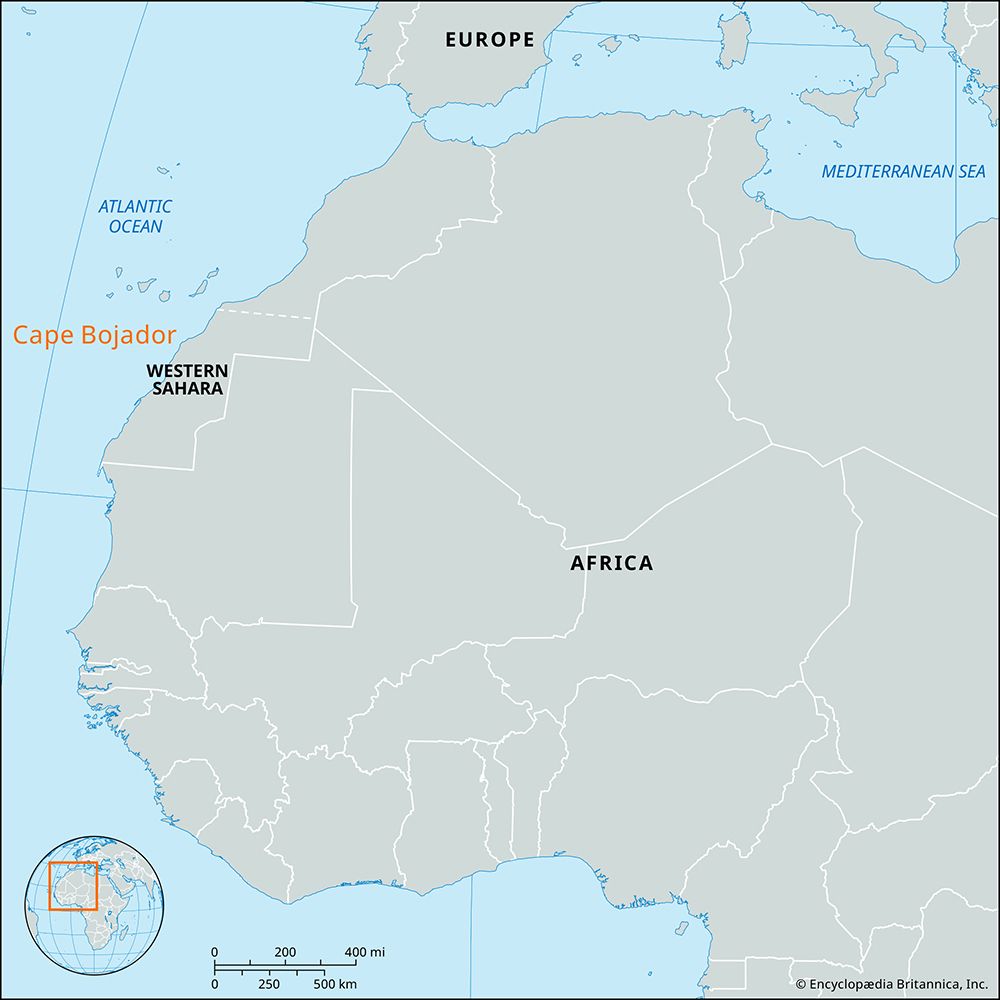
Cape Bojador
The first European explorer to successfully round Cape Bojador was the Portuguese navigator Gil Eanes, who achieved this feat in 1434.
Who was the first European explorer to successfully round Cape Bojador, and when did this occur?
The first European explorer to successfully round Cape Bojador was the Portuguese navigator Gil Eanes, who achieved this feat in 1434.12
Prior to this voyage, the cape was known to early European navigators as “the point of no return” due to the dangerous, reef-lined nature of the coast, which earned it the Arabic name Abū Khaḍar, meaning “the father of danger”. Eanes’s successful passage marked a significant milestone in the Portuguese exploration of the African coast, which was sponsored by Prince Henry the Navigator as part of a broader effort to expand trade and influence.213
What role did Cape Bojador play in the Age of Discovery?
During the Age of Discovery, Cape Bojador served as a critical psychological and navigational barrier for European explorers. Known to early mariners as the “point of no return” due to its dangerous, reef-lined coastline and the Arabic name Abū Khaḍar (“the father of danger”), it represented the southern limit of known exploration for years.4
The cape’s successful passage by the Portuguese navigator Gil Eanes in 1434 was a pivotal moment in the Age of Discovery. This achievement effectively shattered the myth of the cape’s impassability, opening the way for further Portuguese exploration along the African coast. Following this breakthrough, the region became a focal point for Portuguese maritime expansion, which was driven by the desire to explore, spread the Christian faith, and eventually secure a route to the spice trade of the Indies. Unfortunately, the region was also subsequently exploited by the Portuguese, particularly for the trafficking of enslaved Africans.24
How has the historical importance of Cape Bojador been commemorated or remembered in modern times?
In modern times, the historical significance of Cape Bojador is primarily marked by its physical infrastructure and its status as a site of geopolitical contention rather than through formal commemorative monuments.
Following the withdrawal of Spain from the region in 1976, Morocco assumed control and established the cape as the capital of the province of Boujdour. Modern developments at the site include the construction of a desalination plant and barracks for a military garrison, which serve the contemporary needs of the settlement. Additionally, a lighthouse was erected on the cape in the early 20th century to assist with maritime navigation, and a paved road now connects the area to Laayoune to the north.
While the cape remains a landmark of the Age of Discovery due to the 1434 voyage of Gil Eanes, its current identity is deeply tied to the ongoing territorial disputes involving the Polisario Front and the administration of Western Sahara.3
How did the myths and legends surrounding Cape Bojador affect early exploration attempts?
Myths and legends surrounding Cape Bojador acted as a significant psychological barrier that deterred early European exploration along the West African coast for years. Mariners often referred to the cape as “the point of no return,” fearing the dangerous, reef-lined waters and the unknown conditions beyond it, which were captured in its Arabic name, Abū Khaḍar (“the father of danger”).3
This superstition suggested that the cape was impassable, effectively halting southward progress until the Portuguese navigator Gil Eanes successfully rounded it in 1434. While historical tradition emphasizes this event as a triumph over deep-seated fears, some historians suggest that the “myth” of its impassability may have been an exaggeration resulting from vague sailing directions in early records; it is possible that earlier navigators had already passed the cape, perhaps mistaking it for Cape Juby. Regardless of the legend’s accuracy, the perceived danger served as a formidable obstacle that required a shift in maritime confidence and technology to overcome, ultimately clearing the path for further expansion into the Atlantic.37
Sources
- Portugal - Conquest and exploration — Encyclopædia Britannica
- history of Portugal - Conquest and exploration — Encyclopædia Britannica
- Cape Bojador — Encyclopædia Britannica
- Henry the Navigator - Final maritime ventures of Henry the Navigator — Encyclopædia Britannica
- Portugal - Cultural life — Encyclopædia Britannica
- Portuguese literature - The literature of discovery and conquest — Encyclopædia Britannica
- Henry the Navigator - Sponsorship of expeditions — Encyclopædia Britannica
Published on · 3 min read