Guinea
The name Guinea is derived from the Berber word aguinaw or gnawa, which translates to "black man." Consequently, the region was historically referred to as…
How did the Guinea region get its name, and what is its historical significance?
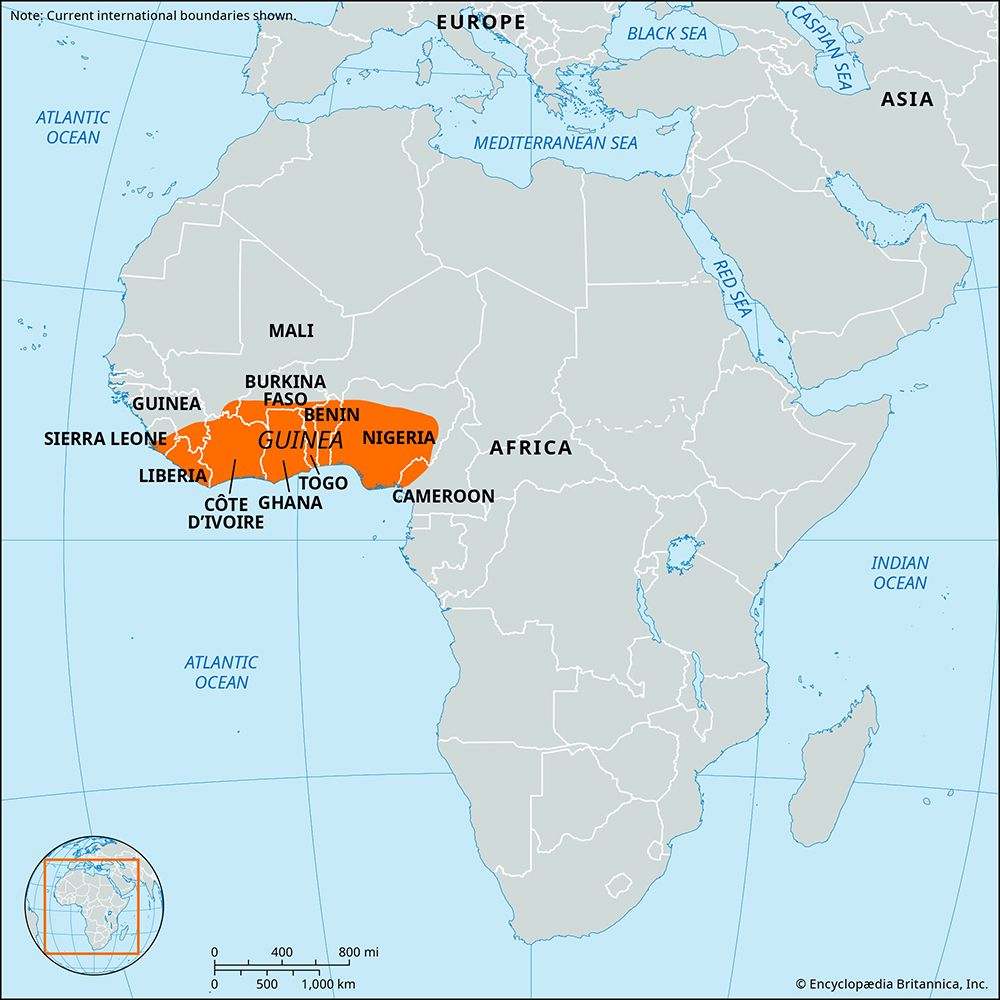
The name Guinea is derived from the Berber word aguinaw or gnawa, which translates to “black man.” Consequently, the region was historically referred to as akal n-iguinamen, or “land of the black men.” This term was adopted by the Portuguese and began appearing on European maps as early as the 14th century.1
The region holds significant historical importance as a focal point of early European exploration and trade in western Africa. Following the Portuguese rounding of Cape Bojador in 1434, the area became a major source of gold and enslaved people. By the 16th century, various European powers established trading posts along the coast, which became known by the primary goods exported from specific areas, such as the Gold Coast and the Slave Coast. Despite its economic allure, European penetration was long limited by the challenging climate, dense rain forests, and difficult coastal navigation.1
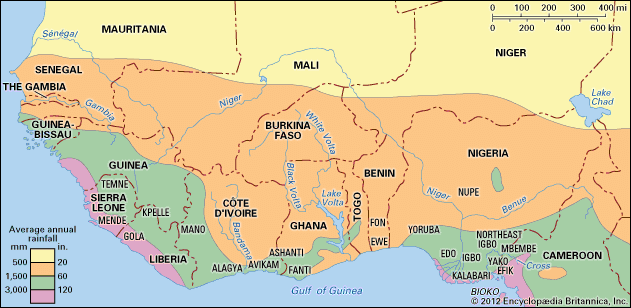
What are the major ethnic groups and languages found in the Guinea region?
The Guinea region, encompassing nations such as Guinea and Guinea-Bissau, is characterized by significant ethnic and linguistic diversity. The population is organized into various groups that often correspond to specific geographic regions.23
Ethnic Groups and Languages in Guinea
In the country of Guinea, the major linguistic groups are tied to four distinct geographic areas:
- Lower Guinea: The Susu language is dominant and serves as a lingua franca for the coastal population.23
- Fouta Djallon: The primary language is Pulaar, a dialect of Fula spoken by the Fulani people.23
- Upper Guinea: The Malinke (Maninkakan) language is the most widespread2.3
- Forest Region: This area features the Kpelle (Guerzé), Loma (Toma), and Kisi languages.23
While French is an official language, instruction is also provided in these national languages.3
Ethnic Groups and Languages in Guinea-Bissau
Guinea-Bissau is home to more than 20 African ethnic groups, including the Balante, Fulani, Diola, Nalu, Bijagó, Landuma, Papel, and Malinke.4
Linguistically, the country is dominated by languages from the Atlantic and Mande branches of the Niger-Congo language family. Although Portuguese is the official language, Crioulo—a creole that developed during the era of the slave trade—functions as the primary lingua franca across rural areas.4
What are some of the unique cultural traditions and practices found in the Guinea region?
The Guinea region possesses a rich cultural heritage defined by its diverse ethnolinguistic groups, deep-rooted musical traditions, and unique artistic expressions.
Music and Dance
Music is central to Guinean culture, with styles varying across geographic and ethnic regions. A hallmark of the area is Manding music, traditionally performed by Mande-speaking peoples like the Susu. The kora—a harplike instrument crafted from a hollowed-out gourd—is a vital component of this tradition. In Guinea-Bissau, the cultural landscape is similarly vibrant, featuring popular genres like funana, which utilizes the gaita (an accordion-like instrument), and finaçon vocal performances.78
Dance in the region is deeply connected to rhythmic patterns, often involving percussive footwork, torso contractions, and shoulder movements. These performances are frequently accompanied by traditional instruments, and in many communities, the dance serves as a rhythmic dialogue between the performer and the musicians.5
Arts and Crafts
Guinean handicrafts, including leatherwork, wood carving, and jewelry, are noted for being more genuinely ethnic than those in many other parts of western Africa, largely due to limited tourism and commercial innovation since independence. In Guinea-Bissau, the Bidyogo people are renowned for their elaborate masquerades and striking costumes, often featuring heavy headdresses representing animals like sharks and crocodiles.79
Religion
The majority of the population in the region practices Islam, predominantly the Sunni branch. While a small percentage of the population is Christian, a minority continues to adhere to local traditional religious practices, which remain an integral part of the cultural fabric.1011
How has the discovery of offshore oil reserves impacted the economies of countries in the Guinea region?
The discovery of offshore petroleum and natural gas reserves has significantly altered the economic profiles of several countries in the Guinea region, though the impact on the general population has been uneven.
- Equatorial Guinea: The exploitation of hydrocarbons beginning in the 1980s transformed the economy virtually overnight. Petroleum now accounts for the vast majority of exports and contributes more than four-fifths of the gross domestic product. Despite this dramatic increase in national wealth, the standard of living for most citizens has not significantly improved, and agriculture remains the primary occupation for many.1415
- Côte d’Ivoire: Since 1995, the exploitation of offshore reserves has provided a significant source of export revenue. These resources have also supported energy projects, with natural gas being used to expand thermal power capacity.16
- Guinea-Bissau: While offshore petroleum is recognized as a potential asset, it remains largely undeveloped and requires improved infrastructure to be fully exploited.17
Across the region, these natural resources are found within the continental shelf of the Gulf of Guinea, which holds substantial deposits of oil and hard minerals.18
Sources
- Guinea — Encyclopædia Britannica
- Guinea - Ethnic groups and languages — Encyclopædia Britannica
- history of Guinea-Bissau - Early history of Guinea-Bissau — Encyclopædia Britannica
- Benue-Congo languages — Encyclopædia Britannica
- Guinea: Top Questions — Encyclopædia Britannica
- Guinea-Bissau - Ethnic and linguistic groups — Encyclopædia Britannica
- Guinea - The arts — Encyclopædia Britannica
- Guinea - Religion — Encyclopædia Britannica
- Fulani — Encyclopædia Britannica
- African art - Bidyogo (Bidjogo) — Encyclopædia Britannica
- Guinea-Bissau - Cultural milieu — Encyclopædia Britannica
- African dance - Rhythm — Encyclopædia Britannica
- Guinea - Settlement patterns — Encyclopædia Britannica
- Equatorial Guinea - Resources — Encyclopædia Britannica
- Guinea-Bissau - Resources and power — Encyclopædia Britannica
- Equatorial Guinea - Economy of Equatorial Guinea — Encyclopædia Britannica
- Gulf of Guinea — Encyclopædia Britannica
- Côte d’Ivoire - Resources and power — Encyclopædia Britannica
Published on · 4 min read