Carnic Alps
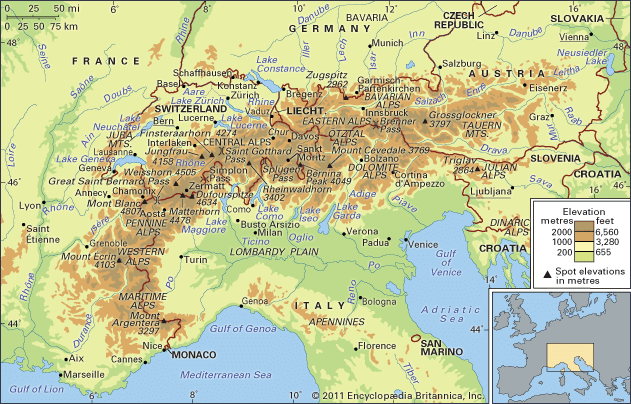
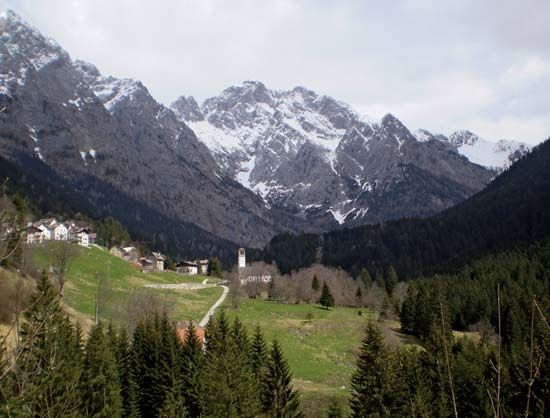
The Carnic Alps are a mountain range within the Eastern Alps that stretch for 60 miles (100 km) along the border between Austria and Italy. The range extends…
What is Carnic Alps?
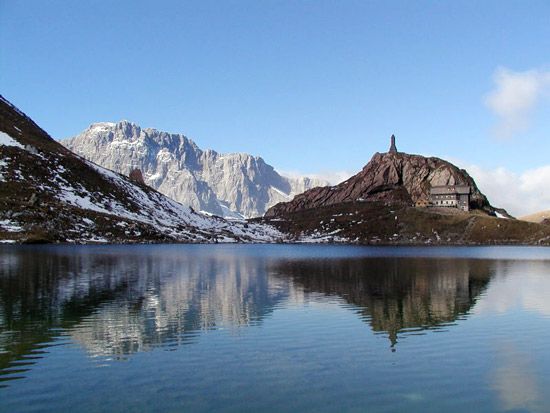
The Carnic Alps are a mountain range within the Eastern Alps that stretch for 60 miles (100 km) along the border between Austria and Italy. The range extends from the Pustertal and the Piave River in the west to the Gailitz River in the east.12
The mountains are geographically situated near several other prominent ranges, including the Dolomites to the southwest and the Julian Alps to the southeast. The highest point in the Carnic Alps is the Kellerwand, which reaches an elevation of 9,121 feet (2,780 meters). The range is accessible via the Plöcken Pass, and the area is well-known for its scenic beauty, hosting various summer resorts and winter sports centers.13
How did the geography of the Alps affect fighting during World War I?
The geography of the Alps profoundly shaped combat during World War I, forcing soldiers to contend with extreme terrain and volatile weather. Both Austro-Hungarian and Italian forces occupied high mountain peaks to gain tactical advantages, requiring them to drag heavy machinery up steep slopes, construct forts, and even tunnel into the rock.3
This rugged environment introduced unique hazards. The winter of 1915–16 was exceptionally severe, with over 40 feet of snow in some areas. The combination of heavy snowfall and the use of explosives to target enemy positions triggered massive avalanches in December 1916, resulting in the deaths of approximately 10,000 troops.3
Furthermore, the mountainous borderland dictated military strategy. Italian commanders had to account for the risk of Austrian forces descending from the Trentino or the Carnic Alps to threaten their rear. Consequently, much of the fighting devolved into trench warfare and costly, stagnant offensives, such as the Battles of the Isonzo, where progress was frequently hindered by both the terrain and the flooding of the Isonzo River.5
What are the Dolomites and how do they differ from the Carnic Alps?
The Dolomites and the Carnic Alps are both distinct mountain ranges located within the Eastern Alps of northern Italy and Austria, but they differ significantly in their geology, elevation, and character.
Key Differences
Feature
Dolomites
Carnic Alps
Geology
Composed of light-colored dolomitic limestone, resulting in jagged, saw-edged ridges and rocky pinnacles.
Composed of a different geological structure, forming a distinct range along the border.
Elevation
Higher; 18 peaks exceed 10,000 feet, with the
Marmolada
reaching 10,964 feet.
Lower; the highest point is the Kellerwand at 9,121 feet.
Geography
Bounded by the Adige, Isarco, and Piave valleys.
Extends 60 miles along the Austrian-Italian border, bounded by the Dolomites to the southwest.
Landscape
Features deep gorges, scree slopes, and 41 glaciers.
Known for scenic beauty and accessibility via the Plöcken Pass.
While the Dolomites are world-renowned for their unique, erosion-carved rock formations and status as a UNESCO World Heritage site, the Carnic Alps serve as a significant border range connecting the Pustertal to the Gailitz River.61
What causes avalanches in high mountain ranges?
The occurrence of an avalanche is determined by the interaction of four primary factors: mountainous terrain, weather conditions, snowpack conditions, and a trigger.89
Contributing Factors
- Terrain: Avalanches typically occur on slopes between 30 and 50 degrees. Key features such as slope shape, elevation, and exposure to sun and wind influence stability. The absence of natural anchors, such as dense tree cover or large rock outcroppings, significantly increases risk.98
- Weather: Dangerous conditions are often created by heavy snowfall, which can overload existing layers, or strong winds that transport snow onto lee slopes and create cohesive slabs. Rapidly rising temperatures and rainfall on existing snow cover are also major contributors.9
- Snowpack: Snow settles in layers that undergo physical changes over time. Weaknesses within these layers can cause a cohesive slab of snow to break loose from the underlying surface.9
- Triggers: Once conditions are unstable, a trigger applies the force necessary to release the slide. Natural triggers include new snow, wind-deposited snow, or falling cornices. Human-related triggers include skiers, snowmobilers, or explosive blasts used for avalanche control.9
Sources
- Carnic Alps — Encyclopædia Britannica
- Carnic Alps — Merriam-Webster
- Tirol avalanches of 1916 — Encyclopædia Britannica
- Julian Alps — Encyclopædia Britannica
- World War I - Italy and the Italian front, 1915–16 — Encyclopædia Britannica
- Dolomites — Encyclopædia Britannica
- Alps - Physiography — Encyclopædia Britannica
- avalanche: Top Questions — Encyclopædia Britannica
- avalanche — Encyclopædia Britannica
- Alps - Climate of the Alps — Encyclopædia Britannica
Published on · 3 min read