Caroline Atoll
Sorry, the Britannica knowledge base does not contain information regarding the specific types of flora and fauna found on Caroline Atoll.
What types of flora and fauna can be found on Caroline Atoll?
Sorry, the Britannica knowledge base does not contain information regarding the specific types of flora and fauna found on Caroline Atoll.
Where is Caroline Atoll located within Kiribati?
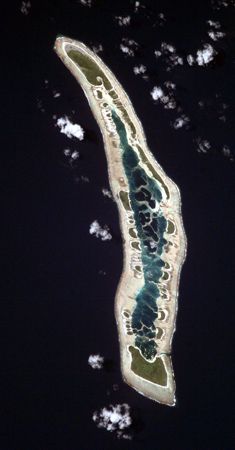
Caroline Atoll is located in the central and southern Line Islands, which are part of the nation of Kiribati in the southwestern Pacific Ocean1. It is situated approximately 450 miles (720 km) northwest of Tahiti.1
Geographically, the atoll serves as the easternmost point of Kiribati, a position established after the International Date Line was shifted eastward in 1995 to ensure the entire country remained within a single time zone.1
How does Caroline Atoll compare to other atolls in the Pacific Ocean?
Caroline Atoll shares the fundamental characteristics of other atolls in the Pacific Ocean, as it is a coral formation that encloses a shallow lagoon. Like many Pacific atolls, its existence is explained by the subsidence theory, which suggests it represents the final stage of reef growth around a sinking, extinct volcanic island.123
However, Caroline Atoll is distinct in several ways:
- Physical Scale: With a total area of 1.45 square miles (3.76 square km) and a maximum elevation of 20 feet (6 meters), it is a relatively small, low-lying structure compared to larger, more complex island groups.1
- Geopolitical Significance: Following the 1995 shift of the International Date Line, Caroline Atoll became the easternmost point of Kiribati and one of the first places on Earth to experience the sunrise each day.1
- Human History: Unlike many remote atolls, Caroline Atoll contains archaeological remnants, such as marae (temple platforms) and adzes, indicating that it was occupied by Polynesians in the past. Currently, it remains uninhabited, distinguishing it from atolls that support permanent populations.12
What is an atoll, and how does it form?
An atoll is a coral reef that forms a closed or semi-closed loop, enclosing a central lagoon. While the reef structure may span dozens of kilometers, it is primarily a submarine feature that rises from the deep ocean floor to just beneath the high-tide level, often topped with low, flat islands.2
The formation of an atoll is best explained by the subsidence theory, first proposed by Charles Darwin:
- Fringing Reef: Coral begins growing along the shoreline of a volcanic island.
- Barrier Reef: As the volcanic island slowly sinks (subsides) or the sea level rises, the reef continues to grow upward and outward, creating a lagoon between the reef and the island.
- Atoll: Eventually, the volcanic island sinks completely below the surface, leaving only the ring-shaped reef structure surrounding a central lagoon.27
While subsidence is a primary driver, changes in sea level due to glacial cycles and plate-tectonic movement also influence the development of these unique marine environments.27
Sources
- Caroline Atoll — Encyclopædia Britannica
- atoll — Encyclopædia Britannica
- Pacific Ocean - Geology — Encyclopædia Britannica
- French Polynesia - Plant and animal life — Encyclopædia Britannica
- Caroline Islands — Encyclopædia Britannica
- Micronesia - Land — Encyclopædia Britannica
- atoll — Merriam-Webster
- coral reef - Origin and development of reefs — Encyclopædia Britannica
Published on · 2 min read