Catanduanes
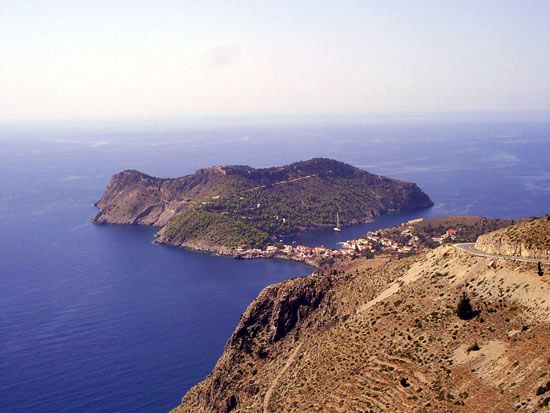
Catanduanes is an island located in the east-central Philippines, situated within the Philippine Sea. It is separated from the southeastern portion of Luzon…
What is Catanduanes?
Catanduanes is an island located in the east-central Philippines, situated within the Philippine Sea. It is separated from the southeastern portion of Luzon by the Maqueda Channel.1
The island features hilly and rolling terrain where residents engage in diversified farming, producing crops such as rice, corn, copra, and abaca. The chief port, Virac, is located in a lowland area on the southern coast, and the island is notably recognized for its historic stone churches. Covering an area of 550 square miles (1,425 square km), the island and its small adjacent neighbors had a population of 246,300 as of 2010.1
What is the significance of abaca production in the Philippines?
The Philippines holds a significant position in the global market as the world’s largest producer of abaca, a plant native to the country that is highly valued for its strong, flexible, and buoyant fiber.2
The significance of abaca production in the Philippines includes:
- Economic Contribution: Abaca serves as an important agricultural export for the nation, with extensive cultivation occurring in southeastern Luzon, eastern Mindanao, and the islands of Leyte and Samar.3
- Industrial Utility: Due to its exceptional resistance to damage in salt water, the fiber is essential for marine cordage, including ships’ ropes, hawsers, cables, and fishing nets.2
- Versatility: Beyond heavy-duty marine use, the fiber is utilized in the production of carpets, table mats, and paper. Additionally, inner fibers are used to manufacture lightweight, strong fabrics for local garments, hats, and shoes.2
Historically, the plant gained prominence in the 19th century as a primary source of cordage fiber, and it remains a vital component of the Philippine agricultural sector today.23
How does the geography of the Philippine Sea affect island life?
The geography of the Philippine Sea profoundly shapes life on the surrounding islands through its complex marine systems, geologic features, and weather patterns.
Marine Resources and Economy
The sea’s currents, particularly the Pacific North Equatorial Current, play a critical role in supporting island life. As this current meets the Philippines, it divides to form the Kuroshio (Japan Current) and various countercurrents. These movements, combined with the presence of reefs, ridges, and seamounts, create nutrient-rich environments that serve as vital fishing grounds. This marine abundance is essential for the local economy and serves as a primary source of protein for the population.4
Geologic and Climatic Impact
The region is defined by a structural basin bordered by island arcs, with the seafloor featuring numerous seamounts and deep trenches, such as the Philippine Trench. While these features contribute to the area’s biodiversity, the sea is also the origin of powerful tropical cyclones (typhoons). These storms frequently strike the islands, particularly from June to December, posing significant risks to life and property.45
What are some unique architectural features of historic stone churches?
Historic stone churches are defined by innovative structural and decorative features that evolved to manage the weight of stone while creating expansive, light-filled interiors.
Structural Innovations
- Arches and Vaults: The arch allowed builders to span space by keeping masonry in compression. This evolved into the barrel vault and the groin vault, which were later refined with ribs to reduce weight.9
- Gothic Pointed Arch: By approximating a catenary curve, the pointed arch channeled compressive forces more efficiently than circular arches, allowing for thinner walls and larger windows.10
- Buttressing Systems: To support high ceilings, masons developed buttresses—exterior masonry supports. The flying buttress was a transformative Gothic development, using an inclined bar to carry roof thrust to an external pier, which enabled the creation of soaring, diaphanous stone skeletons.101112
Decorative and Aesthetic Features
- Ornamentation: Churches often featured elaborate ornamentation, including brattishing along wall tops and diaper patterns.13
- Baroque and Mannerist Elements: Colonial-era churches frequently incorporated salomónica (twisted) columns and highly articulated surfaces where reliefs collapsed walls and ceilings into a single, tapestry-like experience.14
Sources
- Catanduanes — Encyclopædia Britannica
- abaca — Encyclopædia Britannica
- Philippines - Agriculture, forestry, and fishing — Encyclopædia Britannica
- Philippine Sea — Encyclopædia Britannica
- territorial disputes in the South China Sea - Physiography and economic factors — Encyclopædia Britannica
- Philippines - Plant and animal life — Encyclopædia Britannica
- Philippines - Climate — Encyclopædia Britannica
- South China Sea — Encyclopædia Britannica
- masonry — Encyclopædia Britannica
- construction - Stone construction — Encyclopædia Britannica
- Latin American architecture - Seventeenth- and 18th-century architecture in Ecuador , Colombia , and Cuba — Encyclopædia Britannica
- Flying buttress — Encyclopædia Britannica
- Buttress — Encyclopædia Britannica
- Ornamentation — Encyclopædia Britannica
Published on · 3 min read