Cephallenia
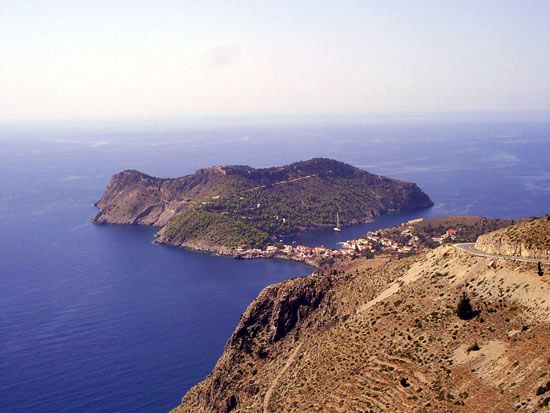
Cephallenia, the largest of the Ionian Islands, holds significant historical and mythological importance.
What is the historical significance of Cephallenia in ancient Greek mythology and history?
Cephallenia, the largest of the Ionian Islands, holds significant historical and mythological importance.
Historical Significance
In antiquity, Cephallenia served as a prominent Mycenaean center and is widely believed to be the island referred to as “Same” in the works of Homer. Throughout the classical period, the island played a strategic role in regional conflicts, notably siding with Athens during the Peloponnesian War. Later, it became a member of the Aetolian League before surrendering to Rome in 189 BCE. Archaeological evidence of its ancient past remains visible today, including Mycenaean tombs at Mazakarata and Diakata, as well as the ruins of the ancient city of Cranii.1
Mythological Connections
In Greek mythology, the island is linked to the figure of Cephalus. While early myths focus on his life in Athens and his tragic relationship with Procris, later legends utilized false etymology to name him the founder of the Cephallenian community and established a genealogical link to the hero Odysseus.2
How has Cephallenia been portrayed in literature and popular culture?
Cephallenia has gained significant prominence in literature and popular culture primarily through its association with the historical romance novel Captain Corelli’s Mandolin. Written by British author Louis de Bernières and published in 1994, this international bestseller is set on the island during World War II. The narrative depicts the experiences of the local community during the Italian and subsequent German occupations, focusing on the romance between a local woman, Pelagia, and an Italian captain, Corelli.1
The novel’s success, which earned the Commonwealth Writers’ Prize in 1995, brought widespread international attention to the island’s landscape and history. Its popularity was further cemented by the 2001 film adaptation starring Nicolas Cage and Penélope Cruz.1
Beyond modern fiction, the island is rooted in classical tradition. In Greek mythology, later legends utilized false etymology to identify the mythological figure Cephalus as the founder of the island’s community, establishing a genealogical connection to the hero Odysseus.3
What is the origin of the name ‘Cephallenia’ and has it changed over time?
The name “Cephallenia” (or Cephalonia) has evolved through various linguistic forms and mythological associations. While the island was likely known to Homer as “Same,” later traditions sought to explain its name through Greek mythology.4
According to these later legends, the name was derived via false etymology from the mythological figure Cephalus, who was cast as the founder of the island’s community and linked to the ancestry of Odysseus2.
Over time, the name has appeared in several variations, reflecting the island’s complex history under various rulers, including the Venetians, French, and British. Modern usage includes:
- Cephallenia/Cephalonia: Common anglicized forms.24
- Kefallinía: The official name in Modern Greek.24
- Kefallinia: A common variant.2
The island currently forms the nomós (department) of Kefallinía within Greece.4
How has the island’s strategic location in the Ionian Sea influenced its history?
Cephallenia’s strategic location in the Ionian Sea, situated between the Greek and Italian mainlands, has made it a focal point for external intervention and shifting political control since classical times.1
The island’s superior harbors, which are more conveniently located for international shipping than those on the western coast of Greece, have historically heightened its importance to maritime powers. This geographic significance led to a long history of occupation and governance by various entities:1
- Ancient Period: The island was a significant Mycenaean center and later participated in the Peloponnesian War and the Aetolian League before falling under Roman control.5
- Medieval and Early Modern Eras: The island was captured by the Byzantine Empire, followed by the Normans, and subsequently ruled by various Neapolitan and Venetian families. It also experienced periods of Turkish rule during the 15th and 16th centuries.51
- Colonial Period: Following the fall of the Venetian republic, the island was briefly held by the French before becoming a British protectorate under the Treaty of Paris (1815). It was eventually ceded to Greece in 1864.51
During World War II, the island’s location again made it a target for occupation by Italian and German forces.1
Sources
- Cephallenia — Encyclopædia Britannica
- Cephalus — Encyclopædia Britannica
- Captain Corelli’s Mandolin — Encyclopædia Britannica
- Cephalonia — Merriam-Webster
- Ionian — Encyclopædia Britannica
- Ionian Islands — Encyclopædia Britannica
- Ionia — Encyclopædia Britannica
Published on · 3 min read