Carson River
The Carson River is a 125-mile-long (200 km) river that originates from headstreams in the Sierra Nevada mountains of California, U.S. It flows northeast…
What is Carson River?
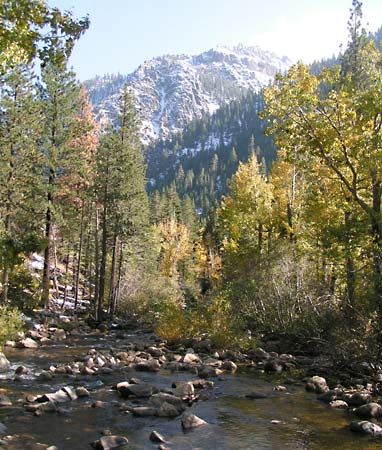
The Carson River is a 125-mile-long (200 km) river that originates from headstreams in the Sierra Nevada mountains of California, U.S. It flows northeast into western Nevada, eventually terminating in the Carson Sink, where the water evaporates into alkaline mud flats.12
The river plays a vital role in the region’s infrastructure, as it is used for extensive irrigation and reclamation projects, with its lower course dammed to support power generation and agriculture. Historically, the river was significant to the development of Carson City, the state capital, which was named after the river. The river was named by explorer John C. Frémont in honor of his scout, Christopher “Kit” Carson. During the 19th century, mills located along the river at Empire were essential for processing silver ore from the Comstock Lode.123
Who was Kit Carson and why was the river named after him?
Kit Carson (1809–1868) was a prominent American frontiersman, trapper, soldier, and Indian agent who played a significant role in the westward expansion of the United States. His career is marked by complexity: while he gained fame as a folk hero for his bravery and service as a guide for explorer John C. Frémont, he is also condemned by many historians for his role in the displacement and suffering of Indigenous peoples, most notably during the forced “Long Walk” of the Navajo in 1864.4
The Carson River was named in his honor by John C. Frémont, whom Carson served as a guide during government-financed expeditions through the West in the 1840s. Because of his association with these explorations, his name was applied to various geographic features and settlements throughout the Southwest, including the river, Carson City, and Carson Pass.45
What is the Carson Sink and how is it formed?
The Carson Sink is an intermittent lake located in western Nevada, situated south of Humboldt Lake. It serves as the terminal point for the Carson River, a 125-mile-long waterway that originates in the Sierra Nevada mountains of California.61
The sink is formed through the natural drainage of the Carson River. As the river flows northeast into western Nevada, it eventually reaches this low-lying basin where the water collects and subsequently disappears through evaporation, leaving behind alkaline mud flats.1
How did the Comstock Lode affect the history of the Carson River?
The discovery of the Comstock Lode in 1859 profoundly transformed the region surrounding the Carson River by fueling rapid economic and industrial development.
As the lode became one of the world’s richest silver deposits, the river became a vital hub for processing the extracted ore. Mills were established at Empire, located directly on the Carson River, to treat the silver ore transported from the mines in Virginia City. This industrial activity was supported by the Virginia and Truckee Railroad, which connected the mines to these river-side mills and maintained extensive shops in Carson City.
Furthermore, the immense wealth generated by the lode led the federal government to establish a branch mint in Carson City to coin the silver output. The economic boom associated with the lode was a primary factor in the rapid growth of the area and contributed to the political decision to admit Nevada as a state in 1864. Following the decline of the lode’s production in the late 19th century, both the mining industry and the associated railroad infrastructure eventually waned.
Sources
- Carson River — Encyclopædia Britannica
- Carson City — Encyclopædia Britannica
- Nevada - Drainage — Encyclopædia Britannica
- Kit Carson — Encyclopædia Britannica
- Nevada - Explorers and settlers — Encyclopædia Britannica
- Carson Sink — Merriam-Webster
- Comstock Lode — Encyclopædia Britannica
- Sierra Nevada - The people and economy — Encyclopædia Britannica
Published on · 2 min read