Abaca
The abaca plant (Musa textilis) thrives in rich, loose, loamy soil with good drainage. Cultivation typically begins by planting pieces of mature rootstock at…
How is abaca cultivated and harvested?
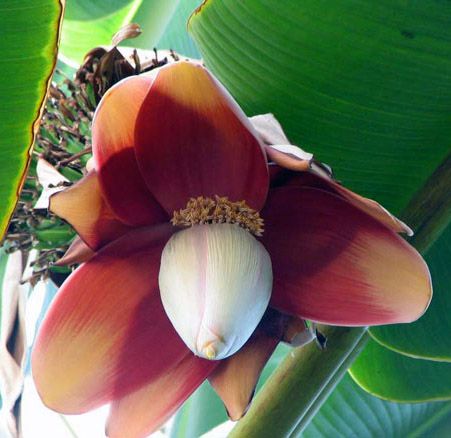
The abaca plant (Musa textilis) thrives in rich, loose, loamy soil with good drainage. Cultivation typically begins by planting pieces of mature rootstock at the start of the rainy season.1
Harvesting and Processing
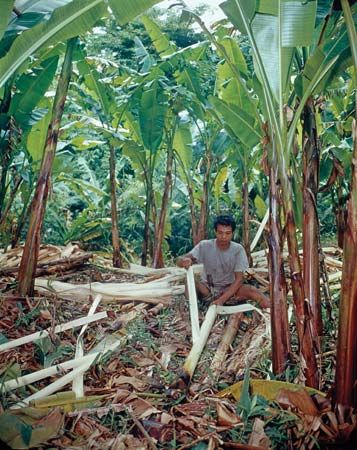
- Harvesting: The first harvest occurs 18 to 24 months after planting. Farmers cut the stalks—which form a cluster called a mat—close to the ground, usually when the plant blossoms. After the initial harvest, two to four stalks can be collected from each mat every four to six months. Plants are generally replaced every 10 years.1
- Extraction: The fiber is obtained from the leaf stalks, or petioles. In the Philippines, workers remove the fiber-bearing outer layer by pulling off strips called tuxies, then scrape away the pulp by hand or machine. In Central America, machine decortication is common, where stalks are crushed and scraped mechanically.1
- Finishing: Once the fiber strands are freed, they are dried in the sun or mechanically to prepare them for use in leaf fiber products like marine cordage.1
What is the historical significance of abaca in the Philippines?
The abaca plant is native to the Philippines, where it has held significant historical and economic importance for centuries. By the 19th century, the plant became a vital source of cordage fiber, gaining international recognition under names such as Manila hemp. Its exceptional strength, flexibility, and resistance to salt water made it an essential material for marine applications, including ships’ ropes, hawsers, and fishing nets.1
The Philippines remains the world’s largest producer of abaca today, with extensive cultivation occurring in regions such as eastern Mindanao, southeastern Luzon, and the islands of Leyte and Samar. Beyond its historical role in global trade, the fiber continues to be an important agricultural export for the nation, contributing to the broader agricultural sector that supports a significant portion of the Philippine workforce. Locally, the plant’s inner fibers have long been utilized to manufacture garments, hats, and shoes, reflecting its enduring integration into both the national economy and daily life.21
What are the main uses of abaca fiber in industry?
Abaca fiber is highly valued in industry for its exceptional strength, flexibility, buoyancy, and resistance to damage in salt water. These physical properties make it a premier material for various heavy-duty and specialized applications.1
Primary Industrial Uses
- Marine Cordage: The fiber is primarily utilized for ships’ ropes, hawsers, and cables due to its durability in marine environments.1
- Commercial and Industrial Equipment: It is used in the production of fishing lines, fishing nets, hoisting and power-transmission ropes, and well-drilling cables.1
- Textiles and Paper: Beyond cordage, abaca is incorporated into the manufacturing of carpets, table mats, and paper products.1
- Local Craftsmanship: The plant’s inner fibers are often used without spinning to create lightweight, strong fabrics, which are locally fashioned into garments, hats, and shoes.1
Because the fiber is obtained from the petioles (leaf stalks) of the plant, its quality and color can vary based on the stalk position, with the strongest fibers consistently sourced from the outer sheaths.1
How is abaca fiber processed after harvesting?
After the abaca stalk is harvested at the time of blossoming, the fiber must be extracted from the petioles (leaf stalks) through a cleaning process. The specific method depends on the region and available technology:
- Manual Extraction: In the Philippines, the fiber-bearing outer layer is typically removed by pulling off strips, known as tuxies, that have been freed at one end. The pulpy material is then scraped away by hand to release the fiber strands, which are subsequently dried in the sun.1
- Machine Decortication: Commonly practiced in Central America, this process involves cutting the stalks into lengths of 0.6 to 2 meters. These segments are then crushed and scraped by machine to free the fiber strands, which are dried mechanically.1
The resulting fiber strands, which can reach lengths of 1 to 3 meters, vary in color and strength depending on the plant variety and the position of the petiole from which they were extracted.1
Sources
- abaca — Encyclopædia Britannica
- Philippines - Agriculture, forestry, and fishing — Encyclopædia Britannica
Published on · 3 min read