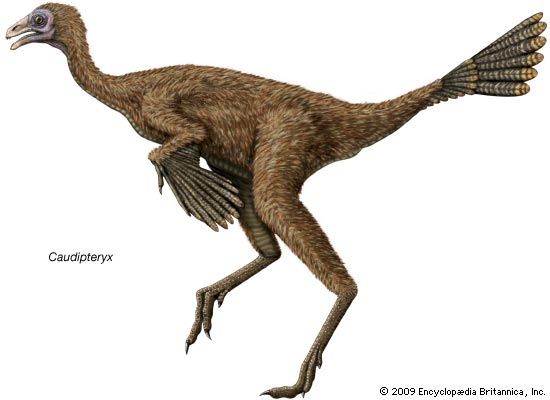
Caudipteryx
Caudipteryx was likely an omnivore that consumed a diet of tough plant material and insects.
What did Caudipteryx eat, and how do we know about its diet?
Caudipteryx was likely an omnivore that consumed a diet of tough plant material and insects.1
We know about its diet primarily through the discovery of numerous gastroliths, or stomach stones, found within the rib cages of fossil specimens. These stones functioned as a gastric mill, similar to the muscular gizzards found in many modern birds, which allowed the dinosaur to grind up tough forage.1
Additionally, researchers infer its dietary habits from its physical anatomy. While Caudipteryx possessed some teeth on the front of its upper jaw, its lower jaws and the rest of its upper jaw were toothless and presumably beaked, which is consistent with its role as a forager. Its overall body plan—a small head, long neck, and compact body—suggests it may have occupied an ecological niche similar to that of a modern pheasant or turkey.1
What evidence do we have about Caudipteryx’s feathers, and what do they tell us about its appearance and behavior?
Evidence for the feathers of Caudipteryx comes from well-preserved fossil specimens discovered in the Liaoning deposits of China, which clearly show impressions of long, vaned feathers on the animal’s forearms and tail.1
These feathers provide significant insights into the dinosaur’s appearance and behavior:
- Appearance: Caudipteryx possessed symmetrical, vaned feathers that resembled those of modern flightless birds. With its long neck, compact body, and fan of tail feathers, the animal likely resembled a small pheasant or turkey.1
- Behavior and Evolution: Because the forelimbs of Caudipteryx were too short for flight, these complex feathers suggest that they originally evolved for purposes other than aerial locomotion. Researchers believe these feathers likely served functions such as insulation, display, or camouflage. Furthermore, because related oviraptorosaurs have been found in brooding positions over their eggs, it is highly probable that Caudipteryx used its long feathers to keep eggs warm and protected from the environment.13
When and where did Caudipteryx live, and what was its habitat like?
Caudipteryx lived approximately 125 million years ago during the Early Cretaceous period (146 million to 100 million years ago).1
The genus is known from fossil remains discovered in the rock deposits of western Liaoning province, China. While specific details regarding the broader ecosystem are limited, the presence of gastroliths (stomach stones) suggests that Caudipteryx inhabited an environment where it could forage for tough plant material and insects. Its physical adaptations—such as a small head, long neck, and compact body—indicate that it likely occupied an ecological niche comparable to that of modern ground-dwelling birds like pheasants or turkeys.1
What are the key characteristics of Caudipteryx that distinguish it from other dinosaurs?
Caudipteryx is distinguished from other theropod dinosaurs by several unique physical and anatomical characteristics:
- Feather Structure: Unlike the filamentous “pelage” found on many other early feathered dinosaurs, Caudipteryx possessed long, symmetrical, vaned feathers on its forearms and tail that closely resembled those of modern flightless birds. Because its forelimbs were too short for flight, these feathers indicate that complex plumage evolved for non-aerodynamic purposes, such as insulation, display, or brooding eggs.13
- Dentition: Caudipteryx exhibited a unique dental arrangement where teeth were present only on the premaxillae (the front of the upper jaw), while the maxillae and lower jaws were toothless and likely covered by a beak.1
- Digestive Adaptations: The presence of numerous gastroliths (stomach stones) within the rib cages of fossil specimens suggests the use of a gastric mill to grind tough plant material and insect exoskeletons, a trait similar to the gizzards of modern birds.1
- Body Plan: As a member of the Oviraptorosauria, it featured a deep abdomen and a short, stiff tail, which, combined with its small head and long neck, gave it a profile similar to a pheasant or turkey.1
Sources
- Caudipteryx — Encyclopædia Britannica
- dinosaur - The plant eaters — Encyclopædia Britannica
- feathered dinosaur — Encyclopædia Britannica
Published on · 3 min read