Cedar Breaks National Monument
Cedar Breaks National Monument is a vast natural amphitheatre located in southwestern Utah, approximately 15 miles (24 km) southeast of Cedar City.…
What is Cedar Breaks National Monument and where is it located in Utah?
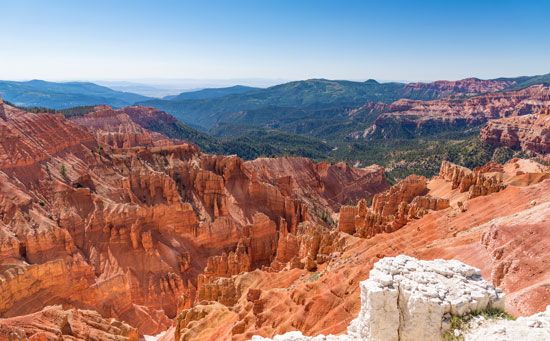
Cedar Breaks National Monument is a vast natural amphitheatre located in southwestern Utah, approximately 15 miles (24 km) southeast of Cedar City. Established in 1933, the monument sits on the western edge of the Markagunt Plateau at elevations reaching 10,600 feet (3,200 metres).1
The amphitheatre spans more than 3 miles (5 km) in diameter and is eroded into a 2,000-foot-thick limestone escarpment known as the Pink Cliffs. The vibrant colours of the cliffs—ranging from red and purple to yellow—are caused by manganese oxide and iron impurities. The area supports a diverse ecosystem, including forests of aspen, spruce, and fir, as well as wildlife such as mule deer and various bird species. Visitors can explore the site via a road that follows the rim of the amphitheatre.1
When was Cedar Breaks National Monument established, and why was it designated as a national monument?
Cedar Breaks National Monument was established in 1933. Originally part of the Sevier (now Dixie) National Forest, it was designated as a national monument to protect its unique geological features, specifically the vast natural amphitheatre eroded into the 2,000-foot-thick limestone escarpment known as the Pink Cliffs.1
The site is recognized for its striking landscape, where iron and manganese oxide impurities create a vibrant array of colours that shift with the sunlight. Beyond its geological significance, the monument preserves a high-altitude ecosystem on the Markagunt Plateau, which supports diverse flora—such as aspen forests and various wildflowers—and wildlife, including mule deer.1
How was Cedar Breaks National Monument formed geologically?
Cedar Breaks National Monument was formed through the geological process of erosion. The monument’s defining feature is a vast natural amphitheatre, spanning more than 3 miles (5 km) in diameter, which has been carved into a 2,000-foot-thick (600-metre) limestone escarpment known as the Pink Cliffs.1
This erosion occurred on the western edge of the Markagunt Plateau, where the landscape reaches elevations of 10,600 feet (3,200 metres). The vibrant colours visible within the exposed rock layers—ranging from reds and purples to yellows—are the result of manganese oxide and iron impurities present within the limestone formations.1
We could dive deeper into the broader geological history of the Colorado Plateau region or explore how similar erosional processes have shaped other iconic landscapes in Utah.
What types of wildlife and plant species can be found in Cedar Breaks National Monument?
Cedar Breaks National Monument supports a diverse range of flora and fauna adapted to its high-altitude environment on the Markagunt Plateau.
Plant Life
The monument features a variety of vegetation, ranging from dense forests to seasonal meadows:
- Forests: The plateau is home to stands of aspen, spruce, and fir trees, as well as the resilient bristlecone pine.1
- Wildflowers: During the spring snowmelt, the slopes and meadows bloom with a vibrant array of flowers, including larkspur, Indian paintbrush, lupine, wild rose, and cinquefoil.1
Wildlife
The high-elevation habitat provides a home for several animal species:
Sources
- Cedar Breaks National Monument — Encyclopædia Britannica
- Cedar Breaks National Monument — Merriam-Webster
- Grand Staircase–Escalante National Monument — Encyclopædia Britannica
Published on · 2 min read