Ceram
The population of Ceram (also known as Seram) is primarily composed of the Ceramese people, who inhabit the island's interior and are of mixed Malay-Papuan…
What are the main ethnic groups and languages spoken on Ceram?
The population of Ceram (also known as Seram) is primarily composed of the Ceramese people, who inhabit the island’s interior and are of mixed Malay-Papuan origin. Along the coasts, the population is more diverse, featuring various groups including the Malay people diverse, featuring various groups including the Malay people.12
Regarding languages, the Ceramese language is spoken by the interior population; it has no written script and is closely related to the indigenous language of Ambon Island. On the coasts, Malay is commonly used as a lingua franca among the diverse settlements.1
How does Ceram’s location in the Maluku Islands affect its strategic importance?
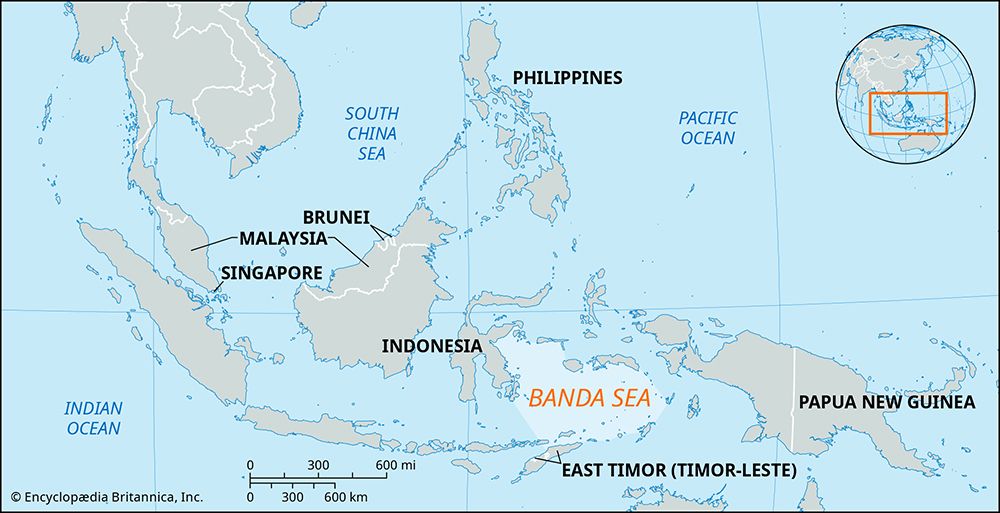
Ceram’s strategic importance is primarily defined by its geography and its historical role within the Moluccas archipelago. Located in eastern Indonesia between the Ceram Sea to the north and the Banda Sea to the south, the island serves as a significant landmass within a region historically known as the “Spice Islands.”124
Its strategic value has been shaped by several factors:
- Economic Resources: Historically, the Moluccas were globally significant for the production of spices like nutmeg and cloves, which drew international traders and colonial powers for centuries. Today, Ceram remains economically relevant due to its natural resources, including timber, forest products, and petroleum deposits near Bula on its northeastern coast.5412
- Geopolitical Position: Situated east of Buru Island and west of New Guinea, Ceram occupies a central position in the eastern Indonesian maritime landscape. This location made it a focal point for colonial competition between the Portuguese, Dutch, and other European powers seeking control over regional trade.154
- Infrastructure: The presence of airfields at Bula and Amahai enhances the island’s connectivity and accessibility within the province of Maluku.12
What traditional arts and crafts are unique to Ceram island?
While the broader Indonesian archipelago is renowned for diverse visual arts such as batik and ikat weaving, specific traditional arts and crafts unique to Ceram island are not extensively documented in the available records.
The interior Ceramese people are primarily noted for their functional craftsmanship, which is closely tied to their survival and lifestyle. Their traditional material culture includes:
- Weaponry: The crafting of traditional tools and weapons, specifically the bow and arrow, the short swordlike parang, and the lance.
- Architecture: The construction of pile-supported houses, which are characteristic of the interior settlements.
- Subsistence Crafts: The processing of sago flour, which remains a central activity for the island’s interior inhabitants.
While weaving and textile design are highly developed across the eastern islands of Indonesia, the provided information does not identify specific artistic patterns or craft techniques that are exclusive to Ceram.
What is the climate like on Ceram island, and how does it affect daily life?
Ceram island experiences a tropical climate characterized by high temperatures and heavy rainfall throughout the year. This environment has profound effects on the island’s geography and the daily lives of its inhabitants:1
- Landscape and Agriculture: The consistent heat and precipitation support dense tropical forests that cover much of the island. These conditions are ideal for the growth of the sago palm, which serves as a vital food source for the interior population.1
- Transportation and Infrastructure: The heavy rainfall significantly impacts mobility. Many of the island’s rivers are only navigable by small craft during the rainy season, which can restrict travel and the transport of goods between inland areas and the coast.1
- Lifestyle and Subsistence: For the people living in the interior, the climate dictates a lifestyle centered on fishing, hunting, and the labor-intensive process of making sago flour. Their traditional architecture, consisting of pile-supported houses, is well-suited to the humid, forested environment.1
- Economic Activity: While the climate supports forestry and the production of timber and forest products, it also influences the agricultural practices of coastal inhabitants, who supplement their diet by growing rice and corn (maize).1
Sources
- Ceram — Encyclopædia Britannica
- Maluku — Encyclopædia Britannica
- Tanimbar Islands — Encyclopædia Britannica
- Moluccas — Encyclopædia Britannica
- Indonesia - Celebes and the Moluccas — Encyclopædia Britannica
- Indonesia - Visual arts — Encyclopædia Britannica
- Southeast Asian arts - Textiles — Encyclopædia Britannica
Published on · 3 min read