Cerastes
The provided search results do not contain specific information regarding the typical lifespan of Cerastes snakes in the wild. While data indicates that the…
What is the typical lifespan of a Cerastes snake in the wild?
The provided search results do not contain specific information regarding the typical lifespan of Cerastes snakes in the wild. While data indicates that the horned viper (C. cerastes) has lived up to 17 years in captivity, wild lifespans are often influenced by environmental pressures, such as predation and habitat challenges, which differ significantly from captive conditions.12
What is the Cerastes snake and where is it commonly found?
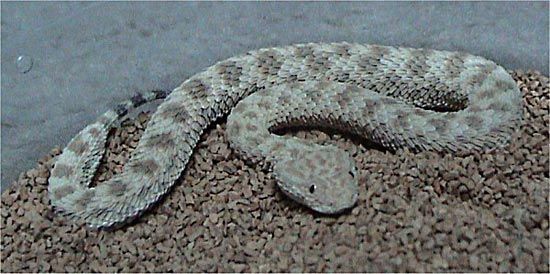
Cerastes is a genus of venomous, desert-dwelling snakes belonging to the viper family, Viperidae. These snakes are typically small, stocky, and broad-headed, rarely exceeding 60 cm (about 2 feet) in length.1
There are two primary species within this genus:
- Horned viper (C. cerastes): Distinguished by a spinelike scale or “horn” located above each eye.15
- Common sand viper (C. vipera): Lacks the characteristic horns of its relative.1
These vipers are commonly found across northern Africa and the Middle East. They are well-adapted to arid environments, featuring pale, sand-colored skin with dark spots or bars that provide camouflage. They frequently bury themselves in the sand to escape the heat and to ambush prey, such as lizards and small mammals. When moving across the sand, they utilize a unique form of locomotion known as sidewinding.15
Are there any documented cases of Cerastes snake bites in humans, and how are they treated?
Yes, there are documented cases of human encounters with Cerastes snakes, as they inhabit regions across northern Africa and the Middle East where they may come into contact with people. While these vipers are venomous, their venom is considered relatively weak and is seldom fatal to humans.7
Treatment of Snakebites
When a bite from a venomous snake occurs, the severity depends on factors such as the victim’s size, the location of the bite, the quantity of venom injected, and the speed at which medical treatment is administered.1
General first aid for snakebites on the extremities includes:
- Immobilization: Keep the limb in a horizontal position and use a splint to restrict movement.1
- Bandaging: Apply a broad, firm bandage over the bite and around the entire limb.1
- Avoidance: Do not cut the wound, apply suction, or use arterial tourniquets, as these are inadvisable. Additionally, avoid stimulants and do not apply ice or other substances to the wound.1
The primary medical treatment for venomous snakebites is the administration of antivenins, which are specialized antibodies that neutralize the toxins.1
How does the Cerastes snake’s venom compare to other venomous snakes?
The venom of the Cerastes genus is characterized as relatively weak and is seldom fatal to humans. While Cerastes vipers belong to the family Viperidae, which includes many highly dangerous species, their specific toxicity levels differ significantly from other members of the family.1
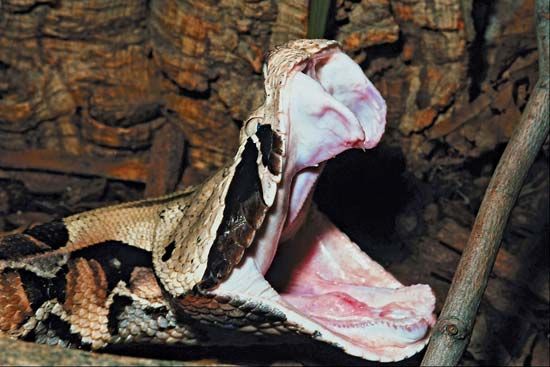
In contrast to the Cerastes, many other vipers—such as the Gaboon viper or various rattlesnakes—possess potent venom capable of causing severe systemic effects in humans. Vipers generally utilize a specialized delivery system consisting of long, hollow, venom-injecting fangs that fold back when not in use, allowing them to strike and envenomate prey efficiently. While some vipers, like pit vipers, also possess infrared-sensitive organs to track warm-blooded prey, the Cerastes is primarily adapted for ambush hunting in desert environments, relying on its camouflage and sidewinding locomotion rather than the high-potency venom found in larger or more aggressive viper species.61
Sources
- Cerastes — Encyclopædia Britannica
- snake - Natural history — Encyclopædia Britannica
- sidewinder — Encyclopædia Britannica
- snake — Encyclopædia Britannica
- horned viper — Merriam-Webster
- viper — Encyclopædia Britannica
- snakebite — Encyclopædia Britannica
Published on · 3 min read