Chenab River
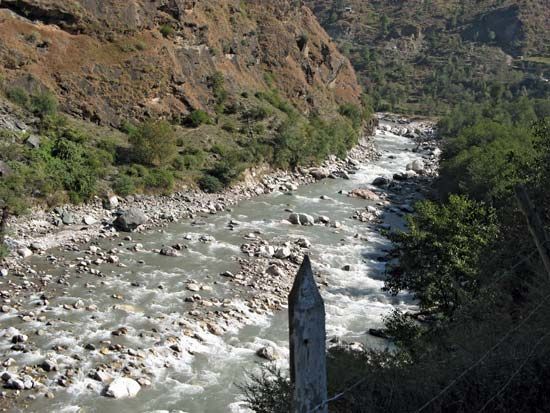
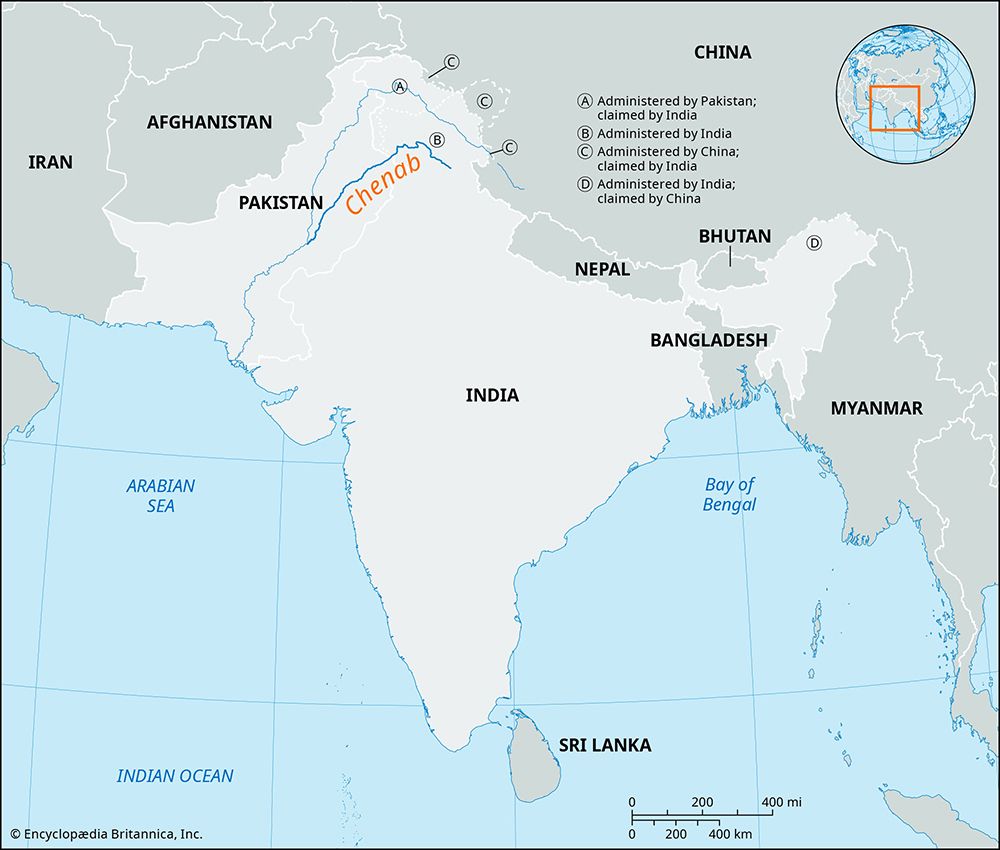
The Chenab River is a major waterway of the Indian subcontinent, flowing through northwestern India and northeastern and eastern Pakistan.
What is Chenab River?
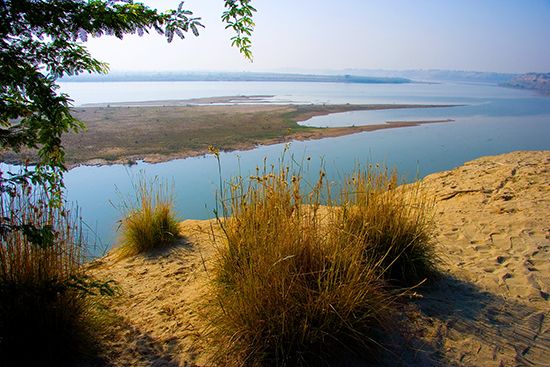
The Chenab River is a major waterway of the Indian subcontinent, flowing through northwestern India and northeastern and eastern Pakistan.1
Formed by the confluence of the Chandra and Bhaga streams in the western Himalayas of Himachal Pradesh, the river travels west through Jammu and Kashmir before turning southwest into the Punjab province of Pakistan. Spanning approximately 605 miles (974 km), the Chenab serves as a vital water source, feeding numerous irrigation canals.1
In its lower course, the river receives the Jhelum River near Trimmu and eventually empties into the Sutlej River, which is a key tributary of the Indus River.123
What are the other four rivers that give the Punjab region its name?
The name “Punjab” is derived from the Persian words panj (“five”) and āb (“water”), referring to the five major tributaries of the Indus River that historically defined the region.
In addition to the Chenab River, the other four rivers that give the Punjab region its name are:
- Beas River
- Jhelum River
- Ravi River
- Sutlej River
While these five rivers are central to the historical and cultural identity of the region, the modern political boundaries established after the 1947 partition of India mean that these waterways are now divided between the Indian state of Punjab and the Pakistani province of Punjab.43
How does the Indus Waters Treaty affect the management of these rivers?
The Indus Waters Treaty, signed in 1960 and brokered by the World Bank, established a framework to manage the Indus River system by dividing the rights to its tributaries between India and Pakistan.67
Under the agreement, the waters of the western rivers—the Indus, Jhelum, and Chenab—were assigned to Pakistan, while the eastern rivers—the Ravi, Beas, and Sutlej—were assigned to India. The treaty also mandated the creation of the Permanent Indus Commission to facilitate communication and resolve implementation disputes.67
In recent years, the treaty has faced significant strain due to disagreements over hydroelectric power projects, such as the Kishanganga and Ratle dams. These tensions escalated in 2025 when India announced it would hold the treaty in abeyance following a terror attack in Kashmir. While a court of arbitration has reaffirmed its jurisdiction and issued awards regarding water-control limits, India has rejected these rulings, challenging the treaty’s long-standing stability.7
What role do the Himalayan glaciers play in the water supply of the Indus River system?
Himalayan glaciers and snowmelt are fundamental to the hydrology of the Indus River system, serving as a primary source of its water supply. The rivers within this system are largely snow-fed, meaning their flow is heavily dependent on the seasonal melting of snow and ice from the Himalayas, the Karakoram Range, and the Hindu Kush.89
The role of these glaciers is particularly critical in the following ways:
- Sustaining Flow: Glacial meltwater and snowmelt provide a significant portion of the river system’s total volume, especially in the upper reaches of the catchments. Tributaries such as the Shyok, Shigar, and Gilgit rivers are specifically noted for carrying glacial meltwater into the main Indus stream.810
- Seasonal Regulation: The river’s discharge fluctuates throughout the year based on these sources. Flow is at its minimum during the winter months (December to February) when temperatures are below freezing, and it begins to rise in spring and early summer as temperatures increase and meltwater increases.9
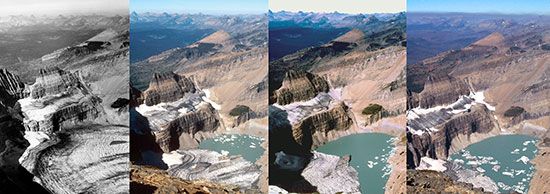
- Climate Sensitivity: The region is highly sensitive to climate change. Recent glacial decline and unpredictable weather patterns have begun to impact the reliability of this water supply, posing challenges for the populations that depend on the river system.8
Sources
- Chenab River — Encyclopædia Britannica
- Jhelum River — Encyclopædia Britannica
- Sutlej River — Encyclopædia Britannica
- Punjab — Encyclopædia Britannica
- India - Drainage into the Arabian Sea — Encyclopædia Britannica
- Indus Waters Treaty: Top Questions — Encyclopædia Britannica
- Indus Waters Treaty — Encyclopædia Britannica
- Himalayas - Drainage of the Himalayas — Encyclopædia Britannica
- Indus River - Hydrology of the Indus River — Encyclopædia Britannica
- Indus River - Climate — Encyclopædia Britannica
- Indus River - Physical features — Encyclopædia Britannica
- Himachal Pradesh - Relief and drainage — Encyclopædia Britannica
Published on · 3 min read