Chevrotain
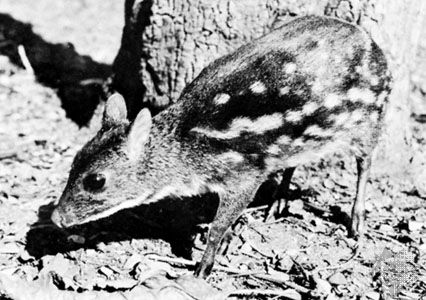
Chevrotains belong to the family Tragulidae, which is classified within the order Artiodactyla.
What is the taxonomic classification of chevrotains within the mammalian order?
Chevrotains belong to the family Tragulidae, which is classified within the order Artiodactyla.1
Within this order, they are further categorized as members of the suborder Ruminantia. Because they possess a three-chambered stomach rather than the four-chambered stomach typical of many other ruminants, they are frequently referred to as pseudoruminants. The family Tragulidae includes three distinct genera: Hyemoschus, Moschiola, and Tragulus.21
How do chevrotains’ digestive systems differ from those of true ruminants?
The primary difference between the digestive systems of chevrotains and true ruminants lies in the number of stomach compartments. While most ruminants possess a four-chambered stomach, chevrotains—along with camels—have a three-chambered stomach, leading to their classification as pseudoruminants.2
Despite this structural difference, the digestive processes are remarkably similar. Both groups are unable to produce the enzymes necessary to break down cellulose directly. To compensate, they utilize a sequential digestive process that involves the following:
- Fermentation: Ingested plant material is stored in the initial chamber, where it is softened and broken down by essential microorganisms.2
- Regurgitation: Both groups regurgitate partially digested material, known as cud, to chew it again.2
- Further Digestion: After re-chewing, the material passes into the remaining stomach chambers for further processing and nutrient absorption.2
In four-chambered ruminants, the stomach is divided into the rumen, reticulum, omasum, and abomasum, whereas the pseudoruminant stomach is divided into three.25
What are some of the different species of chevrotains, and how do they vary?
There are approximately 10 species of chevrotains (family Tragulidae), which are divided into three distinct genera. While they share common traits such as a small, delicate build, nocturnal habits, and the presence of tusks in males, they vary significantly by geography and habitat.1
Genera and Species Variation
- Genus Tragulus (Asian Chevrotains): This group consists of about six species inhabiting forests across Southeast Asia, southern China, the Philippines, and the Greater Sunda Islands. These are known for being reclusive; for example, the silver-backed chevrotain (T. versicolor) remained unphotographed in the wild for over a century until 2019.1
- Genus Hyemoschus (Water Chevrotain): Represented by the water chevrotain (H. aquaticus), this species is larger than its Asian counterparts. It is found in western equatorial Africa and is uniquely adapted to riverbanks, often escaping into the water when threatened.1
- Genus Moschiola (Indian Chevrotains): Taxonomists differ on the classification of this group. While some classify all Indian chevrotains as a single species (M. meminna), others recognize three distinct species: M. meminna, M. indica, and M. kathygre.1
Are there any conservation concerns for chevrotain species, and if so, what efforts are being made to protect them?
Sources
- chevrotain — Encyclopædia Britannica
- ruminant — Encyclopædia Britannica
- tragulid — Merriam-Webster
- Tragulidae — Merriam-Webster
- artiodactyl - Evolution and paleontology — Encyclopædia Britannica
- artiodactyl - Annotated classification — Encyclopædia Britannica
- How many stomachs does a cow have? — Encyclopædia Britannica
Published on · 2 min read