Chinch Bug
Chinch bugs (Blissus leucopterus) are specialized sap-sucking insects within the family Lygaeidae that primarily target grain and corn crops. Unlike many…
How do chinch bugs compare to other common garden and crop pests?
Chinch bugs (Blissus leucopterus) are specialized sap-sucking insects within the family Lygaeidae that primarily target grain and corn crops. Unlike many generalist pests, they exhibit distinct migratory behaviors, moving from hibernating sites to grain fields in the spring and seeking new food sources as crops mature or are harvested.12
Compared to other common pests, chinch bugs are notable for their specific environmental preferences; they thrive in sunshine, which allows for unique cultural control methods like planting shade crops to create unfavorable conditions. While many agricultural pests are managed through broad chemical applications, chinch bug control often integrates habitat management—such as destroying hibernating sites—and the use of resistant crop varieties.13
Some relatives, such as the hairy chinch bug, are non-migratory lawn pests, while others like the false chinch bug are rarely significant threats to crops. In contrast to disease-transmitting insects like mosquitoes or fleas, chinch bugs are primarily economically significant due to their direct damage to plant vitality.13
Where are chinch bugs commonly found, and what types of plants do they typically infest?
Chinch bugs (Blissus leucopterus) are native to tropical America but have significantly expanded their range throughout much of North America.1
These insects primarily infest cereal grains and corn. Their life cycle is closely tied to these crops: in the spring, adults migrate from winter hibernation sites—typically clumps of weeds or grass—to wheat or other grain fields. Females deposit eggs on the roots, stems, and lower leaves of these plants. As the nymphs emerge, they feed by sucking the plant’s sap. When a food source becomes too hard or is harvested, the bugs migrate to find new fields.1
While the common chinch bug is a significant agricultural pest, related species have different habits. The hairy chinch bug (Blissus hirtus) is a non-migratory insect that acts as a lawn pest, while the false chinch bug (Nysius ericae) feeds on a wide variety of plants but is rarely considered a major threat to crops.1
What are the physical characteristics and appearance of chinch bugs?
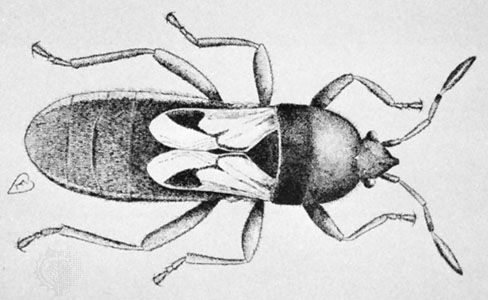
The common chinch bug (Blissus leucopterus) is a small insect measuring no more than 5 mm (0.2 inch) in length. Its appearance changes significantly throughout its life cycle:1
- Adults: These are black in color with distinctive red legs. Their forewings are white and feature a characteristic black spot near the outer edge.1
- Eggs: The eggs are cylindrical and yellow in color.1
- Nymphs: Upon emerging, the nymphs are reddish and feature a light-colored band across their backs. As they grow and molt five times over approximately 40 days, they gradually darken in color.1
In contrast, the false chinch bug (Nysius ericae) is brownish-gray and bears a physical resemblance to the common chinch bug, though it is generally not a significant threat to crops.16
How do chinch bugs damage plants, and what are the signs of a chinch bug infestation?
Chinch bugs damage plants primarily by feeding on their sap. Both the nymphs and adults use their mouthparts to pierce the plant tissue, extracting vital fluids from the roots, stems, and lower leaves of cereal grains and corn.1
As these insects feed, they deprive the plant of essential nutrients, which can lead to significant agricultural damage. Because they often feed in large numbers, the cumulative effect of their sap-sucking can cause the plant to wither or die.17
Signs of an infestation include:
- Plant Wilting: Crops may appear stunted or wilted as the bugs drain the plant’s sap.1
- Migration Patterns: You may observe large numbers of bugs crawling or flying from one field to another, particularly when a current food source becomes too hard to feed upon or after a harvest.1
- Presence of Nymphs: The appearance of reddish nymphs with a light-colored band across their backs on the lower portions of the plant is a clear indicator of an active infestation.1
Sources
- chinch bug — Encyclopædia Britannica
- Pest — Encyclopædia Britannica
- lygaeid bug — Encyclopædia Britannica
- plant bug — Encyclopædia Britannica
- heteropteran - Feeding — Encyclopædia Britannica
- false chinch bug — Merriam-Webster
- chinch bug — Merriam-Webster
Published on · 3 min read