Chinchilla
Chinchillas are primarily distinguished from other rodents by their exceptionally soft, dense, and silky fur, which is generally bluish to brownish gray with…
What are the physical characteristics of chinchillas that distinguish them from other rodents?
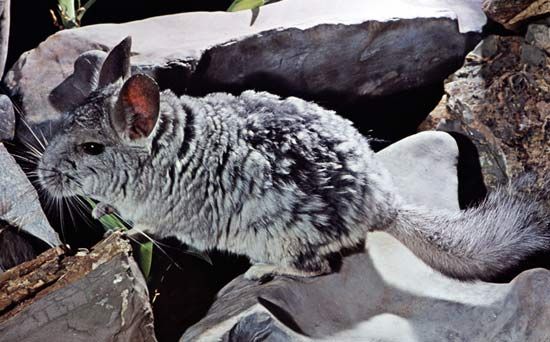
Chinchillas are primarily distinguished from other rodents by their exceptionally soft, dense, and silky fur, which is generally bluish to brownish gray with yellowish white underparts.1
Physically, they possess a compact body reaching up to 38 cm (15 inches) in length and weighing up to 800 grams (1.8 pounds). Key anatomical features include:1
- Sensory organs: They have large eyes and long ears, which are well-suited for their nocturnal and crepuscular activity patterns in the Andes Mountains patterns in the Andes Mountains.1
- Tail: They feature a moderately long, bushy tail that can measure up to 15 cm.1
- Family traits: As members of the family Chinchillidae, they share a common ancestry with viscachas, but they are distinct from the chinchilla rat, which, despite its name, has a more ratlike body form, different foot morphology, and belongs to the separate family Abrocomidae.12
While chinchilla rats may superficially resemble them, they lack the specific fur density and body proportions characteristic of the genus Chinchilla.12
Where are chinchillas native to, and what type of habitat do they prefer?
Chinchillas are native to South America, specifically inhabiting the Andes Mountains across a range that extends from southern Peru to Chile.1
Regarding their preferred habitat, chinchillas are colonial animals that thrive in arid, rocky environments. They are highly adaptable to elevation, living at altitudes ranging from 800 metres (2,600 feet) near the coast to as high as 6,000 metres inland. Within these rugged landscapes, they typically seek shelter during the day by hiding in rock crevices and cavities, emerging during the evening and night to forage for available vegetation.1
While they are sometimes confused with the chinchilla rat—which also occupies rocky, shrubby areas in the Andes—chinchillas are distinct in their specific environmental requirements and social structure. Due to historical overhunting and ongoing habitat loss, these animals remain scarce in their natural range and are currently protected by law.12
What is the average lifespan of a chinchilla in the wild versus in captivity?
In captivity, chinchillas are known for their longevity and can survive for 20 years or more.1
Regarding their lifespan in the wild, the provided information does not specify an average duration. Chinchillas are currently scarce in their native Andes Mountains due to historical overhunting, ongoing poaching, and habitat loss, which significantly impact their survival in natural conditions.1
What adaptations do chinchillas have for surviving in their native habitat?
Chinchillas possess several physical and behavioral adaptations that allow them to survive in the harsh, arid, and high-altitude environments of the Andes Mountains.
Physical Adaptations
- Dense Fur: Chinchillas are renowned for their extremely soft and thick fur, which provides essential insulation against the cold temperatures found at high elevations, which can reach up to 6,000 metres inland.1
- Sensory Organs: They are equipped with large eyes and long ears, which help them navigate and detect potential threats in their rocky, often dimly lit environments.1
- Compact Body: Their compact, medium-sized bodies—weighing up to 800 grams—allow them to maneuver effectively through the narrow crevices and cavities where they seek shelter.1
Behavioral Adaptations
- Colonial Living: Chinchillas are colonial animals, a social structure that likely aids in collective vigilance against predators.1
- Nocturnal Foraging: To avoid the harsh daytime sun and potential predators, they typically remain hidden in rock crevices during the day, emerging during the evening and night to feed on available vegetation.1
- Habitat Selection: By utilizing rocky cavities, they protect themselves from the elements and secure a safe environment in an otherwise exposed landscape.1
Sources
- chinchilla — Encyclopædia Britannica
- chinchilla rat — Encyclopædia Britannica
Published on · 3 min read