Chinchilla Rat
Chinchilla rats are South American rodents that possess a ratlike body form while superficially resembling a chinchilla. Their physical characteristics…
What are the physical characteristics of chinchilla rats?
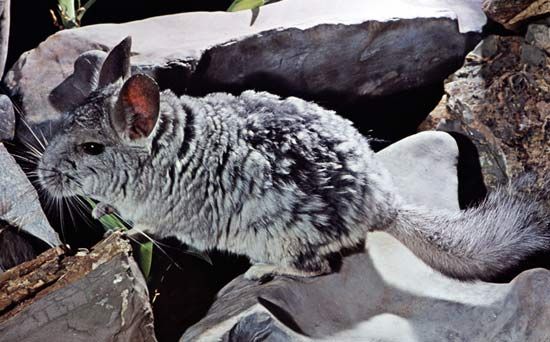
Chinchilla rats are South American rodents that possess a ratlike body form while superficially resembling a chinchilla. Their physical characteristics include short limbs, large eyes, and large, rounded ears.1
Key anatomical features include:
- Feet: The forefeet have four digits and the hind feet have five. The soles are hairless, padded, and covered with tiny tubercles for traction. Stiff hairs, likely used for grooming, project over the middle three toes.1
- Claws: Abrocoma species have small claws, whereas Cuscomys species have large, curved claws. In both genera, the second digits are hollowed out underneath.1
- Fur: They are covered in long, soft, dense fur that ranges from silvery to brownish gray on the upperparts, with white, gray, or brownish underparts.1
- Size: Abrocoma species are medium-sized, weighing up to 350 grams with a body length of 17 to 23 cm. The larger Cuscomys species can weigh 910 grams with a body length of 35 cm.1
What role did chinchilla rats play in ancient Andean cultures?
The role of chinchilla rats in ancient Andean cultures is primarily evidenced by archaeological findings rather than widespread domestication or utility. Specifically, the species Cuscomys oblativa is known to researchers through remains discovered at an Inca burial site at Machu Picchu.1
Beyond this specific archaeological presence, there is no evidence suggesting that chinchilla rats held a significant role in ancient Andean societies, such as being used for food, fur, or husbandry, in the way other rodents like the cavy or chinchilla have been utilized by humans. While the Cuscomys ashaninka species was named in honor of the Ashaninka people of the region, this reflects modern scientific naming conventions rather than an ancient cultural relationship.21
What is the diet and feeding behavior of chinchilla rats?
The diet and feeding behavior of chinchilla rats vary by genus, though information is primarily available for the Abrocoma species.
For the four known species of Abrocoma, the diet consists of the leaves, buds, and stems of shrubs. These rodents are primarily nocturnal and terrestrial, though they are also agile climbers capable of foraging in shrubs and small trees. They are often observed in close proximity to one another, suggesting they may form small colonies.1
Regarding the Cuscomys genus, little is known about their specific feeding habits. C. oblativa is known only from archaeological remains, while C. ashaninka is believed to be arboreal, though its specific diet and behavior remain largely unstudied.1
Where are chinchilla rats typically found in the wild?
Chinchilla rats are native to the Andes Mountains, with a range extending from southern Peru through to west-central Argentina. Their habitats span from coastal foothills up to the high-altitude Altiplano.1
Specific distribution patterns include:
- Abrocoma species: These rodents generally favor rocky areas with brushy vegetation, grass, or open scrublands. For example, Bennett’s chinchilla rat (A. bennetti) is found in central Chile from the coast up to 1,200 meters, while A. boliviensis resides in rocky, shrubby areas of central Bolivia at approximately 2,500 meters. The ashy chinchilla rat (A. cinerea) is restricted to the high-altitude Altiplano (3,700 to 5,000 meters), and A. vaccarum is found on rocky cliff faces in west-central Argentina at 1,880 meters.1
- Cuscomys species: C. oblativa is known from remains at Machu Picchu, though it may still inhabit the surrounding area. C. ashaninka has been identified in the cloud forest of southern Peru at an elevation of 3,370 meters.1
Sources
- chinchilla rat — Encyclopædia Britannica
- viscacha — Encyclopædia Britannica
- rodent - Importance to humans — Encyclopædia Britannica
Published on · 3 min read