Chinstrap Penguin
The chinstrap penguin (Pygoscelis antarctica) is primarily distinguished by a cap of black plumage on its head and a white face, accented by a fine…
What are the distinguishing physical characteristics of chinstrap penguins?
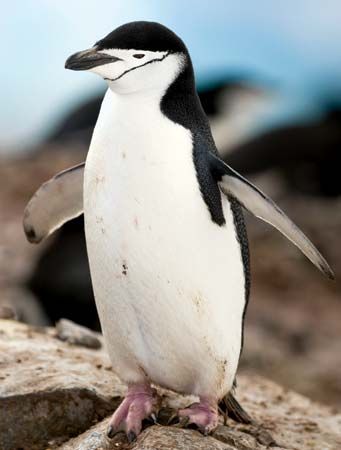
The chinstrap penguin (Pygoscelis antarctica) is primarily distinguished by a cap of black plumage on its head and a white face, accented by a fine, continuous band of black feathers that runs from one side of the head to the other, passing under the chin. This unique marking is the source of the species’ common name.12
Additional physical characteristics include:
- Facial features: They possess a fine ring of black skin around each eye and a black bill.1
- Size and weight: Adults typically reach lengths of 71–76 cm (28–30 inches) and weigh between 3–6 kg (7–13 pounds).1
- Sexual dimorphism: Unlike many other penguin species, males and females are roughly the same size and look nearly identical.1
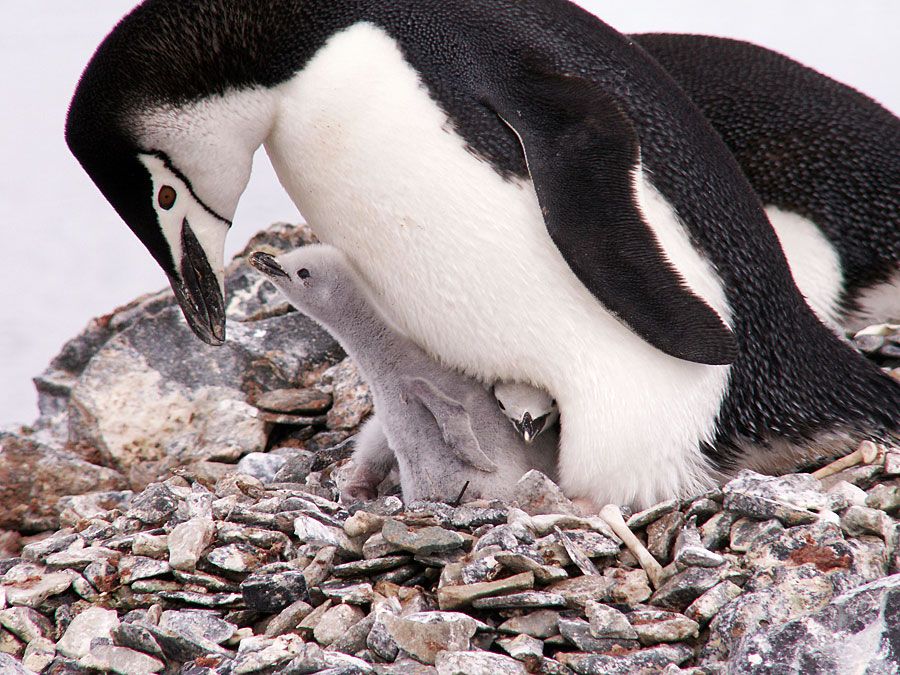
- Juveniles: Young penguins are similar to adults in size and coloration, though they feature patches of dark feathers around their eyes. Chicks are covered in gray feathers and have a black bill.1
What is the average lifespan of a chinstrap penguin in the wild?
In the wild, chinstrap penguins (Pygoscelis antarctica) may live as long as 15 to 20 years.1
How do scientists study and track chinstrap penguin populations?
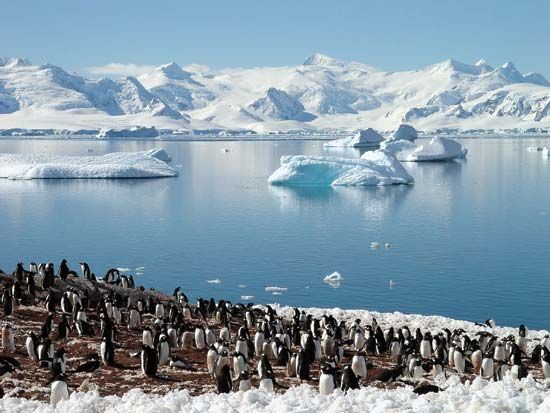
Scientists study and track chinstrap penguin populations primarily by monitoring their large breeding colonies, which are concentrated along the coasts of the South Orkney Islands, the South Shetland Islands, and the South Sandwich Islands, as well as the Antarctic Peninsula.1
Research efforts often involve:
- Population Estimation: Ecologists track the species by estimating the number of breeding pairs within these colonies. Current estimates suggest the worldwide population exceeds 15 million birds.1
- Banding and Recovery: Scientists use banding and recovery studies to track the movement and migration patterns of Antarctic birds, providing insights into how they travel throughout the world.3
- Navigation Research: To understand how penguins return to their colonies from the sea, researchers have conducted experiments on their homing instincts. These studies have revealed that penguins possess a highly developed sun-azimuth orientation system and a biological clock that allows them to navigate effectively even in the polar environment.43
Where are chinstrap penguins primarily found in the wild?
Chinstrap penguins (Pygoscelis antarctica) are primarily found in the northern part of the Antarctic Peninsula and across various Antarctic and subantarctic islands.1
The largest breeding colonies are located along the coasts of the following regions:1
- South Orkney Islands
- South Shetland Islands
- South Sandwich Islands
Additionally, breeding colonies are established on the Balleny Islands, situated between Antarctica and New Zealand. During the winter months, these birds typically move to icebergs in warmer waters or to land areas located north of their primary breeding grounds.1
Sources
- chinstrap penguin — Encyclopædia Britannica
- chinstrap penguin — Merriam-Webster
- penguin - Locomotion and orientation — Encyclopædia Britannica
- emperor penguin: Top Questions — Encyclopædia Britannica
- Antarctica - Birds — Encyclopædia Britannica
- emperor penguin — Encyclopædia Britannica
Published on · 2 min read