Crabeater Seal
The crabeater seal (Lobodon carcinophagus) is a southern seal belonging to the family Phocidae, commonly found among the drifting ice packs surrounding the…
What is crabeater seal?
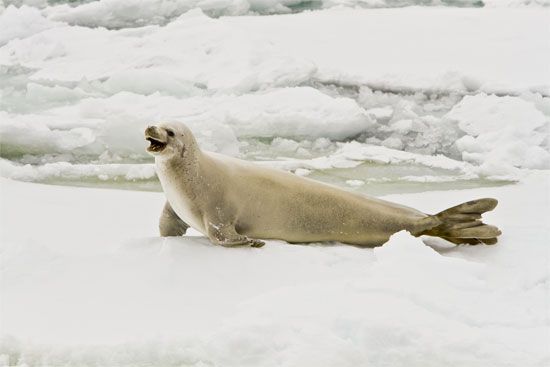
The crabeater seal (Lobodon carcinophagus) is a southern seal belonging to the family Phocidae, commonly found among the drifting ice packs surrounding the Antarctic continent.1
Despite its name, the crabeater seal does not eat crabs. Instead, it feeds primarily on krill, which are small planktonic crustaceans. To accomplish this, the seal possesses elaborately cusped teeth that interlock to effectively filter its food from the water.12
Physically, these slender animals reach lengths of 2 to 2.5 meters (6.6 to 8.2 feet) and can weigh up to 225 kilograms (500 pounds). Their coats are typically blotched gray-brown, though they fade to a whitish color before the annual molt in late summer. These seals breed on pack ice, where they give birth to pale brown pups. Notably, adult crabeater seals often carry scars from encounters with killer whales.1
What is krill and why is it important to the Antarctic ecosystem?
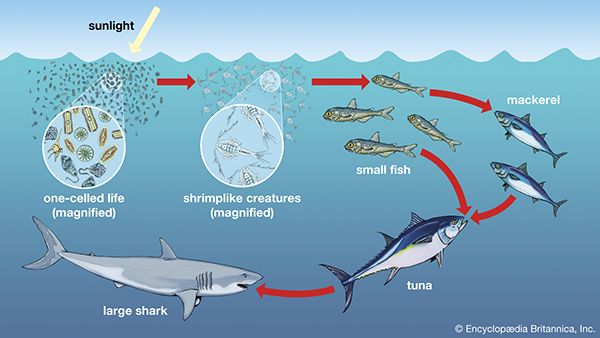
Krill are shrimplike crustaceans belonging to the order Euphausiacea. These pelagic animals, which range from 8 to 60 mm in length, are characterized by their bioluminescent organs and their tendency to gather in vast swarms in the open sea.3
In the Antarctic Ocean, krill are a foundational element of the food chain. They serve as the primary prey for numerous species, including fish, birds, and whales, such as the blue whale. Their survival is closely tied to sea ice, which provides protection and supports the phytoplankton blooms they consume.3
The Antarctic ecosystem is currently threatened by climate change, which has reduced sea-ice coverage and led to significant declines in krill populations. This reduction has negatively impacted predators like Adélie penguins and chinstrap penguins. Furthermore, the expansion of human fisheries for krill oil and food supplements raises serious concerns regarding the long-term stability of these vital marine populations.3
How do crabeater seals use their teeth to filter food?
The crabeater seal (Lobodon carcinophagus) utilizes a specialized dental structure to obtain its primary food source, krill. Unlike many other mammals, these seals possess teeth that are elaborately cusped. When the seal closes its mouth, these complex cusps interlock to form a sieve-like mechanism. This allows the animal to strain water from its mouth while effectively trapping the small planktonic crustaceans inside, a process known as filter feeding.1
What other animals live on the Antarctic pack ice?
Antarctic pack ice serves as a critical habitat for a variety of specialized marine animals. Because Antarctica lacks native land mammals, the species found on or near the pack ice are primarily marine-based, relying on the sea for food and the ice for breeding, resting, or protection.567
Marine Mammals
Several species of seals are closely associated with the pack ice:
- Weddell seals are unique for their ability to survive under fast ice during the winter by using their teeth to maintain breathing holes.86
- Crabeater seals are the most abundant seals in the region and are frequently found on the pack ice.6
- Leopard seals are solitary, carnivorous predators that inhabit the pack ice and are known to hunt penguins and other seals.96
- Ross seals are also found in the Antarctic zone, though they are rarely seen.6
Birds
While many birds leave the continent as the ice pack builds northward in autumn, some species remain or utilize the ice environment:
- Emperor penguins are the notable exception to the seasonal migration, remaining on the ice through the harsh winter to breed.5
- Adélie penguins are also found along the coastline and associated ice environments.5
- Skuas and various species of petrels are powerful flyers that have been sighted across the continent, including near the South Pole.5
Sources
- crabeater seal — Encyclopædia Britannica
- crabeater seal — Merriam-Webster
- krill — Encyclopædia Britannica
- Filter feeding — Encyclopædia Britannica
- Antarctica - Birds — Encyclopædia Britannica
- penguin - Form and function — Encyclopædia Britannica
- Weddell seal — Encyclopædia Britannica
- leopard seal — Encyclopædia Britannica
- Antarctica - Sea life — Encyclopædia Britannica
- pack ice — Encyclopædia Britannica
- Polar ecosystem - The Antarctic region — Encyclopædia Britannica
- sea ice - Sea ice formation and features — Encyclopædia Britannica
Published on · 3 min read