Migration
Animals utilize a variety of sophisticated mechanisms to navigate during migration and homing, often relying on a combination of celestial, magnetic, and…
How do different animals navigate during migration?
Animals utilize a variety of sophisticated mechanisms to navigate during migration and homing, often relying on a combination of celestial, magnetic, and environmental cues.1
Celestial and Magnetic Navigation
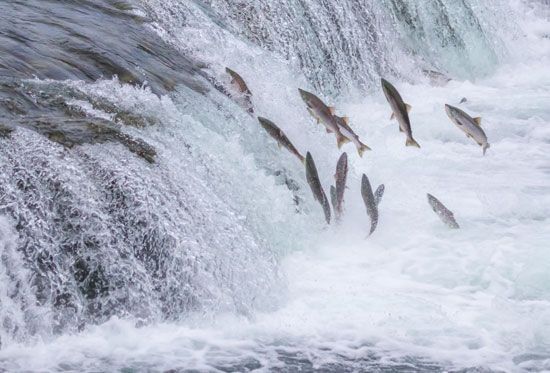
Many species, including birds, fishes, and various insects, use the Sun as a compass, often compensating for its movement throughout the day using an internal clock movement throughout the day using an internal clock. Nocturnal migrants, such as certain birds, perform celestial navigation by orienting themselves to the stars. Additionally, many animals possess a sensitivity to the Earth’s magnetic field, which serves as a vital navigational guide for species like sea turtles and salmon.com/animal/sea-turtle) and salmon.124
Landmarks and Olfaction
Animals also rely on learned environmental information:
- Visual Landmarks: Topographical features such as coastlines, mountain ranges, and river systems help guide many migratory species.3
- Olfaction: Chemoreception is critical for some animals. Salmon, for instance, imprint on the unique chemical signature of their home stream, allowing them to return to their specific spawning grounds. Similarly, some birds use their sense of smell to detect trace atmospheric gases to aid in navigation.41
What is animal migration and why do animals migrate?
Migration is the regular, seasonal movement of an animal population to and from specific areas. It is distinct from emigration or range expansion, as it typically involves a return journey and is often linked to annual cycles.6
Animals migrate primarily to exploit fluctuating food resources that would otherwise go unutilized. By moving, species can settle in areas that are seasonally productive, such as birds traveling from the Arctic to the tropics to follow optimal food availability.7
The process is driven by a complex interplay of internal and external factors:
- Physiological Preparation: An internal rhythm, governed by the pituitary gland, prepares animals by regulating metabolism and fat deposition.8
- Environmental Triggers: While internal cycles prepare the animal, ecological conditions—such as day length, temperature, weather, and food availability—act as the final cues to initiate movement.8
Ultimately, migration allows highly mobile species to survive in environments where life would otherwise be untenable due to seasonal scarcity.7
How do animal migrations impact ecosystems and biodiversity?
Animal migration plays a vital role in maintaining the health and balance of ecosystems and supporting biodiversity. By moving between regions, migratory species ensure that fluctuating food resources are efficiently exploited, allowing larger populations and a greater total biomass to be supported than would be possible if animals remained in a single area year-round.89
The ecological impacts of these movements include:
- Resource Utilization: Migrants connect disparate life zones, such as the Arctic and the tropics, by moving to areas where productivity is at its peak. This prevents food surpluses from going unutilized and allows species to survive in environments that would otherwise be untenable during periods of scarcity.8
- Predator-Prey Dynamics: The seasonal influx of migratory predators can significantly increase pressure on local prey populations. While this can have localized effects, it often occurs without causing long-term harm to resident species, as the migratory presence is temporary.7
- Seed Dispersal and Pollination: Many animals, including birds and mammals, act as essential agents for seed dispersal and pollination. By transporting seeds away from parent plants, these animals reduce competition, facilitate the colonization of new areas, and help maintain diverse plant communities.1011
What are some examples of long-distance animal migrations?
Many species undertake remarkable long-distance journeys to exploit seasonal resources or reach breeding grounds. Here are several notable examples of long-distance animal migrations:
- Arctic Tern: This bird holds the record for the longest annual migration of any animal. It breeds in the Arctic and winters in the Antarctic, completing a round-trip journey of approximately 60,000 to 82,000 km (37,000 to 51,000 miles).1415
- Gray Whale: The California population of the gray whale performs one of the most significant whale migrations, traveling about 5,000 km (3,000 miles) each way between its summer feeding grounds in the Arctic and its winter breeding lagoons off the coast of Baja California.16
- Monarch Butterfly: In North America, these insects travel up to 3,000 km (1,870 miles) to reach overwintering sites in Mexico or along the California coast. Notably, no single individual completes the entire multi-generational migration circuit.1718
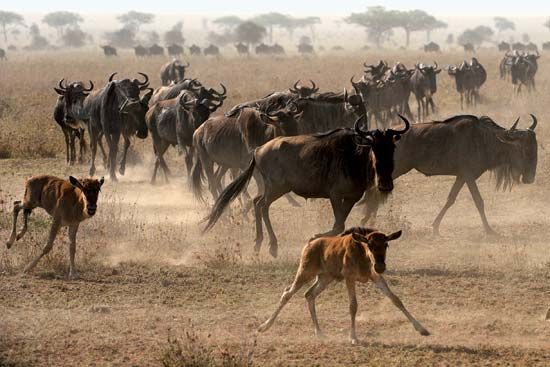
- Wildebeest: In the Serengeti region of Tanzania, herds of wildebeests and zebras travel more than 1,600 km (1,000 miles) annually, following the rhythm of the wet and dry seasons to find water and fresh grazing.19
Sources
- Migration - Other animals — Encyclopædia Britannica
- Migration - Navigation and orientation — Encyclopædia Britannica
- Migration - Birds — Encyclopædia Britannica
- Chemoreception - Homing — Encyclopædia Britannica
- Homing — Encyclopædia Britannica
- Migration — Encyclopædia Britannica
- Migration - Physiological stimulus of migration — Encyclopædia Britannica
- Migration - Ecological significance of migration — Encyclopædia Britannica
- Tropical rainforest - Relationships between the flora and fauna — Encyclopædia Britannica
- artiodactyl - Migration — Encyclopædia Britannica
- Falconiform - Migration — Encyclopædia Britannica
- seed dispersal — Encyclopædia Britannica
- mesopredator release — Encyclopædia Britannica
- Monarch butterfly - Migration — Encyclopædia Britannica
- Migration - Insects — Encyclopædia Britannica
- Arctic tern — Encyclopædia Britannica
- Migration - Terrestrial mammals — Encyclopædia Britannica
- cetacean - Distribution and migration — Encyclopædia Britannica
- Migration - In coastal and pelagic regions — Encyclopædia Britannica
Published on · 4 min read