Krill
Krill are shrimplike crustaceans that serve as a foundational element of marine food chains, particularly in the Antarctic Ocean. They act as a primary food…
What is the relationship between krill and other marine animals like whales and penguins?
Krill are shrimplike crustaceans that serve as a foundational element of marine food chains, particularly in the Antarctic Ocean. They act as a primary food source for a variety of marine life, including fishes, birds, and whales, such as blue whales and finback whales.1
In Antarctic waters, krill are the main prey for several penguin species. Because krill are essential to the ecosystem, their population health directly impacts these predators. For example, some ecologists link the population declines of Adélie penguins and chinstrap penguins to reduced krill abundance, which has been driven by climate change and the loss of sea ice. There is significant concern that human harvesting of krill may further disrupt these vital wildlife populations.1
What role do krill play in the marine ecosystem and food chain?
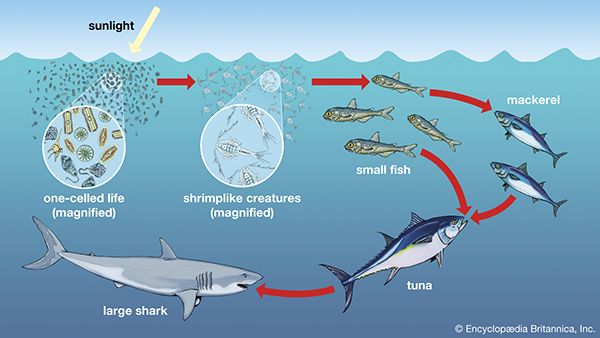
Krill are small, shrimplike crustaceans that function as a cornerstone of marine food chains, particularly within the Antarctic Ocean. By consuming microscopic phytoplankton, they effectively bridge the gap between primary producers and higher-level consumers in the ecosystem.1
Their role as a primary food source is critical for a wide array of marine life, including various fishes, birds, and whales, such as blue whales and finback whales. Because krill gather in vast swarms, they provide a dense, nutrient-rich energy source that supports these large populations.13
However, this ecosystem is sensitive to environmental shifts. Climate change has reduced sea ice coverage, which is essential for protecting krill and their food sources from predators and storms. Declining krill populations have been linked to reduced numbers of Adélie penguins and chinstrap penguins. Furthermore, the expansion of human fishery activities poses an ethical concern, as overharvesting may further threaten the stability of these vital wildlife populations.1
How does climate change affect krill populations?
Climate change significantly impacts krill populations, particularly in the Antarctic Ocean, where they have declined notably since the 1970s. The primary driver of this decline is the reduction of sea ice coverage. Sea ice is vital because it provides a protective environment for krill and the phytoplankton blooms they consume, shielding them from storms and predators.1
Beyond the loss of habitat, krill are threatened by ocean acidification, which occurs as oceans absorb increased levels of atmospheric carbon dioxide. This process reduces the availability of carbonate ions, which are essential for many marine organisms. While krill themselves are not primary calcifiers, they rely on pteropods—tiny mollusks that are highly sensitive to acidification—as a food source. If pteropod populations decline due to their inability to maintain their shells in acidic waters, the food supply for krill and their predators, such as whales, is further destabilized.45
These environmental pressures, combined with the expansion of human fishery activities, pose a serious threat to the stability of marine food chains and the survival of species that depend on krill.1
Where are krill commonly found in the world’s oceans?
Krill are pelagic, shrimplike crustaceans that inhabit the open sea across the world’s oceans. While there are 82 described species, they are most famously associated with the Antarctic Ocean, where they serve as the most important organism in the higher food chain.12
In these southern waters, particularly near the Antarctic Peninsula, krill gather in vast, dense swarms that can be found from the ocean surface down to depths exceeding 2,000 meters. These swarms are essential to the regional ecosystem, providing a critical food source for whales, fishes, and birds, including penguins.182
It is important to recognize that the health of these populations is ethically significant; the expansion of human fishery activities must be managed responsibly to ensure that the harvesting of krill for human consumption does not compromise the survival of the wildlife that depends on them for sustenance.1
Sources
- krill — Encyclopædia Britannica
- Southern Ocean: Top Questions — Encyclopædia Britannica
- krill — Merriam-Webster
- ocean acidification — Encyclopædia Britannica
- plankton - Phytoplankton — Encyclopædia Britannica
- Ocean Acidification: How Carbon Dioxide Is Hurting the Seas — Encyclopædia Britannica
- ocean warming — Encyclopædia Britannica
- Antarctic krill — Merriam-Webster
Published on · 3 min read