Christmas Rose
The Christmas rose (Helleborus niger) is a hardy, evergreen perennial valued for its ability to bloom during the winter months, often appearing in the snow…
How does the Christmas rose compare to other winter-blooming plants in terms of hardiness and ornamental value?
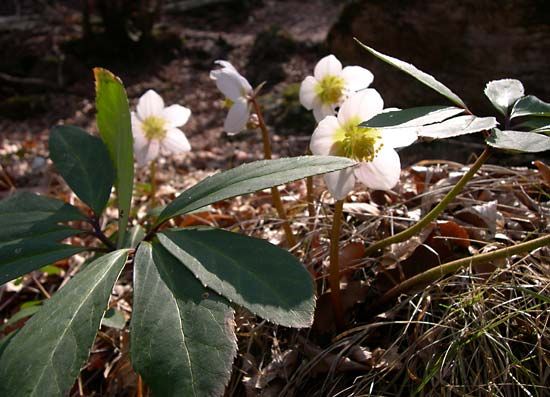
The Christmas rose (Helleborus niger) is a hardy, evergreen perennial valued for its ability to bloom during the winter months, often appearing in the snow in mild climates or in late spring in colder regions. While it thrives in moist, nonacidic soil and partial shade, its hardiness is generally managed by selecting protected locations in colder zones.12
Compared to other winter-blooming plants, the Christmas rose is notable for its ecological role as a vital forage source for pollinators like bees during a season when few other nectar-producing flowers are available. Its ornamental value is derived from its striking, bowl-shaped flowers, which feature five petal-like sepals in shades of white to pinkish-green.123
It is often compared to the closely related Lenten rose (Helleborus orientalis), which is also popular in European gardens but typically blooms later in the season and produces flowers in clusters of two to six, ranging from cream to purplish hues. While both are members of the buttercup family, the specific timing and floral characteristics distinguish them within a winter garden.23
What is the scientific name of the Christmas rose, and why is it called a ‘rose’ if it’s not related to true roses?
The scientific name of the Christmas rose is Helleborus niger. It is a member of the buttercup family (Ranunculaceae), which is entirely distinct from the rose family (Rosaceae) that includes true roses (genus Rosa).1562
The plant is called a “rose” primarily due to its appearance and a popular Christmas legend rather than any botanical relationship. The name stems from a tale in which an angel parted the snow to reveal these flowers, which had sprung from the tears of a young shepherdess who had no other gift to offer the infant Jesus. Because its bowl-shaped, white-to-pinkish flowers bloom during the winter season—often appearing in the snow—the name became associated with the holiday.15
In which regions is the Christmas rose native, and what are its preferred growing conditions?
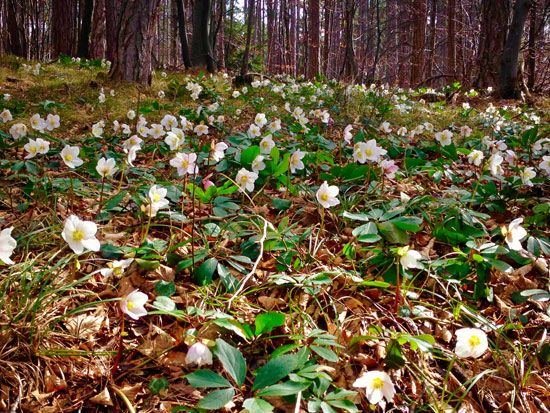
The Christmas rose (Helleborus niger) is native to the mountain forests of central and southern Europe.2
This perennial herb thrives under specific environmental conditions:
- Soil: It prefers moist, nonacidic soil.12
- Light: The plant grows best in partial shade.12
- Climate: In regions with mild winters, it blooms during the Christmas season. In colder areas, it requires protected locations to flourish and may bloom as late as spring.12
Because it is a poisonous plant containing toxic compounds like cardiac glycosides, it should be handled with care. Despite its toxicity, it serves an important ecological role by providing nectar for pollinators like bees during the winter months when few other food sources are available.12
What are the unique characteristics of the Christmas rose plant, including its appearance and flowering time?
The Christmas rose (Helleborus niger) is a small, poisonous perennial herb belonging to the buttercup family.11
Appearance
This evergreen plant typically reaches a height of 0.1 to 0.5 meters (0.3 to 1.6 feet). Its leaves are compound, featuring seven or more leaflets arranged like fingers on a hand, which emerge directly from the plant’s crown. The striking, bowl-shaped flowers measure 5 to 7.5 cm (2 to 3 inches) across and consist of five colored sepals that range in color from white to pinkish-green.21
Flowering Time
The plant is notable for its winter blooming cycle. In regions with mild winters, it flowers during the Christmas season, often appearing directly in the snow. In colder climates, the flowering period may shift to late spring, though the plant can be forced to bloom in a greenhouse.21
Sources
- Christmas plants and animals: 12 festive species - Christmas rose ( Helleborus niger ) — Encyclopædia Britannica
- Christmas rose — Encyclopædia Britannica
- plant hardiness zones — Encyclopædia Britannica
- horticulture - Temperate zones — Encyclopædia Britannica
- hellebore — Encyclopædia Britannica
- Christmas rose — Merriam-Webster
- Rosales - Ornamental species — Encyclopædia Britannica
- rose — Encyclopædia Britannica
Published on · 3 min read