Cisticola
Cisticolas are small birds belonging to the Sylviidae family, though some classifications place them in their own distinct family, the Cisticolidae.
How do cisticolas differ from other small birds in their family?
Cisticolas are small birds belonging to the Sylviidae family, though some classifications place them in their own distinct family, the Cisticolidae.1
They are distinguished from other small birds in their family by several unique characteristics:
- Courtship Behavior: Males are known for their towering courtship flights, earning some species the nickname “cloud-scrapers”.1
- Identification Challenges: They are notoriously difficult to identify, with some species distinguishable only by the specific configuration of their wing feathers.1
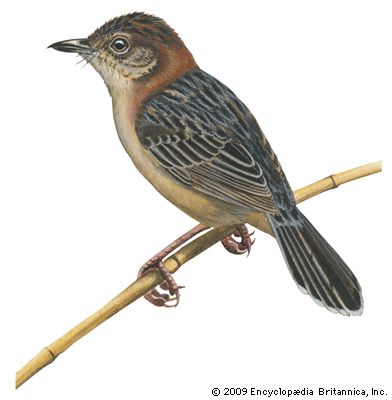
- Physical Appearance: They typically feature brown plumage, which may or may not be streaked, and possess a broad, relatively short tail that is often pale-tipped.1
- Nesting Habits: Like most members of the genus, they construct domed nests. Notably, some species, such as C. exilis, are referred to as tailorbirds because they sew green leaves together to form their nests.1
How many species of cisticola exist, and what are some notable examples?
There are approximately 75 species within the genus Cisticola. These birds are primarily found in Africa, though their range extends across southern Eurasia to Australia.1
Notable examples include:
- Zitting cisticola (C. juncidis): Also known as the common fantail warbler, this is the most widespread species. It is a streaky, reddish-brown bird measuring about 11 cm (4.5 inches) in length, with a range spanning from Europe and Africa to Japan and Australia.1
- Golden-headed cisticola (C. exilis): This is the most common species found from India through the Philippines to Australia. It is frequently referred to as a tailorbird because of its unique nesting behavior, which involves sewing green leaves together to construct its nest.1
What are the defining characteristics of cisticola birds?
Cisticolas are a group of approximately 75 species within the genus Cisticola, traditionally classified under the Old World warbler family, Sylviidae, though some systems place them in the family Cisticolidae.1
Key characteristics include:
- Habitat: They primarily inhabit grasslands, thorny scrub, and marshes, with the highest concentration found in Africa, though they range across southern Eurasia to Australia.1
- Appearance: They generally feature brown plumage, which may be streaked or plain, and possess a broad, relatively short tail that is often pale-tipped.1
- Behavior: Males are known for high-altitude courtship flights, leading to the nickname “cloud-scrapers.”1
- Identification: They are notoriously difficult to distinguish, sometimes requiring an examination of wing feather configurations for accurate identification.1
- Nesting: Most species build domed nests. Notably, C. exilis is known as a tailorbird for its ability to sew green leaves into its nest structure.1
Are there any cultural or folkloric references to cisticolas in the regions where they live?
Sorry, the Britannica knowledge base does not contain information regarding cultural or folkloric references to cisticolas.
Sources
- Cisticola — Encyclopædia Britannica
Published on · 2 min read