Common Yellowthroat
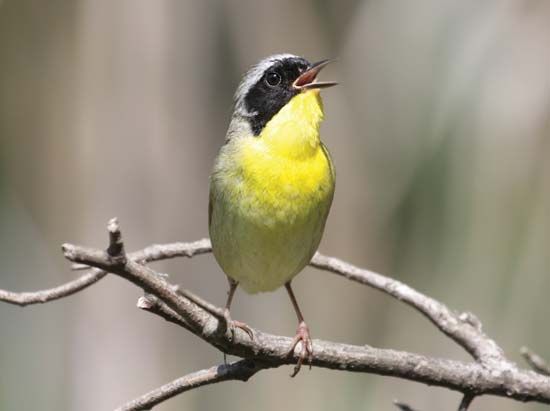
The common yellowthroat (Geothlypis trichas) is a small North American warbler widely recognized for the male's distinctive black "mask" and bright yellow…
What is Common yellowthroat?
The common yellowthroat (Geothlypis trichas) is a small North American warbler widely recognized for the male’s distinctive black “mask” and bright yellow throat. Measuring 11–14 cm in length, these birds are highly adaptable, nesting in diverse habitats ranging from marshes and wetlands to forests and grasslands.
Predominantly insectivorous, they hunt by plucking insects from the air or foliage. The species is polygynous, with males performing aerial displays to attract mates. Females build nests near the ground, where they are vulnerable to predators and brood parasitism by cowbirds.
With a population of approximately 77 million, the common yellowthroat is classified as a species of least concern by the IUCN. Despite their wide range, they face threats during nocturnal migrations, where they are known to collide with man-made structures like windows and towers.
How do brown-headed cowbirds trick other birds into raising their young?
The brown-headed cowbird (Molothrus ater) is a brood parasite that tricks other birds into raising its young through a calculated process of nest infiltration.
A female cowbird typically monitors the nests of other songbirds and often removes one of the host’s eggs before laying her own. She is highly prolific, capable of laying up to 40 eggs in a single season, and has been documented parasitizing the nests of over 200 different species.2
Once the cowbird egg hatches, the young parasite often gains an advantage by either displacing the host’s own nestlings or outcompeting them for food, frequently growing to a size that exceeds the foster parents. This behavior can severely threaten the survival of the host’s offspring. While some species, such as the Kirtland’s warbler, have evolved to recognize and bury foreign eggs under new nest material, many others unknowingly raise the cowbird chicks at the expense of their own young.23
What are some other types of North American warblers?
North American wood warblers (family Parulidae) are a diverse group of over 50 species known for their vibrant plumage and active behavior. Here are some notable examples:
- Yellow warbler: A widely distributed species known for its bright yellow coloration and the male’s faint red-streaked underparts.
- Blackpoll warbler: A common but less-striking species that undertakes impressive long-distance migrations to South America.
- Northern parula: The namesake of the family, characterized by its pale blue feathers, white wing bars, and a yellow breast marked by a dark band.
- Black-and-white warbler: A streaked species commonly found east of the Rocky Mountains that exhibits creeper-like foraging habits.
- Myrtle warbler: A member of the large Dendroica genus, recognized for its contrasting black, white, and yellow plumage.
- Ovenbird: Distinct for its unique nesting behavior, this species constructs a domed nest on or near the ground.
- Kirtland’s warbler: A species that has been the focus of significant conservation efforts, including habitat management and the control of nest parasites.
Why do common yellowthroats migrate at night?
The common yellowthroat is classified as a nocturnal migrant, a behavior it shares with many other warblers, thrushes, and flycatchers.18
While the provided search results confirm that common yellowthroats perform their spring and fall migrations at night, they do not explicitly state the evolutionary or physiological reasons why this specific species prefers nocturnal travel over diurnal (daytime) migration. Generally, for many small passerine birds, migrating at night allows them to avoid daytime predators, utilize cooler air temperatures to prevent overheating during strenuous flight, and spend the daylight hours foraging for food to refuel for their journey.18
During these nocturnal flights, common yellowthroats are known to be vulnerable to collisions with communications towers and windows, and radar studies indicate that such migratory activity typically peaks between 10 pm and 1 am.18
Sources
- Common yellowthroat — Encyclopædia Britannica
- Cowbird — Encyclopædia Britannica
- Kirtland’s warbler: Top Questions — Encyclopædia Britannica
- brown-headed cowbird — Merriam-Webster
- wood warbler — Encyclopædia Britannica
- Migration - In North America — Encyclopædia Britannica
- piciform - Annotated classification — Encyclopædia Britannica
- Common yellowthroat: Top Questions — Encyclopædia Britannica
- Migration - Modes of migration — Encyclopædia Britannica
Published on · 3 min read